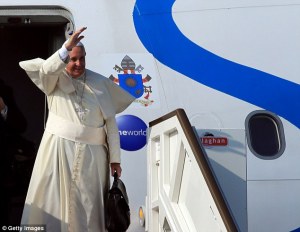
Reflections on the Pope in DC, Part Two: The Cross and the Hill

1000Just when you think things couldn’t get more exciting, Pope Francis takes things to a new level.  That’s the way it felt in Washington the day after the Canonization Mass at The Catholic University of America.  The pope, of course, was about to do something no other pope had ever done before: address a joint meeting of the United States Congress.  But before turning to that address in the next post, I want to offer some personal observations surrounding the event.

220px-Farr-Portrait-2013On a personal level, the pilgrims from the Diocese of Monterey were blessed by the great generosity of Congressman Sam Farr (D-CA, 20th District) and his staff.  Mr. Farr not only obtained tickets for a diocesan-sponsored pilgrimage group; he invited Monterey Bishop Richard Garcia to attend the pope’s speech in the Gallery of the Chamber itself.  Retired Monterey Bishop Sylvester Ryan was seated in a caucus chamber, and still another room was prepared for additional visitors from his District, and still others were outside watching on Jumbotrons.  So, pilgrims from the Diocese were found everywhere that historic day.  Once more, a very public “thank you” to Congressman Farr and his entire staff!

IMG_0734 (2)My own responsibilities that day included a very special mission.  Some weeks ago at the Vatican, the Pope was shown the actual cross worn by Father Junipero Serra over his Franciscan habit.  He asked that it be made available during the Mass of Canonization, so Bishop Garcia personally carried the relic to Washington, where he provided it to the papal Master of Ceremonies.  The day after the Mass — which was the same day as the Pope’s speech to Congress — was the first time we could retrieve the relic for its return to the Carmel Mission where St. Junipero is buried.  Since the Bishop had to head into the Gallery, he asked me to pick up the cross.  So, after driving the bishops to Capitol Hill on Thursday morning, I returned to the Basilica and met with Msgr. Rossi, the Rector.  The cross had been safely preserved in the sacristy where the Pope had vested for the Canonization Mass, and I carefully returned it to its box for the Bishop to transport it back to California.  Mission accomplished, I returned to Capitol Hill and was able to see the last half of the Pope’s remarkable address [see the next post].

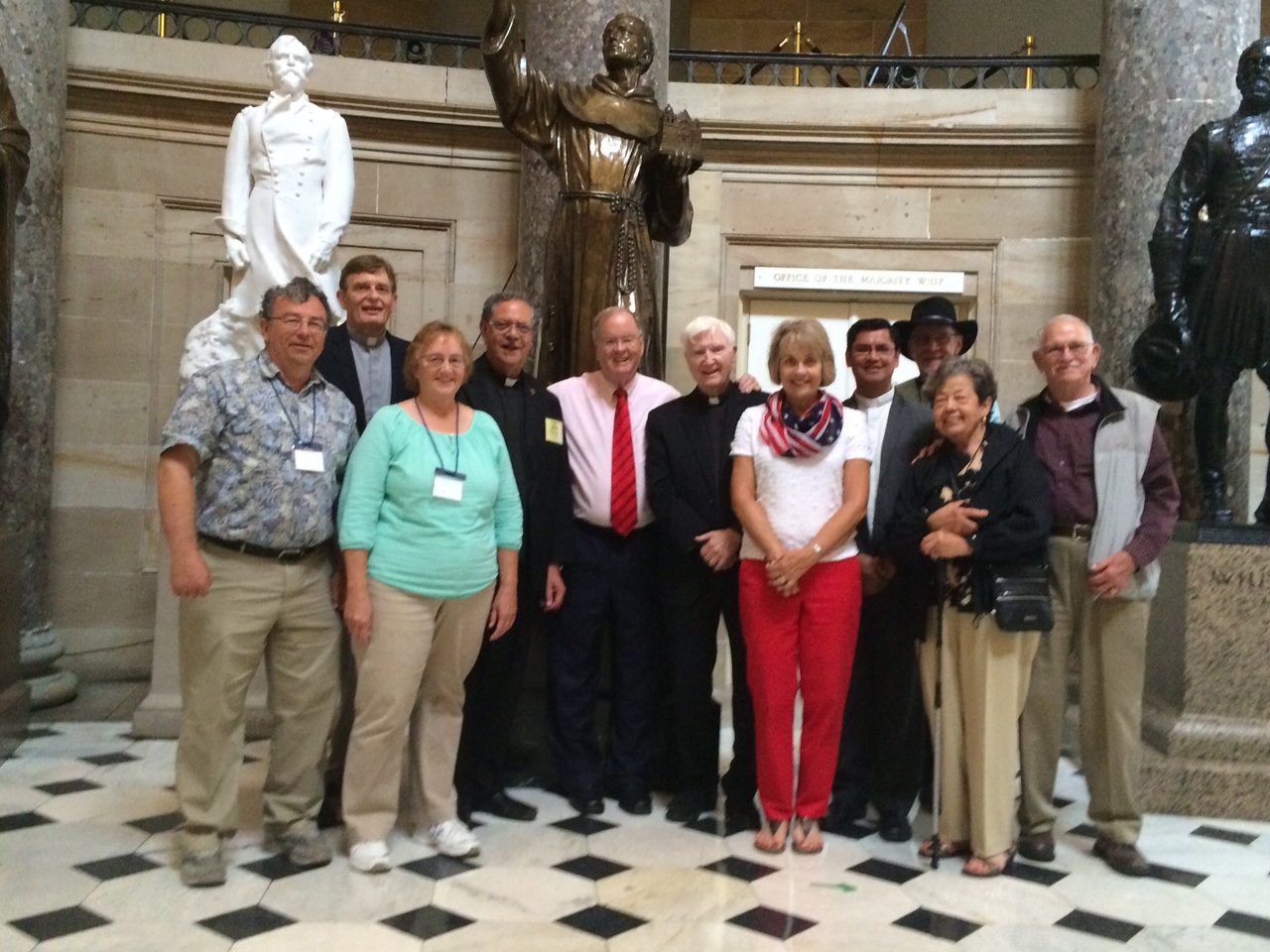
IMG_1814Following the papal address, Congressman Farr and his staff laid on a light lunch for all of us, and then he gave a few of us a brief tour of the House, including the part of Statuary Hall containing the statue of St. Junipero Serra; the only other State represented by a saint is Hawai’i, with its statue of St. Damien of Molokai.  In an interesting bit of trivia, the masking tape was still on the floor in front of the statue of St. Junipero showing where the Pope and the Congressional leadership had stood only moments before.  The Congressman, as indeed all of us, had been moved by the positive tone of the pope’s address.  He remarked that it was exactly the kind of message our lawmakers needed to challenge them out of the overarching negativity and polarization that seems to have frozen them into indecision and inaction.

It was on this wonderful, positive, and very personal note that we left the Hill.  Some of us departed Washington shortly thereafter, some of us returning to California, while some of the bishops headed off to New York and/or Philadelphia.

Let’s now take a closer look at the remarkable address Pope Francis delivered to the Congress.

Reflections on the Pope in DC, Part One: “Siempre Adelante”!

24B5572900000578-0-image-a-78_1421328465237“Keep Moving Forward”: Siempre Adelante!

During the papal Mass at the Catholic University of America last Wednesday, Pope Francis ended his homily by quoting St. Junipero Serra’s motto, “Siempre Adelante!”  Indeed, as has become a cornerstone of his teaching, the pope’s entire homily was about not remaining bottled up inside ourselves or our churches or our ecclesial institutions, but about going out to meet people where they actually are and not, as he would echo in New York, where we would like them to be.  He spoke of the joy associated with living out this pilgrim spirit and, with power and poetry, he challenged:

Go out to all, proclaim by anointing and anoint by proclaiming. This is what the Lord tells us today. He tells us:

A Christian finds joy in mission: Go out to people of every nation!

A Christian experiences joy in following a command: Go forth and proclaim the good news!

A Christian finds ever new joy in answering a call: Go forth and anoint!

These last few days have been remarkable on so many different levels and the impact of the Apostolic Journey of Pope Francis of Rome will be felt, studied, pondered and — we pray to God! — experienced for years to come.  In keeping with his charge to keep moving forward, he himself has left Cuba, Washington, and now New York.  As I write these words he has just landed in Philadelphia on the last leg of his North American sojourn.  Each and every stop along the way has significance, both in itself as well as in relationship to his whole overarching vision of the church as the loving outstretched hands of God’s own mercy.  We, the Church, are servant-missionaries, going out to encounter others in their own sitz-im-leben, their own particularities of life, their own existential realities, and caring for each other there.  As Christ Himself told his followers: “Be not afraid,” and, “Put out into the deep.”

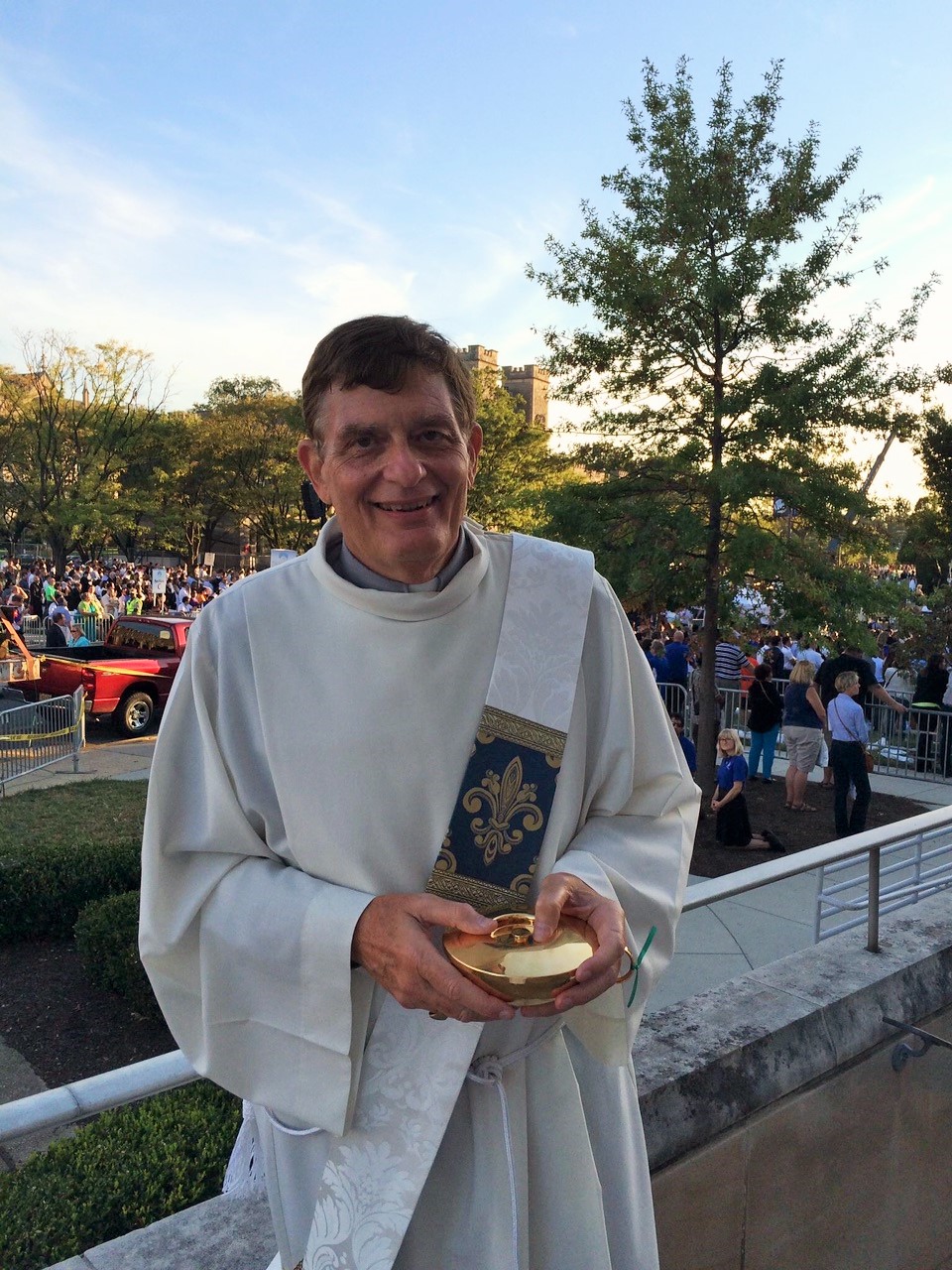
IMG_1780I was so blessed to be able to participate as one of the corps of deacons assigned as ministers of Holy Communion during the papal Mass at the Catholic University of America.  As a deacon of the Archdiocese of Washington who is currently serving in the Diocese of Monterey (the home of our newest Saint), and as a former resident of the District and student at CUA, just arriving back in town was a thrill.  But experiencing the pope on such familiar territory was electrifying and beyond words.  It will take a long time for its full impact to sink in.  These are a few initial recollections.

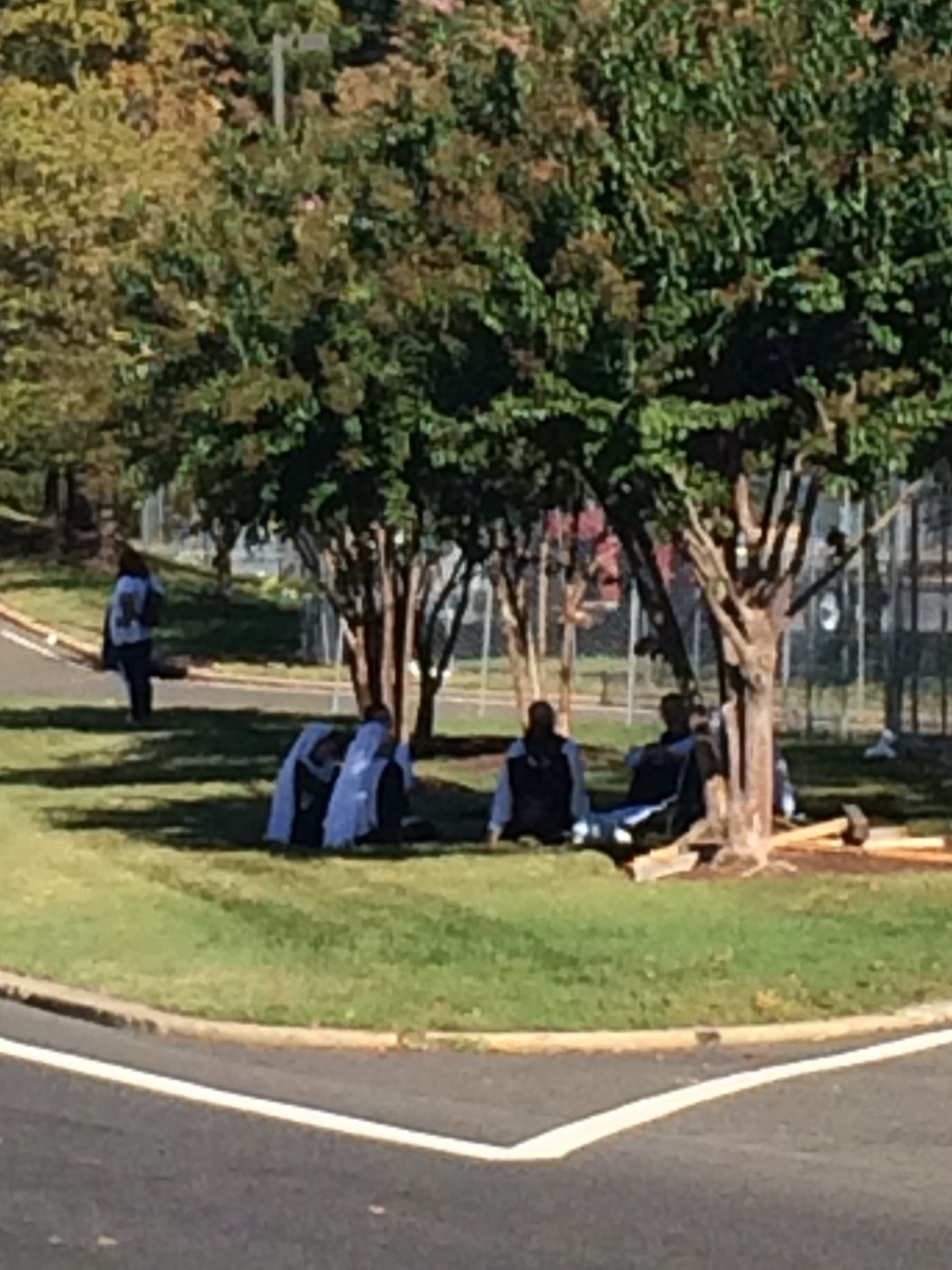
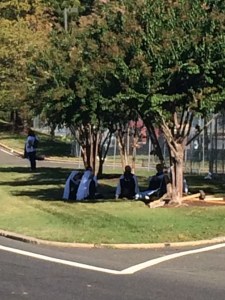
The day began early.  Even though we’ve lived in Washington many times over the years, trying to gauge the impact the pope’s travels through the District would have on public transportation was nearly impossible.  The Catholic University campus was scheduled to open at 10:00 AM, with Mass beginning at 4:15 PM.  Concelebrating priests and assisting deacons were told to be checked in and at our staging areas by 2:00 PM.  My traveling companions and I decided to forego the Metro and splurge on a taxi, leaving at 7:00 AM.  Traffic was light and we made great time.  Michigan Avenue was closed at Trinity Washington University, so we got out and walked toward Catholic University.  We hit the first security checkpoint at 7:30 and there we waited until they opened at 10:20.  The mood was good, however, and people were just excited about being in place instead of stuck in traffic across town!  There were pilgrims gathering from all points of the country.  People of all ages, colors, languages and backgrounds were lining up.  IMG_1748There were also sisters, some very young and others in their wisdom years, as well as priests and deacons (perhaps most noticeable by our ubiquitous little bags carrying albs and stoles for the Mass!).  The weather was wonderful, although by mid-morning, the temperature and sun began to bake a bit.  Some sisters found temporary relief under some nearby trees!
As a former career Navy officer, I was also struck by the sheer volume and diversity of the security forces assembled around the checkpoint: TSA, Homeland Security, the Secret Service, DC police, FBI, and others who left their uniforms and windbreakers at home to operate more subtly.

At 10:20 we began going through the checkpoint and, with the exception of being able to leave our shoes on, the procedure was exactly like going through security at the airport; in fact, that’s probably because the officials handling it were all TSA!  Belts off, jackets off, bags checked, and on and on.  However, everyone, including the TSA personnel, were in great spirits and full of excitement (unlike most lines at the airport!).

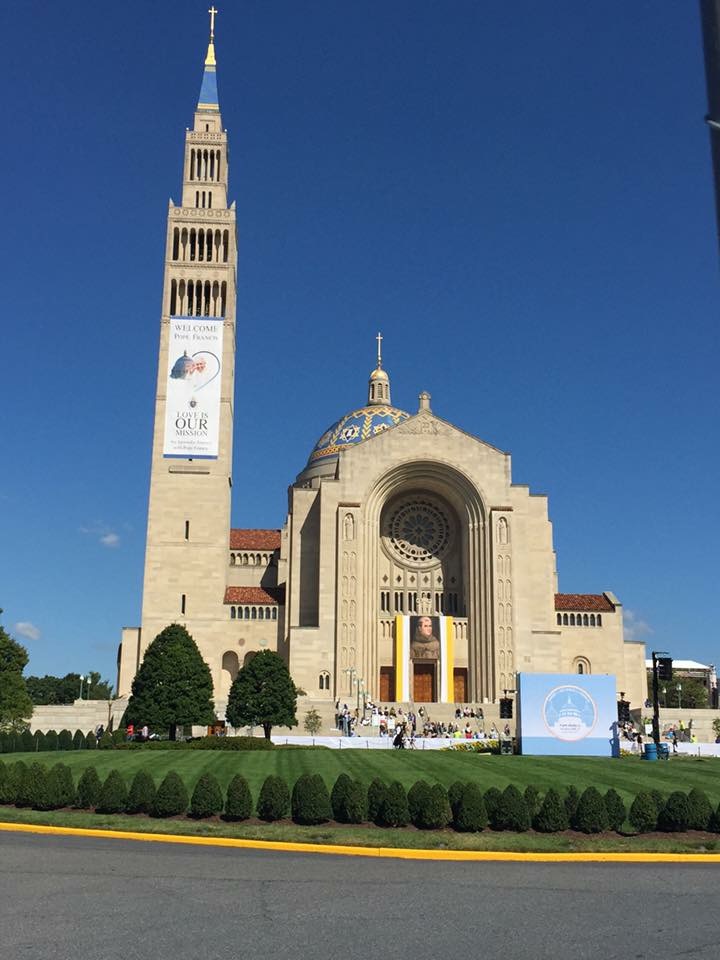
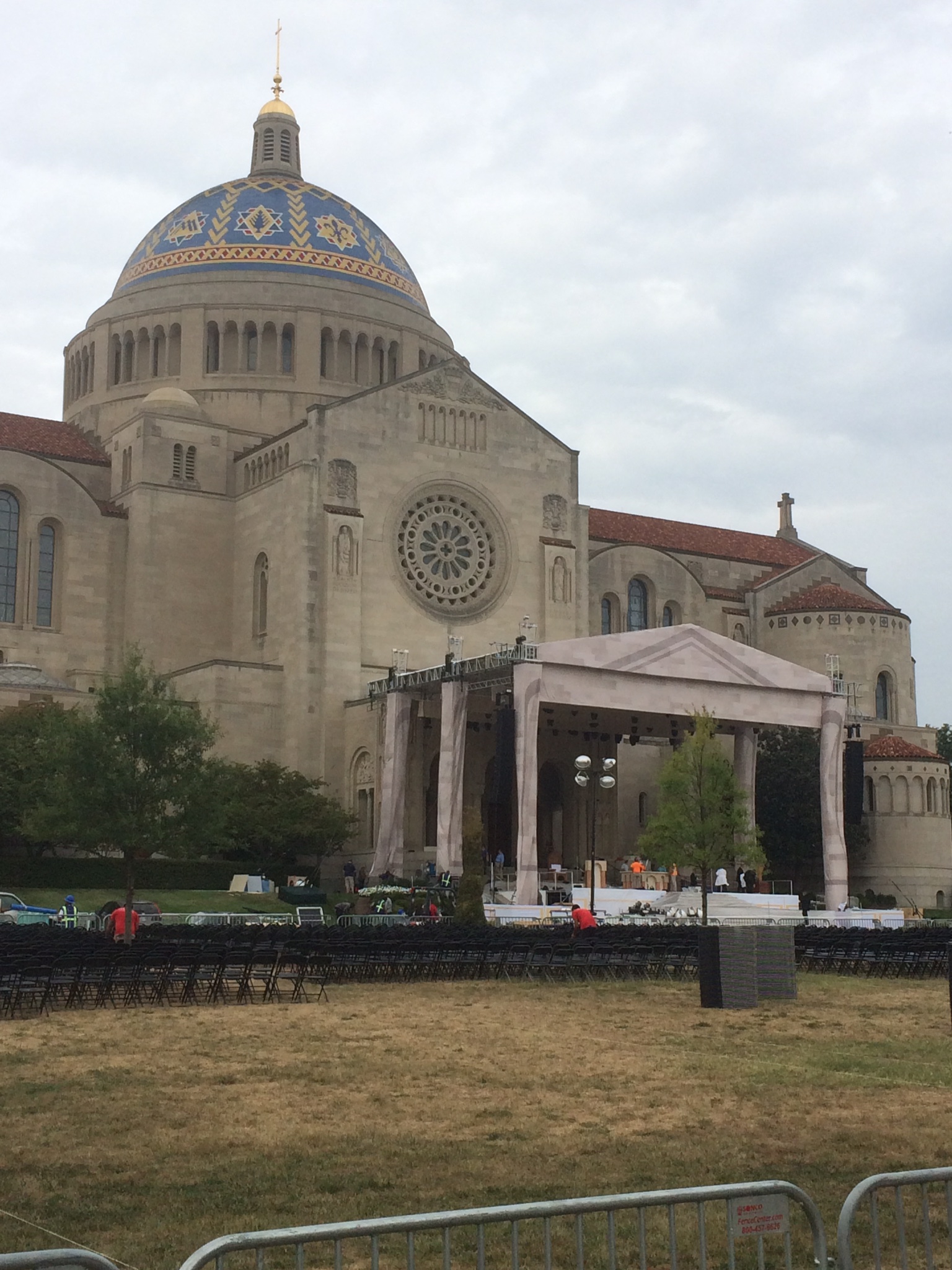
IMG_1272Once through we made our way to our assigned entrance point.  Priests and deacons had to check in with our own coordinators to receive additional instructions about where to vest and so on.  Then there was time to wonder around the familiar campus and check out the venue.  The Basilica of the National Shrine of the Immaculate Conception is the best known feature of the campus and, of course, the papal Mass was going to be celebrated right outside in order to accommodate as many people as possible.  Even though the Basilica is the eighth largest church in the world, it was no where close to being adequate for the estimated 25,000 to 30,000 pilgrims who were gathering.

There were volunteers everywhere, most of them very excited and happy students, who directed folks to tents for water, cookies, and nutrition bars, and the Basilica Gift Shop had set up a couple of huge tents in front of Mullen Library.  I made my way to our assembly point for deacons and checked in.  It was a wonderful reunion, since many of the deacons gathering were brother deacons from the Archdiocese of Washington, along with a small contingent of deacons from the Diocese of Monterey and, of course, from other dioceses around the country.  I showed the Monterey group around a bit, and we had lunch together sitting on a curb along with some undergraduates taking a break from their own escort duties.
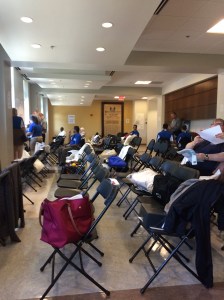
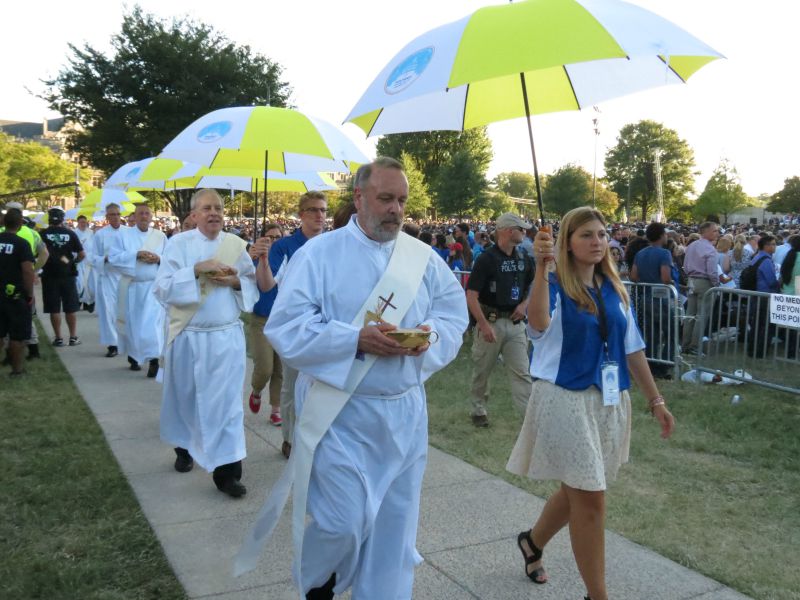
IMG_1293As we reassembled in our staging area, we found out how this was going to work.  We deacons would remain in the building during the first part of the Mass.  We could follow the Mass through the windows or on a TV located in the building.  We were introduced to our teams as well.  Each of us had an assigned “escort” who was, in most cases, an undergraduate student from CUA.  The escort would have an umbrella to hold over us during communion, not so much for us, but to show people where the communion ministers were actually located!  In addition to the escorts, we had team captains for each section who helped get us where we needed to be and help with crowd control.  It was all very well organized.  Long before the Mass began, every one of those chairs was filled with students and deacons.  And that was just one of the rooms being used.

And then, the Pope arrived.

IMG_1310Look, I’m a teacher, and I love being around students.  Here we were, assembled in a hot, humid classroom.  But the students (as well as most of us deacons) all had their cell phones out, tracking the pope’s location. Their own excitement and love for the man was palpable — and noisy!  “He’s just left the nunciature!”  “They’re approaching the USCCB!”  “They just left the USCCB — can you see him yet?”  “There he is!  There he is!”  “Francis!  Francis!”  They were standing on chairs, they helped each other find space at the windows, and I have never seen such joy, as they saw Francis make his way in the popemobile along the same paths that they walked every day to classes.  I have to admit, I was pretty much an undergraduate at that moment myself — it was surreal to see this man, this Pope, on such familiar territory.

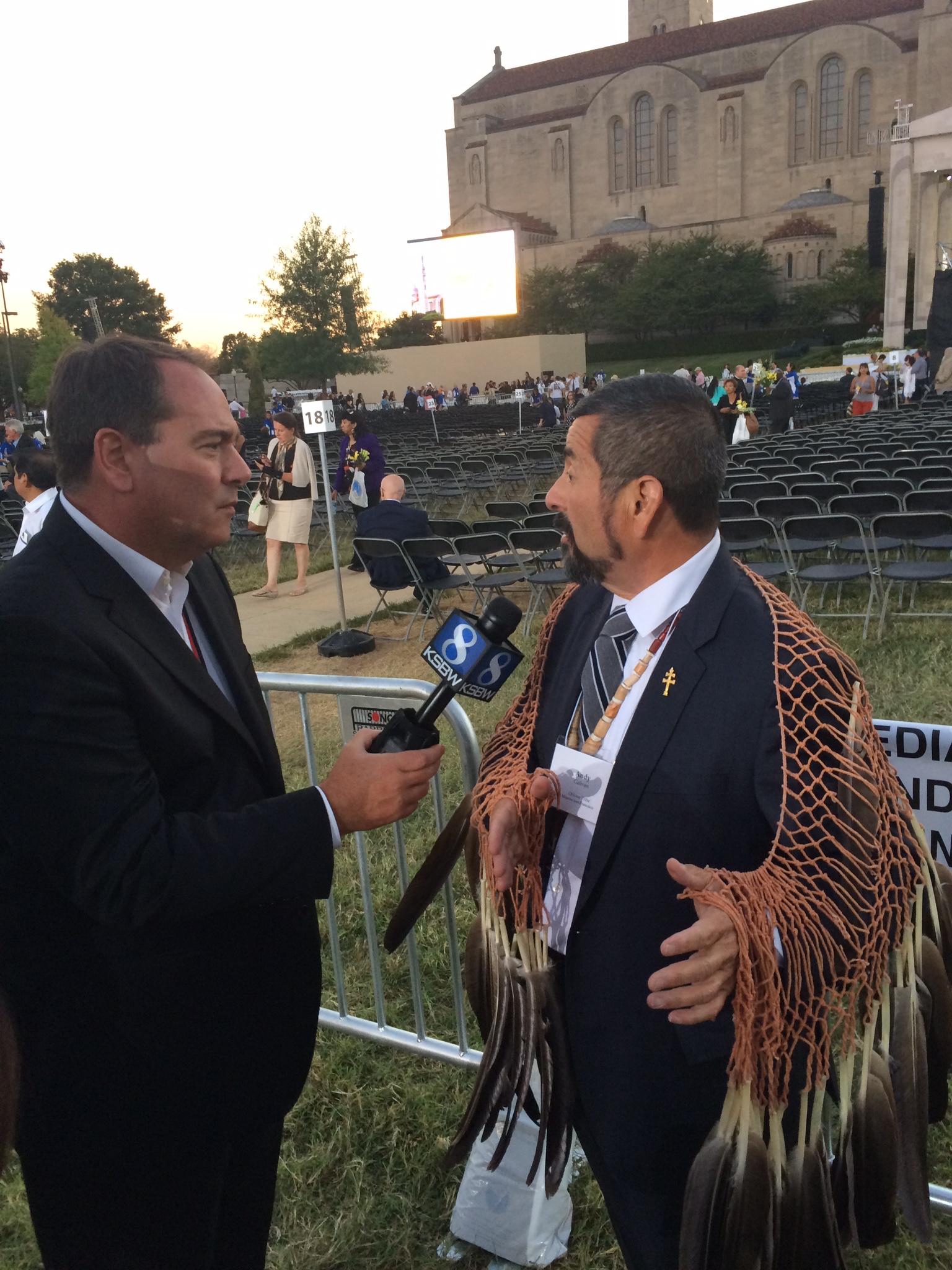
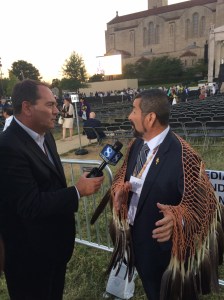
The Mass itself was glorious.  Several things stood out, for me at least.  The canonization of Junipero Serra, the subject of concerns raised by some Native American groups, was handled beautifully.  In fact, not only did Native Americans participate in the canonization itself, the first reading of the Mass, from Isaiah, was proclaimed in Chochenyo, a native language previously declared to be a “dead” language, which has now been restored. IMG_1772 In fact, the man who proclaimed that reading was himself one of those responsible for restoring the language and here it was being heard again publicly for the first time by millions of people watching around the world!  After the Mass, the Pope met with nine Native American tribal leaders from California, including descendants of the Peoples with whom St. Junipero had served.  One of those leaders was Andy Galvan, who had helped present the relics of the saint during the Mass.  A fascinating and passionate man, he eagerly recounted his meeting with the pope as well as his pride in his cousin, who had proclaimed that first reading during the Mass.
Another part of the Mass which I will always remember took place during the pope’s wonderful homily.  A number of hosts had been consecrated at an earlier Mass to facilitate the distribution of communion during this Mass.  During the homily, Masters of Ceremonies brought a ciborium to each deacon so that we would be ready to form our procession and get to our communion stations.  Picture this: we were seated listening to the Holy Father speak of “going out” and of bringing Christ to all peoples where they actually are, and calling us all to a joyful mission, and all the while we were holding the Eucharistic Christ in our own hands, ready to do just that in a very real way.  For me, and I believe for all of us deacons assembled that day, this was a profound moment.

communionPerhaps another point to ponder for deacons.  It was interesting that it was the Order of Deacons who distributed Communion that day.  We were not able to sit outside with the bishops and priests in front of the Holy Father, but were instead staged inside with our student-escorts and team captains.  But then the Order of Deacons emerged from that building and processed to all points of the assembly to serve, as we should, the People of God.  It was the deacons who were called to serve in a particular way at that Mass.  As the ordained servants of the People of God, we were focused on carrying out that service.

As always, distributing Holy Communion is a joy: we experience the Christ who is really present under the sacramental forms of bread and wine, and we also experience the Christ who is really present in the people coming forward.  Some people dropped to their knees to receive, other stood and received on the tongue and others on their outstretched hands: all were reverent, joy-filled, and happy.

IMG_1309As people left the campus after the Mass, some of us stayed behind to speak with the media and to enjoy the afterglow before finding our way back to wherever we were staying.  It had been a long day, but a glorious one.  And all who were there left, I believe, with a renewed sense of mission.

A mission to “keep moving forward”: Siempre adelante!

In the next blog, we’ll reflect on the Pope at the Congress of the United States.

The Pope in DC: On the Ground and “Concrete Consequences”

IMG_1740I watched the Pope’s Alitalia touch down at Joint Base Andrews (what old-timers like me still refer to as Andrews Air Force Base) from the media center established in a Crystal City hotel.  What a great moment to see him arrive!  Several of us were there in support of Bishop Richard Garcia, the Bishop of the Diocese of Monterey in California.  As the Bishop of the Diocese in which Father Junipero Serra is buried, he has been a popular interviewee by the media.  It has been a real treat to watch him navigate those waters with skill, wit and humor.

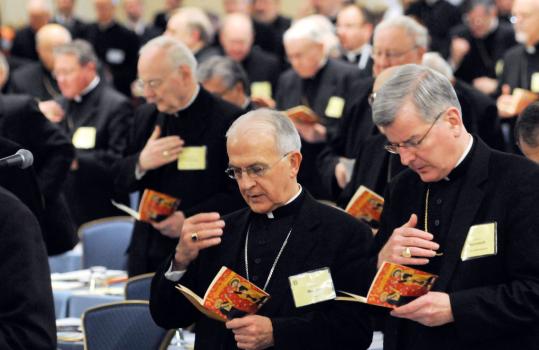
Back at our hotel, more and more bishops were pouring into the registration area, and the USCCB staff set up a nerve center in support of the bishops.  It was wonderful to see some old friends from the staff and the bishops.  They have a full day tomorrow, beginning with security screening here at the hotel prior to boarding their assigned buses.  They will head to Morning Prayer with the Holy Father at St. Matthew’s Cathedral on Rhode Island Avenue.  Then they will have lunch with him, eventually getting to the Basilica of the National Shrine of the Immaculate Conception on the campus of The Catholic University of America on Michigan Avenue.  There are then a variety of options for the bishops following the Mass!  They’re in for a very full, rich, and tiring day.

As early as they’re starting, though, our little team is heading out toward Catholic University even earlier, since we have to find our own way there, and the street closures are, well, profound!  DC is a small town and with the Pope heading to several different venues throughout the day, navigating the District — on a workday no less! — will be a challenge.  We’re hoping to have a taxi drop us off at Trinity University down the street from CUA, and then walk to the campus.  Somewhere during that trip, I’ll be giving an interview to CBS on the cell phone!

IMG_1732The campus opens mid-morning and the deacons and priests who are assisting and concelebrating will check in and be given our specific assignments.  I’m hoping to be in the vicinity of our pilgrimage group from the Diocese of Monterey, but there’s no way to predict that.  The challenge, of course, will be AFTER the Mass. Once the Pope departs people tend to want to rush away, but that will not be possible.

For those who are here, the challenge will be to remember that this is an historic moment with and for our Holy Father Francis, despite whatever happens.  Patience, patience, patience!  What’s even more important is to focus less on the “event” vibe that naturally surrounds such a moment, and really listen to Pope Francis and his challenges to us.  It will be joyful, but it will not be an end unto itself.  May this Mass renew us in our own vocations of service to those who are most in need around us.  The great German theologian Herbert Vorgrimler once wrote that the role of the deacon is to offer our communities “concrete consequences” to the Eucharist in which we share.  That challenge will be offered to us by Pope Francis tomorrow.  He, too, will ask that all of us Catholics, regardless of ministerial role, identify and provide the “concrete consequences” of tomorrow’s Eucharist to the world around us.  As the motto for this Apostolic Journey puts it, “Love is our Mission”!

IMG_1741

The Pope in DC: Preparatory Thoughts

Ever since the Pope announced his first-ever visit to the United States, preparations began.  Then, as his plans expanded from Philadelphia to New York to Washington, DC, matters became even more hectic.  Then, the surprise announcement of his intention to canonize Franciscan Junipero Serra during his time in Washington, and the jump was made into hyperspace.  Today, in Washington, all of those preparations could be seen coming together.

In front of BasilicaIt was a cloudy, cool day by Washington standards, and later in the afternoon, the clouds opened and, as one hotel worker remarked, it felt like Winter had arrived, not the Fall!  I am here for several reasons.  I am a deacon ordained and incardinated into the Archdiocese of Washington, DC, so this is my home archdiocese in ecclesial terms, and it is good to be back here on that level alone.  In fact, as a DC Deacon, I have served here on the Archdiocesan staff as well as on the senior staff of the United States Conference of Catholic Bishops (USCCB).  So, when we took the Red Line to the Brookland/CUA Metro stop this morning, the closest stop for the Catholic University, and right across the street from the USCCB, I felt immediately back at home.

But the other reason I’m here is to accompany and assist the Bishop of Monterey in California, Richard J. Garcia, on whose staff I serve currently.  Soon-to-be Saint Junipero Serra founded many missions in California, and seven of them are located within the Diocese of Monterey, with Serra himself buried in the sanctuary of his favorite mission at Carmel.  The bishop was asked to come to Washington a bit early to meet with numerous press outlets to speak of the canonization and its meaning for Catholics today.  He asked me and a couple of our priests to assist with the interviews so much of the day was spent responding to those press requests.IMG_1737

It was wonderful to watch the preparations on the campus of the Catholic University.  I did my doctoral work here, and watching the students going about their normal business while others were setting up chairs, workers putting the final touches on the altar and sanctuary on the East side of the Basilica, and technicians conducting never-ending sound checks: it was all very exciting.  Eventually we headed back to our hotels to get ready for tomorrow.  Our pilgrimage group has made it safely, and we’ll meet with them for breakfast tomorrow before they head out on their DC adventures.  Other clergy and laity are also heading in, many of whom will be helping with the Papal Mass on Wednesday.

IMG_1732As I’ve written before, it will be important to keep in mind all of the “moving parts” of the Pope’s visit, which has already begun — in Cuba.  That part of the trip is closely linked, intentionally I am sure, to the pastoral visit to the United States.  The Pope will pray with the bishops of the United States on Wednesday morning at St. Matthew’s Cathedral in Washington, have lunch with them at the St. John Paul II Cultural Center near the Catholic University, and then the Mass later in the afternoon.  Then the next day, Thursday, the Pope will address a joint session of Congress, the first time a pope has ever done that.  While Californians are focused on the canonization of Father Serra, I think most Washingtonians, and perhaps most Americans, are more interested in the Congressional address, which promises to be an exciting challenge to every part of the American political spectrum.

And then, of course, the Pope leaves for New York and Philadelphia.  I hope simply to reflect and report on my impressions of the DC portion of the apostolic journey.

For now, please keep Pope Francis in your prayers, that he travels in safety and good health, and that his mission of spreading the Good News is met with joy and enthusiasm!

The Pope’s Challenge: Where would YOU stop? UPDATED

The internet is abuzz with the images of Pope Francis making an impromptu visit to a refugee camp while he was en route to visit a local parish,  St. Michael the Archangel in Pietralata.  Watch the video here.  Here’s another copy of the video, without the English getting in the way.  UPDATE: See that priest leading the Pope into the camp?  More about him later.

That’s the basic scenario, and that’s the challenge the Pope’s action places before us, especially those ordained to serve.

Here’s the parish the Pope was heading for when he took his pastoral detour.  260px-Chiesa_san_michele_arcangelo_a_pietralata

Imagine the excitement of the parishioners: the Pope is coming!  Here’s the picture they had on their website.

sanmichelepietralata_it_bkumbria_1423155071

The pastor of St. Michael’s is Monsignor Aristide Sana, who was ordained on 18 March 1965 in St. John XXIII’s home diocese of Bergamo.  Now a priest of the Diocese of Rome, he’s been the pastor of this parish since 1998.  From what I can find, there are three other priests assigned, but I didn’t notice any deacons.

I keep imagining a conversation between Pope Francis and Monsignor Sana: “So, I just stopped at the refugee camp on the way here.  Nice people!  What are you guys doing to help?”  Actually, I can only imagine the Pope’s question; we can leave the response to our own consciences.

UPDATE: Here’s a new video clip from the Pope’s visit to St. Michael the Archangel.  He is teaching a religious education class to the kids; they all (including the Pope) seem very excited!  Also, if you look closely, the priest near the Holy Father looks like the same man who was with the Pope at the refugee camp.  I wonder if that is Monsignor Sana, the pastor of the parish?

If the pope was coming to visit OUR parishes, where would he choose to stop while en route? Imagine the pope asking those kind of questions of US!  What are the “refugee camps” right in our own back yards?  Where are the “margins” within our own communities?  And, knowing that, where are WE?

The Synod on the Family: Curtain Up on Act II

Beatification Paul VIToday we experienced the ringing down of the curtain on Act I of the synodal process on the Family.  Pope Francis closed the Extraordinary Synod today with Mass in St. Peter’s Square and the beatification of Blessed Paul VI.

But the process has only just begun!  Perhaps the best road map to the future is found in the Pope’s speech on Francis at SynodSaturday closing the final work session of the Extraordinary Synod.  In fact, I believe that this beautiful speech deserves to be read in its entirety; you may find it in English translation here, and if you read Italian you can read it as the Pope delivered it, here.  It is spiritually rich, and it also gives us wonderful insights into the Holy Father’s dreams for the next steps in the process.

Act II, which has now begun, takes place over the next twelve months.  Act III will be Ordinary Synod on the Family to be held in October 2015.  Here’s how the Pope explained it in his speech:

Dear brothers and sisters, now we still have one year to mature, with true spiritual discernment, the proposed ideas and to find concrete solutions to so many difficulties and innumerable challenges that families must confront; to give answers to the many discouragements that surround and suffocate families.

One year to work on the “Synodal Relatio” which is the faithful and clear summary of everything that has been said and discussed in this hall and in the small groups. It is presented to the Episcopal Conferences as “lineamenta” [guidelines].

US BishopsUsing the Synod’s Relatio, the various bishops’ conferences around the world will be discussing its contents and mapping out their specific courses of action for their dioceses.  For example, here in the United States, the United States Conference of Catholic Bishops (USCCB) will have it on their agenda next month at the Fall Meeting in Baltimore.  We can expect that individual diocesan bishops will then develop ways and means of encouraging further conversations within their own dioceses over the coming year.  Keep in mind, as the Pope says above, that the current Relatio is merely a starting point, a kind of rough draft, for the work that lies ahead.

Then, next October, Act III will begin as the Pope opens an Ordinary Synod (not an Extraordinary one such as just ended) on the Family.  At that time, more discussions will be held by the Synod Fathers, many of whom will be different bishops than the ones who attended this one, and a final document will be prepared for the Holy Father.  It can then be anticipated that the Pope will take all of these results and draft his own Apostolic Exhortation in which he charts the course ahead.

I think there are several important things to keep in mind.

1) To speak of the current Relatio as anything other than a working document is a mistake.  It does not constitute in any way “official teaching.”  Rather, it simply recounts, as the Pope says, the various elements which were discussed during this first stage of the process.  So, for people to be upset over what the document currently says, or doesn’t say, is very inappropriate and unnecessary.  The various topics for FUTURE work are all there; what final forms may come in the year remain to be seen.

2) This is why the Pope directed that even those three paragraphs which did not gain a 2/3 majority vote would still be printed in the text.  He also directed that the voting results be included so that everyone (and not just bishops!) could see how the voting went.

francis at synod 23) I would strongly recommend that people spend more time on the Pope’s speech at this point, because it gives the clearest indication of how HE is seeing things.  Consider just two tantalizing tidbits.

  • When the mid-point version of the Relatio was released last week, much attention was given to the language of “welcome” that used with regard to homosexuals, as well as the gifts that they bring to the Church.  In fact, some in the blogosphere complained about that translation of “welcome”.  The Italian verb used was “accogliere”.  According to Italians I’ve asked, the best English translation for that verb is “to welcome.”  Still, the English translation was later changed to “provide for” — clearly not an accurate translation.  Now look at the Pope’s speech from Saturday.  He’s not talking specifically about homosexual persons, but more generally, and he uses “accogliere” again.  He reminds the bishops that there first duty is to “feed your sheep, feed your sheep.”  He then tells them that they are to:

Seek to welcome [“accogliere”] – with fatherly care and mercy, and without false fears – the lost sheep. I made a mistake here. I said welcome [“accogliere”]: [rather] go out and find them! [“Ho sbagliato, qui. Ho detto accogliere: andare a trovarle.”]

I find it interesting that he takes the time here to use the very verb so many were fussing about earlier in the week: and then he plainly says that even as “welcoming” it doesn’t go far enough!  We’re not merely to welcome those who come to us who are lost: we are to go out and find them.

  • The Pope also reminds us that, as a Church, we are already to be open to all who seek.  In a particularly beautiful passage, he teaches:

And this is the Church, the vineyard of the Lord, the fertile Mother and the caring Teacher, who is not afraid to roll up her sleeves to pour oil and wine on people’s wound; who doesn’t see humanity as a house of glass to judge or categorize people. This is the Church, One, Holy, Catholic, Apostolic and composed of sinners, needful of God’s mercy. This is the Church, the true bride of Christ, who seeks to be faithful to her spouse and to her doctrine. It is the Church that is not afraid to eat and drink with prostitutes and publicans. The Church that has the doors wide open to receive the needy, the penitent, and not only the just or those who believe they are perfect! The Church that is not ashamed of the fallen brother and pretends not to see him, but on the contrary feels involved and almost obliged to lift him up and to encourage him to take up the journey again and accompany him toward a definitive encounter with her Spouse, in the heavenly Jerusalem.

So, however Act II and Act III develop over the next year, the vision of our Holy Father Francis is quite clear: the Church as “field hospital” for all in need is open to receive patients; in fact, we’re supposed to be out in the streets and the fields and the back alleys finding those in need.  Brother deacons, this message is particularly apt for us!  If the whole Church is a field hospital, we deacons should be the EMTs.

Stay tuned.  This is going to be quite a year ahead!  And, as the Pope requested, pray for him.  He has set us on a challenging course, but one that will, with God’s grace, bear much fruit.

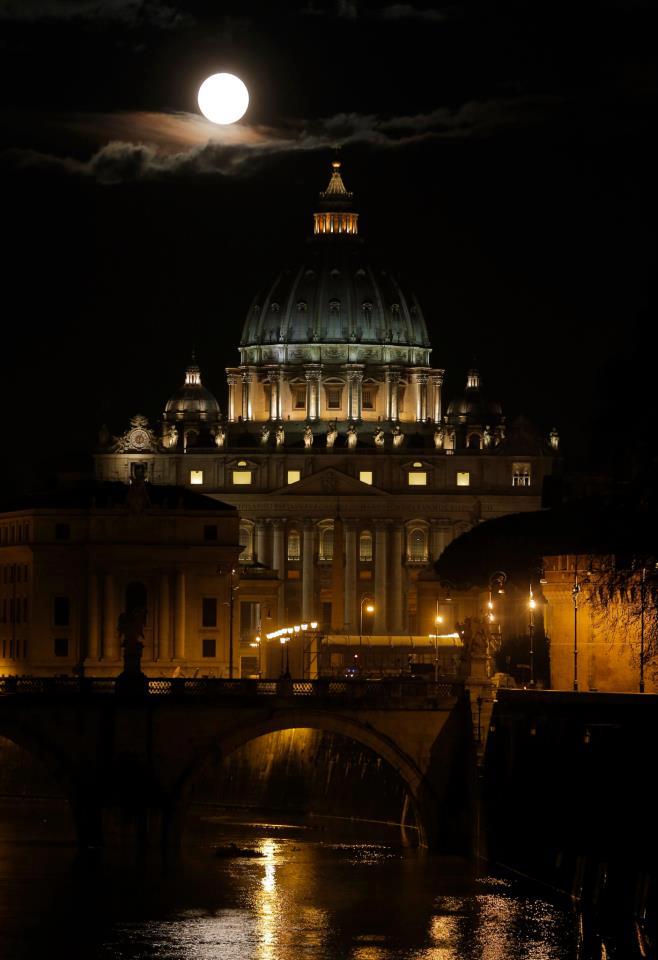
Moon Over St. Peter's

Short Papacy? Consider the Precedent

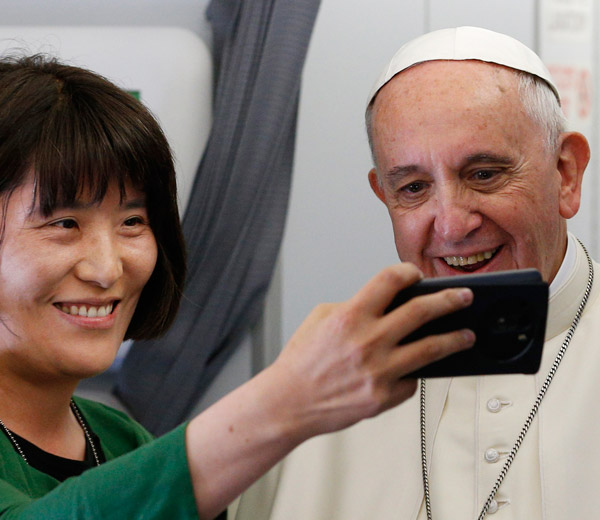
Francis in KoreaOn his recent flight back to Rome from Korea, Pope Francis chatted for about an hour with the reporters traveling with him.  In response to a question about his popularity, he mentioned that he kept things in perspective by remembering that he would probably be around only for two or three more years.  As he put it, “I know this will last a short time, two or three years, and then to the house of the Father,” and in response to an earlier question he suggested that he might follow the example of Pope Emeritus Benedict and retire at some point.  You can read the full text of the press conference here.

As I read the interview, especially about the pope’s thoughts about his own future “on the job”, so to speak, I was reminded of St. John XXIII, whose own reign was less than five years in length.  He once remarked about his relationship with the Roman Curia that, because of his advanced age, no one expected him to live very long.  He continued that were certainly right about that, but their mistake was that they thought he wouldn’t do anything while he was there!

John and CuriaDespite his short papacy, St. John inaugurated a sea change both within the Church as well as how the Church relates to the world.  Not only did he convoke the Second Vatican Council, he also initiated the process of a complete revision of the Code of Canon Law.  Some popes with much longer reigns accomplished far less!

Let’s see what Pope Francis has in mind. . . .

The Canonization Chronicles: Rebuilding Rome (or at least a part of it!)

The pace of life in and around St. Peter’s is really so full of energy and enthusiasm right now, the best word I’ve seen to describe comes from NCR reporter Joshua McElwee — a carnival.  The constuction and preparation of the altar and platform and other structures in the Piazza is one thing.  I’ve lost count of the various national and regional flags, the languages being spoken, and even the number of times street vendors have approached with the finest souvenirs ever made!  Really!  They told me so!

Everything is new and fascinating in this Eternal City right now, at least the parts closest to the Vatican.  New structures have been built, especially the press scaffolds and so on.  Traffic has been completely re-routed around the Vatican, and most of the shops and cafes and restaurants will be closed all day tomorrow because of the press of the crowds.

photo 1It has been another wonderful day with friends and new acquaintances. I had a quick coffee with NCR reporter Joshua McElwee, and then, after meeting with brother deacons Rob Mascini (the Netherlands) and Enzo Petrolino (Italy), I wandered over to the Borgo Pio, one of my favorite streets in Rome, just around the corner from St. Peter’s.  Always a fascinating place people watching!

There was even some nice music for pranzo. . . .

After wandering around this morning and early afternoon, with the temperature rising fast, I stopped outside the Libreria Editrice Vaticana (bookstore) near the Vatican Press Office for a lemonade.  Soon a couple came up and asked me in halting Italian if they could sit down as well!  I answered “sure” in my best Midwestern English, and met a delightful couple from Chicago.  While they are thrilled with the canonizations in a general way, they’re really hoping to encounter Francis.  This seems a very three popescommon response.  People are happy for the two popes being canonized, but in the hearts of many, Francis is already a saint as well, and he’s still with us!  One of the most common images (of which I have many in my bag already) shows the two new saints flanking  Pope Francis who is in the middle and slightly elevated over Pope John and Pope John Paul II.

My new friends told me that this was their first ever trip to Rome, but that they were already looking forward to coming back when things would be less hectic.

Among all the various national groups, the one that stands out are the Poles.  As one person put it to me, “The Poles are back!”  There are signs and songs and shouts all over the place; I can only imagine what will happen tomorrow when Pope John Paul II is announced as “Saint John Paul.”  But Pope John is not forgotten.  I saw several groups of people John’s home diocese of Bergamo: from young and old,  clergy, religious and laity,  all of whom are literally camping in St. Peter’s Square.  Although the police are trying to tell people they can’t do that, no one has yet started removing them either.  It will be interesting to see what happens on that score as well.

I had a delightful conversation with CNS reporter Carol Glatz and then decided to grab a taxi and return to our lodgings and rest for tomorrow.  But, with every respect to my friends and colleagues, the highlight of the day was about to happen, completely by chance.


The Via della Conciliazione is now a pedestrian thoroughfare.  People are simply walking up and down the whole length of the street, and the only motorized vehicles allowed now are related to public safety.  Along the way, I encountered this delightful group of children being entertained by some local workers.  Enjoy the video.  It makes my day every time I watch it!

I have come back to the religious house where I’m staying where they young rector from the Congregation of Mariannhill Missionaries (CMM) and I took a light supper in the kitchen and talked about many things.  Born and raised in South Africa, Fr. Musa is excited about the new energy being found in and about the church.  He won’t be able to attend the canonizations tomorrow because he serves in several parishes on the weekend, but he asked for special prayers at the canonization and promised his in return.  The house has pilgrims from the United States (well, just me), the Netherlands,  and Germany.  There was a young woman from Michigan staying here, according to Musa, but she called him to say that she was going to camp out in St. Peter’s Square tonight.

As for me, I will be getting up at 2:45 AM.  Sister Philomena, the 84-year old dynamo who runs the kitchen, is putting out some breakfast things for me tonight, and Musa is getting up to arrange a taxi at 3:30 AM.  (The taxi company wouldn’t arrange things in advance!).  He said it was his way of participating in the event.  I’ll take the taxi to Saint John Lateran to pick up the bus which will take us to the edge of Vatican City.  There we will be met by officials from the Vatican’s Pilgrimage office at 5:00 AM and escorted to the church of Santa Maria in Traspontina to await the Mass and our service as ministers of communion.

So, it’s off to bed for a few hours sleep.  Tomorrow will be an incredible day!  Oh, and the forecast calls for rain and storms, but only AFTER the conclusion of the Mass.  We shall see. . . .

The Canonization Chronicles: Notes from Friday, 25 April

It was a busy day today, and these scattered thoughts reflect some of the craziness that’s building around here.

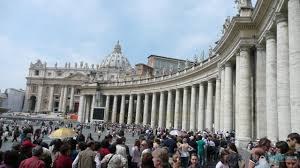
Queue for St. Peter'sIt was still another gorgeous Roman day.  As I entered the Piazza San Pietro, it was obvious that the crowds are building in both numbers and intensity.  There were long lines yesterday to get into the Basilica, but nothing like today!  The queue wrapped around the piazza and into the Via della Conciliazione.  The crowds today were often celebrating in parish, organization, or even national groups.  One sizable group had brought in a large wooden cross, secured it in a stand, and serenaded passersby with a variety of songs and hymns for at least an hour.  Other groups were singing around the Square as well.  I would estimate — very unofficially — that the crowd in the Square today was at least triple what was there yesterday — and tonight, a deacon friend from Rome told me that they are now estimating as many as five million people to be “attending” the canonization ceremonies at venues all over town.  One group today was practicing their “John Paul II, we love you” chant, although I didn’t hear a similar chant for Pope John.  The press scaffolding next to the Vatican Communications Office seemed quite crowded today, much more so than yesterday.

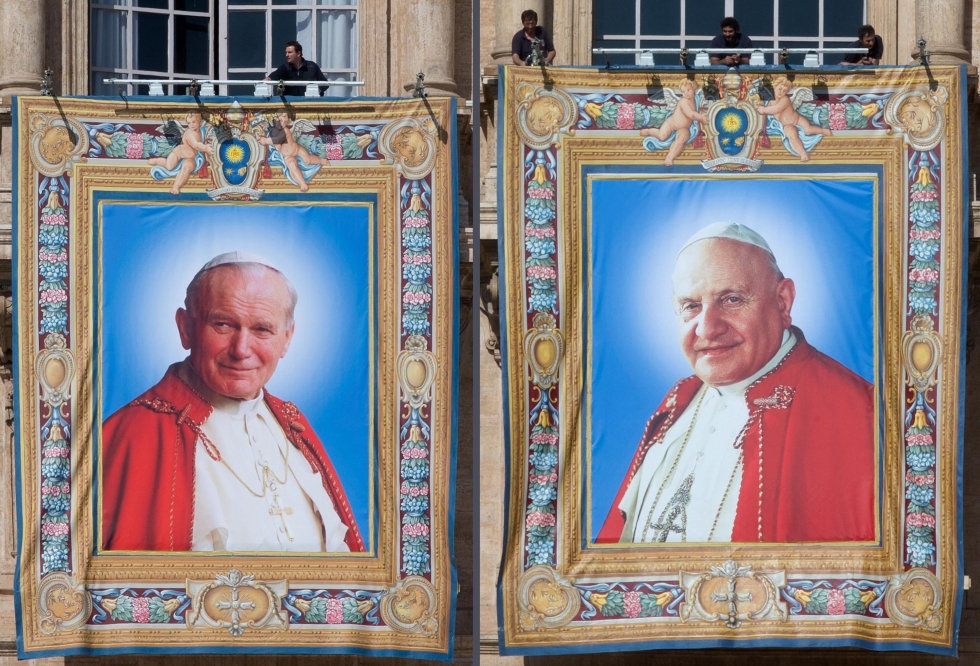
double_popesPerhaps the most visible change of all today, however, was the hanging of the tapestries with the portraits of the two new saints from the front of the Basilica.  They’re not hanging together like this; that’s just a camera trick. St. John is on the right side of the Basilica and St. John Paul is on the left side of the Basilica.  The tapestries seem smaller than what I would have expected when you see them against the full size of the Basilica, but maybe that will change for Sunday!

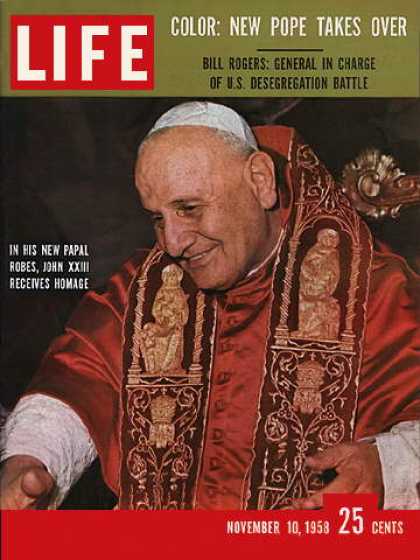
John in LifeBefore going on, I’d like to add a bit about Pope John.  Personally, I am sorry that so many people have forgotten just how popular, inspiring and influential  Pope John was in his day.  When he died on Pentecost, 1963, a proposal to proclaim him a saint immediately, “Santo Subito”, was chanted by the people and circulated among the world’s bishops who were preparing to return to Rome for the second session of the Council.  It was proposed that the Council itself, when back in session, make the proclamation of sainthood (under the leadership of Pope John’s good friend and successor, Pope Paul VI).  Although Pope John was extraordinarily popular and beloved for his simplicity, humor and pastoral concern, the bishops decided that to proclaim him a saint immediately would be unseemly; there also seemed to be a sense that it would be better to wait until “Pope John’s Council” was successfully concluded as his legacy before proceeding further.  Obviously, these are two very different men, and this is not a popularity contest!  Still, I hope that younger people who have really only known St. John Paul II and his recent successors might be inspired by this canonization to study and learn about St. John XXIII and Pope Paul VI.  To understand where we are today on many levels in the Church, a person really needs to understand those two popes of the Council and the first years of its implementation.


As I wandered around the Square talking with people, and later in conversations with friends, there was a general enthusiasm about the leadership of Pope Francis, his genius at linking these two new pope-saints, and his own unique stamp on exercising the Petrine ministry.  The only concern raised was that he has made himself so open and vulnerable that he may be attacked!  The numbers at his Wednesday audiences are stunning, and he has begun the audiences much earlier, arriving in his popemobile sometimes as early as 9:30 AM so he has more time to meander through the crowds before taking his position on the platform for the formal portion of the audience.

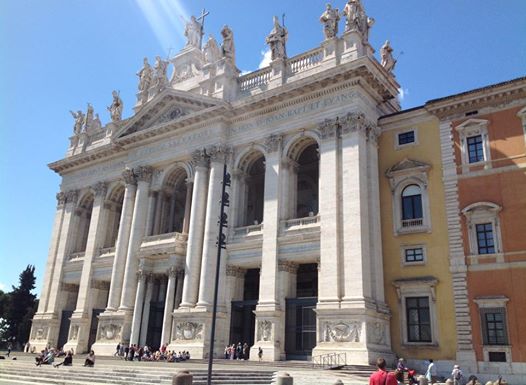
St. John LateranFinally, a brief word about the instructions we’ve received for Sunday.  I must leave the monastery in which I’m staying at 3:30 AM for the trip to St. John Lateran.  I have included a picture of St. John Lateran in bright sunshine which I took yesterday; that’s not a view I’ll have at 5:00 AM on Sunday morning!

At some time between 4:30 and 5:00 AM, a special bus will take us priests and deacons who are distributing communion from the Lateran to the church of Santa Maria in Traspontina at the other end of the Via della Conciliazione from St. Peter’s (a week ago, we were told the bus would leave at 5:30; that’s been changed.  Maybe by Sunday, it will change even further.  I intend to be there in plenty of time!).  At Santa Maria we will vest in alb and white stole and wait for the Mass of Canonization to begin at 10:00 AM, when we will make our way out the front doors of the church into the Via della Conciliazione.  Eventually, we will distribute Communion to those communicants in the area.  We have been told to distribute communion only on the tongue (actually, the instructions say “data in bocca” (given into the mouth), in order to prevent someone from taking the Host in the crowd and giving it to another.

I’m going to St. Peter’s tomorrow morning; it will be interesting to see what happens next as the numbers build along with the excitement!

Santa Maria in Traspontina

Santa Maria in Traspontina on the Via della Conciliazione

Missing the Point about Clerical Celibacy

priest_celibacyThere are few constants in life.  One of them, however, is this: Whenever the subject of clerical celibacy in the Catholic Church is raised, everyone has an opinion to share.  And when “celibacy” is linked to something said by the Pope — well, all bets are off!  So, naturally, here I am, entering the fray again because, as part of my opinion, most commentators miss the real point.


The current round of discussion began yesterday when a Brazilian Bishop Erwin Kräutler, Bishop of Xingu, reported a recent audience with Pope Francis in which the pope suggested that various approaches might be explored at the initiatives of regional and national episcopal conferences.  Read one report of the interview here.  This includes the possible ordination of viri probati (“proven men”), which generally refers to experienced married men.  You can read Deacon Greg Kandra’s reporting on the interview here.  The comments on his Facebook page reflect the normal range of responses.  Some paraphrasing: “Celibacy is just a discipline, so let’s dump it.”  “Celibacy is the ideal which needs to be protected.”  “Celibacy should remain the norm; we could let some married guys into the priesthood, but let’s not get carried away.”  “Sure, you can drop celibacy, but it would break the church because married priests will cost more.”  And on and on.

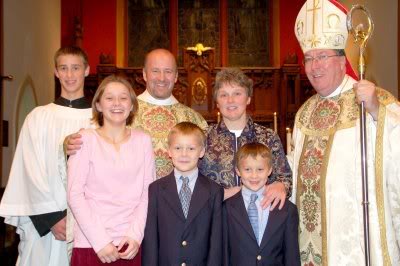
familyordination

Don’t get me wrong.  These are all interesting questions: what does it mean to speak of something as a matter of discipline and (consequently) potentially changeable?  Why is clerical celibacy to be understood to be “the norm” when our history and the diversity of the Church’s praxis in both the Western and Eastern traditions tells us otherwise?  And more than one diocese has undertaken to examine the costs involved when the pastoral leader of a parish (deacon or layperson) is not a priest: would it really cost the diocesan church more?  What these studies have found is that, while the actual salary of a priest is minimal, when the other allowances made regarding housing, food, and so on are taken into account, there is much less difference than one might assume.  Each of these questions, and so many more, need to be addressed.  But there is, in my opinion, a much more fundamental issue involved here.  The hand-wringing on both ends of the spectrum miss a point that can actually bring them closer together.


No serious commentator I know is saying that we should “do away with celibacy.”  For those persons who have the gift (charism) of celibacy, they should be encouraged, whether they are considering ordination or not.  This charism has found its longest expression, not in the ordained ministries, but in vocations to religious life.  Sisters, brothers, monks, nuns and friars have, from the beginning, discerned the counsels of poverty, chastity and obedience as the bedrock of their vocations.  The fact that some religious men later entered the ordained ministries began to confuse the issue.  Let’s see this point in practice.  One of the comments on Deacon Greg’s Facebook page makes the common point that in the Eastern traditions, deacons and presbyters are married, but the episcopate is celibate.  This point is frequently made, mistakenly, that Eastern bishops are expected to be “purer” than their more “junior” colleagues.  However, the source of that practice lies in the fact that the Eastern traditions tended to call their bishops from religious orders (in which all the members had taken vows of poverty, chastity and obedience); in the West, it is far more common (while not universal) to call our bishops from the diocesan clergy.  If the Eastern traditions followed this practice, some of their bishops would be married as well.


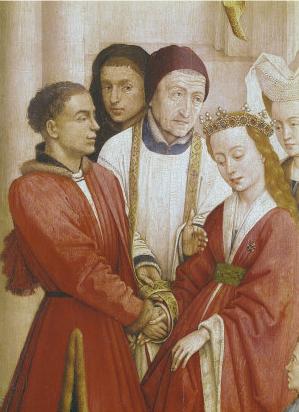
matrimonyThe real problem, as I see it, is not celibacy.  It is the OBLIGATION for Latin Church seminarians to remain celibate as a mandatory precondition to be ordained.  This obligation presumes a linkage, in the West, between a vocation to the celibate life in addition to a vocation to ordained ministry.  It is this link which needs to be examined.  As our experience in both East and West has clearly shown, this linkage is certainly not an absolute or inherent factor.  Instead, one could envision an approach which does parallel the Eastern practice: seminarians gifted with celibacy would remain celibate in the clerical state, once ordained.  Seminarians who enter into marriage would continue to discern a vocation into ordained ministry.  Another clear analogy is that of (so-called permanent) deacons: We have both married and celibate candidates; this could be exactly the same pattern for the seminary.  The bottom line is this: one’s “state of life” (married, single, widowed, professed) should all be respected in its own right without any of them being understood as a prerequisite to ordination.  (When I served on the senior staff of the United States Conference of Catholic Bishops, I once took a phone call from a man interested in the diaconate.  However, he said, “I’m not eligible.”  I asked him why, and he said that he wasn’t married, and he believed that it was a prerequisite to be married in order to become a deacon!   His mistaken understanding was that the priesthood was the path for celibate guys, and diaconate was the path for married guys.  He was stunned to learn that we have both celibate and married men in BOTH orders.)


One further observation: As a married deacon (married for nearly 43 years, ordained for nearly 25 years), I think there’s another benefit to this discussion which is often overlooked.  Certainly we have a strong tradition in the Latin Church which values celibacy’s current relationship with the clerical state.  Celibacy, as beautiful as it can be, has never been considered to be a sacrament of the Church.  Matrimony, on the other hand, is a sacramental way of life.  Just as celibacy can offer an eschatological meaning to Orders, so too would a clergy witnessing the sacramental graces of the sacrament of Matrimony.  The Church is entitled to all of the charismata given to the Church by the Holy Spirit, and a clergy that reflects how the ordained ministries model the great diversity of these gifts, can be a powerful witness to the world.

Francis preaching

During his daily homily yesterday, the Pope spoke of the need to avoid a “dictatorship of thought” and echoed the call of every other Pope since St. John XXIII: that what is needed in today’s Church is a novus habitus mentis: a “new way of thinking.”  The pope is reminding us all very clearly and strongly that this new way of approaching things continues to be necessary.  As a truly “catholic” church of “both-and”, we can find a variety of ways to approach the clerical state, ways which value the variety of charisms given to the Church by God.