This will be the third and final essay in a series on “Deacons and the Synod.” The first essay focused on the apparent lack of deacon participants in the upcoming October General Assembly of the Synod on Synodality and related issues. In the second essay, I suggested that there might be productive ways for deacons to participate in this October’s synodal process going on in Rome without being there in person. In my opinion, it is vital for deacons to be a voice in the synodal process given the nature and sacramental significance of the diaconate itself. From the earliest days of Christianity, deacons were to be the “eyes and ears, heart and soul” of the bishop” (see, for just one example, the mid-3rd Century Syrian Didascalia Apostolorum, “Let let the deacon be the hearing of the bishop, and his mouth and his heart and his soul; for when you are both of one mind, through your agreement there will be peace in the Church”). We are ordained by the bishop to participate in his own pastoral ministry. This occurs not only by serving the specific needs of others but also by making those needs known to the bishop. None of us, bishops, deacons, presbyters, religious, and lay people, serve in a vacuum. In this case, our bishops cannot serve needs they do not know about. How can we bishops and deacons be “both of one mind” if we do not share what burdens our hearts in the care of others?
And so we arrive at this third and final essay. Deacons exist, deacons are ordained, for others. They need to be part of the synodal process not for themselves but for the entire People of God. St. Paul VI referred to deacons as “the animators of the Church’s diakonia,” and St. John Paul II further explained that deacons “are the Church’s service sacramentalized.” Through their ordination, deacons take on a servant-leadership role in the Church. In this essay, therefore, we consider ways in which deacons might lead the entire community of faith in developing a synodal Church. To paraphrase Pope Paul and Pope John Paul: deacons can be understood as “the animators of the Church’s synodality,” and that deacons “are the Church’s synodality sacramentalized.”
I suggest deacons find ways to identify areas of need and concern as their pastoral experience and prayerful reflection indicate and to communicate these experiences and reflections, through appropriate channels, to their bishops. However, they should not stop there. It is not sufficient for deacons to be in a kind of “closed loop” with their bishops. How can deacons help lead others in a synodal path, especially all of those people who will not be present in Rome in October? I offer again the five suggestions I offered previously, slightly expanded. These and similar suggestions can serve as a foundation not only for the Church’s deacons but for the wider community of faith as well. As I wrote before, this list is not exhaustive. Feel free to add to it!
Follow the progress of the Assembly through the media. Don’t trust unofficial sources. Follow the releases from the Holy See. As someone who studies and teaches Ecclesiology, I have spent considerable time checking out a variety of sources, generally online, to see what our parishioners and others may be encountering. I have found it disturbing, aggravating, and infuriating to see what nonsense is spewed by so many “commentators.” Sometimes, there is simply a presentation of factual errors and myths. Still, those errors and myths are now “out there” for anyone to see and hear. People in good faith are therefore misled without even realizing it, and they then make judgments about what they’re hearing from our pulpits and classrooms. “Father must be wrong in his homily because Dr. So-in-So on YouTube said the opposite.” And these are the more benign consequences!
Far more disturbing are those “experts” who are bad-mouthing Pope Francis, his pontificate, and most of the world’s bishops. Can a pope be criticized? Of course. But there is a difference between legitimate concerns over certain aspects of a papacy and crossing the line into schism. Some commentators, for example, refuse to refer to Pope Francis by his papal title and use only his birth name. Again, on one level, that is not the end of the world; but more often than not, it is a way to minimize or even question the ecclesial legitimacy of Pope Francis.
We deacons need to view such “experts” with great caution. Not only our parishioners are vulnerable to such poisonous commentary, thinking it to be accurate, but so too can clergy. In this essay, I don’t want to deviate from the subject at hand and name some names of these “commentators.” Perhaps that can be the subject of a later essay. For now, I simply advise great caution in finding accurate resources on the papacy and on the synodal process itself. Do not trust any sources that might lead others into serious error and even schism. Just as a reminder, c. 751 defines schism as “the refusal of submission to the Supreme Pontiff or of communion with the members of the Church subject to him.” Lack of submission and communion is the foundation of schism.
Therefore, I recommend using only the best resources moving forward, starting with the official documents related to the Synod itself. These may be resources offered by the Holy See, the various episcopal Conferences (such as our own USCCB), or official statements of our own diocesan bishops.
Study the Instrumentum Laboris. Here’s a link to it. How do you respond to these issues and questions yourself? I will develop this item shortly. Imagine that you were there “in the room where it happened” at the Synod Assembly. The Instrumentum Laboris outlines the various topics to be discussed during the Assembly. There is no reason why each and every one of us can’t have these discussions ourselves, and lots of reasons why we should! More later.
Deacon Directors or other leaders in the diaconal community: Consider having weekly sessions (perhaps via ZOOM) for the deacon community to discuss the highlights of the past week. Not much to add to this suggestion. Every diocese has different options available to it that might facilitate such discussions. The diaconate community might decide to hold these discussions, not simply among themselves, but also with other members of the parish or deanery. Just as the bishops have invited other participants into their Synod (It is called the “Synod of Bishops,” after all), having people other than deacons joining in our local meetings can be productive and necessary.
Perhaps pastors and deacons might do something similar for the entire parish and deanery. Bishops may initiate a diocesan process as well for their dioceses.
in opening the Synod, Pope Francis spoke of the three-fold focus of communion, participation, and mission. He pointed out that “the words ‘communion’ and ‘mission’ can risk remaining somewhat abstract, unless we cultivate an ecclesial praxis that expresses the concreteness of synodality at every step of our journey and activity, encouraging real involvement on the part of each and all. Here is where deacons can be particularly helpful. As the Assembly progresses, deacons and others can discuss the practical realities of implementing the issues being discussed. I have subtitled this third essay “Concrete Consequences.” I take that verbiage from the late German theologian Herbert Vorgrimler who once wrote that deacons are to develop and demonstrate the “concrete consequences” of the Eucharist on the lives of our communities. This is where we can make our most unique contributions, where we take theory and aspiration and make it tangible.
WORKSHEETS FOR THE SYNODAL ASSEMBLY
The Instrumentum Laboris contains fifteen worksheets that will guide the Assembly’s discussions. The same worksheets could guide local and regional processes. While this is not the place to review each worksheet in detail, I offer some comments on their general organization.
Notice there are three groups of five worksheets. Group B1 concerns communion, Group B2 addresses co-responsibility, and Group B3 involves participation, governance, and authority. All of these themes flow directly and intentionally from the work of the Second Vatican Council. As Pope Francis and the Synod coordinators have stressed, the upcoming Assembly is not a general council of the Church; it is not Vatican III! Pope Francis recently observed that the work of Vatican II remains incomplete, and the themes for the Synod Assembly reflect a two-fold concern. First, that the work of the Council itself remains a work in progress, and second, that the Synod should be understood against the background of the Council, and building on a Conciliar foundation.
Finally, once these discussions are held, the results should be offered to our diocesan bishops for his own reflection, use, and decision-making. This is one way for us deacons in particular to offer our service as his “eyes, ears, voice, heart, and soul,” the traditional roles of the deacon.
Conclusion
Each and every one of us is called to be part of a synodal Church. Several hundred people have been invited to participate in a remarkable gathering in October. The vast majority of us will not be there in person. That does not mean we do not have a responsibility to participate in our own ways. Instead of feeling “left out” we should embrace our baptismal inclusion in the People of God, and for deacons, our vocational call to animate the Church’s diakonia — and synodality.
My recent essay on the apparent lack of deacons at the upcoming Assembly of the Synod on Synodality caused some interesting responses. First, I was informed by an authoritative source that “deacons” would indeed be a part of the Assembly, just none from North America. However, in the succeeding days, it seems that only one deacon (from Europe) has been identified as a participant. This was discovered only because he came forward and identified himself. The official list of participants identified other clergy as presbyters or bishops; the deacon was simply listed without any indication that he was a deacon. It should also be mentioned that well over half of the world’s 50,000 deacons live and minister in North America. Not to include some kind of deacon participation from all the continental synodal regions, including participation from North America, is a missed opportunity.
Active participation by the world’s deacons would be a two-fold benefit. First, the Assembly could consider the various questions of the Instrumentum Laboris through the lens of ministers whose very raison d’etre is to be the “eyes, ears, heart, and soul” of the bishop, identifying the needs of the church and the world, and providing servant leadership to meet those needs. Their experience could be invaluable. Second, and perhaps even more important, deacons would be able to listen and learn, through the Assembly process, from the wisdom and insights of the rest of the participants. As I noted in the previous essay, every other conceivable group is included in the “guest list”: lay women and men, women and men religious, bishops, presbyters, youth, and scholars. These fortunate people will share and learn, reflect, and discern together the “joys, hopes, griefs and anxieties of the people of this age” (Gaudium et Spes, #1).
Other respondents to my essay, both clergy and laity, reacted variously. Some simply agreed that not having deacons at the Assembly was a serious shortcoming that should be corrected. Others just rolled their eyes, shrugged their shoulders, and pointed out that this exclusion is nothing new, that deacons are often overlooked at every level of Church life: parish, deanery, diocese, and universally. Still others wrote that such an absence was really a good thing. That, as deacons, we are called to remain with the marginalized and the poor who were also not invited to the Assembly. Other deacons agreed that it was a good thing we are not there, so we can simply continue to focus on the immediate and practical needs of the people we serve. A French deacon wrote an article for La Croix International, in his own cri de coeur (“Priests Should Stop Pushing Deacons to One Side”) published on 20 July, which reminds us that experiences of diaconal marginalization are not focused on any particular region of the world.
This brief essay attempts two things. First, to sketch why I believe it is a most unfortunate oversight and a lost opportunity not to have the intentional participation of deacons at the Assembly. Second, since we are not in a position to change this situation, I want to offer a few suggestions on how deacons might still participate, even unofficially, in the Assembly and the subsequent steps in the synodal process.
Why should deacons be at the assembly? Why not?
Let’s first consider why deacons should not be at the Assembly. They should not be there from a sense of clericalism or entitlement: “We’re ordained so we should be represented.” No one has a right to be at the Assembly on such terms. The argument for participation is not based on clericalism, power, or ego.
So why should they be there? Deacons should be there because Pope Francis said so. He has emphasized that the current synodal path is “an exercise in mutual listening. I want to emphasize this. It is an exercise of mutual listening, conducted at all levels of the Church and involving the entire People of God.” Though unnamed, the diaconate is certainly part of “the entire People of God”! Deacons should be at the Assembly precisely because the pope wants “all levels of the Church” involved. Yet most lists related to the Synod are silent on the diaconate. Not so about any other group in the Church: but deacons are not mentioned. Why would this be?
There seem to be several possible explanations, none of them good. First, the order of deacons might be misperceived as a minor form of the priesthood and therefore included within the presbyterate. Ecclesiology has long since demonstrated that deacons “are not ordained unto the priesthood,” and do not participate in the ministerial priesthood. Unfortunately, too many people still see the diaconate merely as an “apprentice model” of the priesthood. It most certainly is not. Second, and equally problematic would be the opposite misunderstanding that deacons are simply some kind of “super-laity” and therefore need not be numbered among the clergy. Many deacons still encounter this mistaken notion, even among priests. Third, it could be that, even after more than fifty years since the diaconate’s renewal, it has simply not captured the ecclesial imagination; simply put, deacons don’t easily fit into many people’s categories of ordained ministry.
Church teaching has no such ambiguity. The Second Vatican Council refers to the sacramental grace of Holy Orders as applied to the diaconate: “For strengthened by sacramental grace, in communion with the bishop and his group of priests they serve in a diaconate of liturgy, of word, and of charity to the people of God” [Lumen gentium #29]. The same text refers to the functions of the diaconate as “supremely necessary” in the life of the Church. In the 1998 Directory for the Ministry and Life of Permanent Deacons [DMLPD], the Congregation for Clergy stated, “The origin of the diaconate is the consecration and mission of Christ, in which the deacon is called to share. Through the imposition of hands and the prayer of consecration, he is constituted a sacred minister and a member of the hierarchy. This condition determines his theological and juridical status in the Church” [DMLPD, #1]. In a particularly striking passage, the Congregation taught:
In every case it is important, however, that deacons fully exercise their ministry, in preaching, in the liturgy and in charity to the extent that circumstances permit. They should not be relegated to marginal duties, be made merely to act as substitutes, nor discharge duties normally entrusted to non-ordained members of the faithful. Only in this way will the true identity of permanent deacons as ministers of Christ become apparent and the impression avoided that deacons are simply lay people particularly involved in the life of the Church.
In short, the diaconate is not an optional, “nice-to-have” volunteer organization. As St. John Paul II taught frequently, “The diaconate is not a job; it is a vocation.”
A Unique Vocation
The tradition of the Church has always maintained that deacons have a unique character, related to but distinct from the presbyterate. And the most ancient sources emphasize the relationship that should exist between the deacon and the bishop, with the deacon serving as the bishop’s “eyes, ears, heart, and soul.” This is demonstrated during the deacon’s ordination when, from time immemorial, only the bishop lays hands on the ordinand. In the ordinations of presbyters, all priests present lay hands on the new priests; for new bishops, all bishops present lay hands on their new brothers. Not so with the deacon. The deacon is focused uniquely on the bishop.
The deacon is ordained to participate in his own way in the three-fold ministry of the bishop: Word, Sacrament, and Charity. The entire Church is called to be a servant church, a diaconal church. Pope Paul VI repeatedly taught that deacons are to be “the animators of the Church’s service,” and St. John Paul II carried it a step further when he referred to the diaconate as “the Church’s service sacramentalized.” He would later recall:
A particularly felt need in the decision to re-establish the permanent diaconate was and is that of the greater and more direct presence of ministers of the Church in the various environments of the family, work, school, etc., as well as in the established pastoral structures.
John Paul II General Audience, “Deacons Serve the Kingdom of God,” 6 October 1993
Deacons are called to feed the hungry, but also to address the cause of that hunger. Deacons are advocates for those who are voiceless; defenders of those who are powerless. As Father Joseph Komonchak once said, “Vatican II didn’t renew the diaconate because of a shortage of priests, but because of a shortage of deacons.” He was right then, and the need persists today. Certainly, there is a shortage of deacons at the Assembly!
Therefore, deacons should be active participants throughout the whole synodal process for two critical reasons, alluded to above. First, since deacons have a “greater and more direct presence” in the lives of the faithful they serve at home, in schools, the workplace, and in their professions, they can bring this pastoral experience and the needs of the people to the Assembly table. Second, deacons should be present to listen, share in the process of discernment, and learn from the other participants. The “agenda” of the deacon’s service is determined by the needs of others.
Deacons: How to Participate From Home
Since deacons are not currently on the guest list for the Assembly as of this writing (with one exception), how can we still contribute to the process? Consider the following suggestions, and feel free to add to the list!.
Follow the progress of the Assembly through the media. Don’t trust unofficial sources. Follow the releases from the Holy See.
Deacon Directors or other leaders in the diaconal community: Consider having weekly sessions (perhaps via ZOOM) for the deacon community to discuss the highlights of the past week.
Perhaps pastors and deacons might do something similar for the parish.
in opening the Synod, Pope Francis spoke of the three-fold focus of communion, participation, and mission. He pointed out that “the words ‘communion’ and ‘mission’ can risk remaining somewhat abstract, unless we cultivate an ecclesial praxis that expresses the concreteness of synodality at every step of our journey and activity, encouraging real involvement on the part of each and all. Here is where deacons can be particularly helpful. As the Assembly progresses, deacons can discuss the practical realities of implementing the issues being discussed.
In short, even though we won’t be in the Assembly itself, we can still be active in our response to it. In doing so, we should attend to the three potential risks identified by Pope Francis: formalism, intellectualism, and complacency. His words speak for themselves.
The first is formalism. The Synod could be reduced to an extraordinary event, but only externally; that would be like admiring the magnificent facade of a church without ever actually stepping inside. . . . If we want to speak of a synodal Church, we cannot remain satisfied with appearances alone; we need content, means and structures that can facilitate dialogue and interaction within the People of God, especially between priests and laity. Why do I insist on this? Because sometimes there can be a certain elitism in the presbyteral order that detaches it from the laity; the priest ultimately becomes more a “landlord” than a pastor of a whole community as it moves forward. This will require changing certain overly vertical, distorted and partial visions of the Church, the priestly ministry, the role of the laity, ecclesial responsibilities, roles of governance and so forth.
Can we deacons help in developing the “content, means, and structures” Pope Francis mentions? What would this mean in your parish or other ministries? What about the elitism he mentions? He specifically refers to the priesthood; are we able to help in addressing that? And, we should also address similar elitism that may be present in our own order.
A second risk is intellectualism. Reality turns into abstraction and we, with our reflections, end up going in the opposite direction. This would turn the Synod into a kind of study group, offering learned but abstract approaches to the problems of the Church and the evils in our world. The usual people saying the usual things, without great depth or spiritual insight, and ending up along familiar and unfruitful ideological and partisan divides, far removed from the reality of the holy People of God and the concrete life of communities around the world.
Here is where deacons can offer special help. Given our lifestyles, we live, work, and minister in the midst of the laity in a way other clergy may not be able to. While we can still fall into the trap of intellectualism, it is more than likely that we will get called out on it by our friends, families, and neighbors. We need concrete approaches to today’s problems, and we are in a good position to do that.
Finally, the temptation of complacency, the attitude that says: “We have always done it this way” (Evangelii Gaudium, 33) and it is better not to change. That expression – “We have always done it that way” – is poison for the life of the Church. Those who think this way, perhaps without even realizing it, make the mistake of not taking seriously the times in which we are living. The danger, in the end, is to apply old solutions to new problems.
Let’s face it: it’s easy to fall into this trap of complacency. Our secular experience already tells us this can be deadly. We need to guard against it within the Church as well. Deacons are uniquely positioned to be a guardrail against all these risks.
Conclusion
I believe that the best way for deacons to proceed at this point is to become, if we are not already, active supporters of every aspect of the synodal process. This is a critical moment in the life of the Church, and the call to animate the Church’s diakonia remains, wherever we are.
Pray, serve, study, create, exhort, hope, and love. Repeat!
Six weeks ago Pope Francis issued an Apostolic Letter called “Traditionis Custodes” (“Guardians of the Tradition”). When I heard the news and read the Letter, my first thought was, “thank God.” In this essay I want to explain why, and suggest several points for moving forward.
The Letter had little impact on the majority of Catholics, Catholics who celebrate Mass at their local parish, help out as they can, enroll their children in religious education classes, celebrate the sacraments with great joy, and, in short, participate in the life of their parish in peace. However, the Letter exploded like a bomb in the circles of those who refer to themselves as “traditional” or “traditionalist” Catholics. We must be cautious with these terms. All Catholics are “traditional”: we hold that God’s revelation flows from Christ through the double streams of Sacred Scripture and Sacred Tradition. A “traditionalist” has been described as “an advocate of maintaining tradition, especially so as to resist change.” This certainly seems an appropriate characterization of some of these groups. Liturgically, they express this traditionalist identity through the use of the 1962 Missale Romanum and largely reject the principles of liturgical reform mandated made by the Second Vatican Council in its first document, Sacrosanctum Concilium [SC] (the Constitution on the Sacred Liturgy), promulgated in December, 1963. With this new Letter and its restrictions on the use of the older form of the Mass, traditionalists are convinced even more that the Catholic Church is headed in the wrong direction.
Historically, liturgical reform began long before Vatican II. But with the affirmation of the reform movement by the Council, and the principles of reform clearly articulated in SC, the pace of liturgical change accelerated. St. Paul VI wasted no time. A month after the promulgation of SC , he instituted the Consilium ad exsequendam Constitutionem de Sacra Liturgia [Council for the Implementation of the Constitution on the Sacred Liturgy]. Building on the specific principles contained in SC, the Consilium developed the reforms to the Mass, and Pope Paul promulgated the novus ordo Missae (the “new order of the Mass”) in the Roman Missal of 1970. At the end of this essay we will look in detail at his own view of the Roman Missal that bears his name.
PERSONAL TESTIMONY
Before going any further, I want to offer some personal testimony from those days. I loved the pre-Conciliar Latin Mass. It was the Mass of my youth. I was born in 1950, and this was the Mass we celebrated every Sunday. When I entered Catholic grade school, it was the Mass we celebrated every day before class. I began serving the Mass in 1957 as a seven year-old third grader. In our parish, we had three Masses on every weekday, and six on Sunday, one of which was a Solemn High Mass. I continued to serve at the parish until I left home in 1963 at age 13 to enter the high school seminary. Obviously, I continued to serve in the seminary, and by age 15 I was Master of Ceremonies for Holy Week when I went home for Easter break. I had also been studying the piano and organ since second grade and by seventh grade, I was one of the three regular organists for our parish, covering all of those Sunday and weekday Masses, along with funerals and weddings. I continued to do this when I would come home for the summers. To say that I was heavily engaged in the liturgical life of the parish would be an understatement. I loved the pre-Conciliar Latin Mass. At the same time, I was enthusiastic about the possibilities of the changes set in motion by the Council.
When I started the seminary, in September, 1963, the Second Vatican Council was entering its second session and, by the time we went home for Christmas vacation that December, Sacrosanctum Concilium had been promulgated by an overwhelming vote by the world’s bishops of 2,147 placet to 4 non placet. By the end of that school year, we were beginning to feel the effects of the changes to come. We were following events in Rome closely. Some of the priests on our faculty had friends and classmates studying and working in Rome, and they would share their own insights about the Council and the discussions taking place among the bishops. The Council was as real to us as if we were actually there. One poignant memory remains with me. During that school year of 1963-64, one of our religion teachers in the seminary was an elderly priest. One day we were talking about the liturgical changes being debated in Rome. Father began to talk about his time as a parish priest, and how special it was to celebrate the Mass for his people. “You know, gentlemen, I am so excited about the possibilities being discussed. For years, I have dreamed of turning around to face my people and say — in English! — ‘The Lord be with you.’ How many times I have turned toward them and said ‘Dominus vobiscum’ to a church of people who had no idea what was going on at the altar.” He continued, “I know that I will never live to see that day, gentlemen, but if — God willing — you become priests, you’ll be able to do just that!” Fortunately, he was wrong. Before the end of that school year, we had received permission from the bishops to implement ad experimentum some of the liturgical changes. There was Father, turning to us with tears in his eyes, greeting us with “The Lord be with you!” I remained in the seminary throughout high school and college (1963-1971), living through the final years of the Council and the first years of its implementation. It was a blessed time.
CURRENT SITUATION
Not everyone accepted the liturgical changes, of course. Various individuals, notably Archbishop Marcel Lefebvre, formed groups to celebrate the “old Mass” rather than the “new Mass.” Every pope from Paul VI to Francis has attempted to resolve the disputes with these groups. The goal, of course, is communio. One of the four traditional marks of the Church is the claim that we are “One.” This mark is founded in the priestly prayer of Christ as the Last Supper, when Jesus prayed to His Father “that they may all be one, as you, Father, are in me and I am in you, may they also be in us” (John 17: 21). Over the decades since the Council, the popes have all showed good faith in working with these groups in a quest to strengthen or in some cases restore that unity.
While I knew some of this history, my research interests revolved around other issues. Since ordination as a deacon for the Archdiocese of Washington, DC, I have served in wide variety of pastoral, diocesan, and national assignments, from Washington, DC, to Iowa, Illinois, and California. In more than three decades of diaconal ministry, I have encountered very few parishioners who characterized themselves as “traditionalist” or who preferred to worship according to the 1962 Missale. So I decided, after the Pope’s letter, that I should look more closely into these matters. My reason was simple: I wanted to see if there was some way to help alleviate the pain these folks were experiencing. I had heard of several popular personalities who had extensive influence on Twitter and YouTube, so off I went.
I began exchanging tweets with one of these personalities, a Texas “influencer” who promptly “blocked” me on Twitter when I suggested some of his claims about the Church were inaccurate. Over on his YouTube channel, one of this man’s “co-hosts” repeatedly mocked “the Novus Ordo Church.” In another video, this same duo condemned, mocked, and dismissed the language they associated with the Council, terms like “pastoral,” “People of God,” and “social justice.” The co-host complained (and, as usual, mocked) Vatican II’s call for a reformed liturgy which involved “the full, conscious, and active participation” of the laity at the Mass. He gleefully reported, to the great amusement of his host, that as a sign of dissent against this teaching, he would pull out his rosary at the “novus ordo” Masses he occasionally and reluctantly attended. Interesting idea: the rosary as dissent! Then I was struck by another fact. While the host repeatedly complained about the constant liturgical “novelties” and “abuses” of the novus ordo, implying widespread experience with the “new Mass,” he remarked casually to his co-host that in all the years since his conversion to Catholicism (he had been a priest in the Episcopal church) he had only attended nine or ten novus ordo Masses!
These commentators are not alone. I spent considerable time looking at other sites to see other reactions to the pope’s Letter. Again, there were hyperbolic, breathless headlines, mostly directed in vitriolic terms against the Holy Father. Not having spent much time in this “traditionalist” world, I was stunned. These people, while claiming an identity of “faithful Catholics,” presented themselves as anything but! To offer any support of Pope Francis was ridiculed as ultramontanism. Furthermore, their mocking dismissal of Vatican II was disturbing. They seemed to lump together all of the world’s bishops who were the Council Fathers of Vatican II, characterizing them as some kind of liberal, hippy, cabal that was out to destroy the Church. Others adopted an attitude that people don’t need to pay attention to Vatican II because it was a “lesser” Council which will go down in history as a minor kerfluffle. Certainly, they say, it was not of the stature of the magnificent Councils of Trent or Nicaea. For the record, all of the twenty-one general Councils of the Church hold the same magisterial status. As I heard and read these comments, I realized that none of these people seemed to have any real substantive knowledge about what the Council was all about: why it was called in the first place, what its goals were, and the vision behind the decisions the world’s bishops made.
Consider again the final vote on Sacrosanctum Concilium. 2,147 bishops approved the text; only 4 disapproved. Look at those numbers. They are incredible. To hear some of our “traditionalist” sisters and brothers, it may seem that there was a huge rift among the bishops about the principles of liturgical reform being promulgated in Sacrosanctum Concilium. There was vigorous debate, of course! However, when the final version was presented for their vote, the bishops were nearly unanimous in their approval.
Fast forward to the present. Pope Francis explained in the Letter that he wrote it after consulting with the bishops of the world and their concerns over the continued usage by some Catholics of the 1962 Missale Romanum. These concerns revolve around the unity and communio of the Church. This was the hope of Pope Benedict when he promulgated Summorum Pontificum. Benedict created a novelty by initiating a practice never before done within a single ritual church. His hope was that by creating two “forms” (the “ordinary” which is the Mass of Paul VI, and the “extraordinary” which is the 1962 Roman Missal) the forms would mutually enrich each other, and those feeling disenfranchised by the liturgical changes following the Council might be reconciled. Unfortunately, despite his good intentions, Benedict’s attempt was a failure. For all their public protestations to the contrary, the “traditionalists” who are “influencers” on social media communicate a radical disunity with the Church and her magisterium. Many of the people I encountered on Twitter and YouTube have come into the Catholic Church from other religious traditions, and it makes one wonder what attracted some of them to the Catholic Church in the first place if they have so many problems with the magisterium of the Church! Nonetheless, I am not judging their motivation, their spirituality, or their love for the Church, and I believe they are attempting to operate in good faith.
Where might we go from here? Consider the following four points.
1) As other commentators have pointed out, this issue is not about Latin. It’s never been about Latin. It is about the Church. It is about ecclesiology. The ancient maxim, dating back as far as the 5th Century St. Prosper of Aquitaine, is lex orandi, lex credendi. How we are praying reflects how we are believing. This goes far beyond the language in which the liturgy is celebrated. If the issue was simply about the use of Latin, that need could be met readily simply by using the Latin editio typica of the current Roman Missal. But this is not about the Latin alone.
What kind of Church is reflected in in the 1962 Missale? And what kind of Church is reflected in the current Missal? As is well known, Vatican II described the Church in scriptural and sacramental terms. The world’s bishops also chose to speak of the Church as a pilgrim and moved away from the previous model of perfectas societas. They also stressed the Trinitarian identity of the entire church in all of its members as the People of God, Mystical Body of Christ, and the Temple of the Holy Spirit. I am not saying that the pre-Conciliar Church did not see itself as sacramental or did not appreciate its Trinitarian foundation. What I am saying is that Vatican II’s vision of Church, as discernible through a study of the historical development of the various drafts of the key conciliar documents, chose to stress aspects of this identity with new focus and emphasis. This can be seen, for example, in many of the changes made to the Mass following the Council. One particular example is that the 1962 Missale refers to the assembly of the faithful at Mass rarely, and these were directions to the priest-celebrant such as to turn toward the people to determine if there were communicants. While much ink has been spilled in the intervening years about what “active participation” by the laity should mean, we must always keep in mind that “active participation” is not to be considered in isolation: Sacrosanctum Concilium almost always links it with “full,” and “conscious.” Consider this passage:
Mother Church earnestly desires that all the faithful should be led to that fully conscious, and active participation in liturgical celebrations which is demanded by the very nature of the liturgy. Such participation by the Christian people as “a chosen race, a royal priesthood, a holy nation, a redeemed people, is their right and duty by reason of their baptism. In the restoration and promotion of the sacred liturgy, this full and active participation by all the people is the aim to be considered before all else; for it is the primary and indispensable source from which the faithful are to derive the true Christian spirit; and therefore pastors of souls must zealously strive to achieve it, by means of the necessary instruction, in all their pastoral work.
Sacrosanctum Concilium, #14
This ecclesiological foundation is behind all of the teaching and action of every Pope since St. Paul VI promulgated the novus ordo missae. The conversation that we should be having is less about Latin or even about which edition of the Mass we should be using. Rather, it must be about the kind of Church we are called to be. One traditionalist commentator is fond of referring dismissively to the post-Conciliar Church as “the Church of Nice,” a Church which doesn’t want to offend anyone, especially those not part of the Catholic Church. It is important to understand that the attitude of the Church’s bishops is born of a desire to respond to Christ’s prayer for unity. One of the goals of the Council and the post-Conciliar papal magisterium has been to work for Christian unity. This does not mean watering down our teachings, but finding areas of common faith and seeking pathways toward ultimate reunion. The Church, according to Vatican II, is to serve “as a leaven and as a kind of soul for human society as it is to be renewed in Christ and transformed into God’s family” (Gaudium et spes, #40).
Reception of Vatican II is, therefore, central to this current issue regarding the Mass. The Council articulated a vision for the future of the Church, and suggested directions for ongoing reform. Vatican II, as all prior twenty general Councils of the Church, articulates magisterial teaching. One does not have the option to say, “I will respect the magisterial authority of THIS Council but not THAT one.” This is a fundamental point being raised by every pope from St. Paul VI to Francis.
2) The normative Roman Missal is not the1962 Missale Romanum. There is discussion among traditionalists that this Missale “was never abrogated” when the 1970 Missal appeared. The traditionalist-vilified novus ordo Missae is the norm, what Benedict XVI termed the “ordinary” form of the Mass. It seems wise to me that the characterization of ordinary and extraordinary forms has been discarded. Given the intimate sacramental relationship between the Eucharist (the Mass) and the Church, such a distinction is not helpful. Remember lex orandi, lex credendi. So, for example, we do not speak of an “ordinary” form of the Church and an “extraordinary” form of the Church. As I said above, the fundamental issue here is not language of the Mass, or the associated rubrics. This is about the Church. The ritual and sui iuris Churches that make up the Catholic Church have one ritual expression of the Eucharist within each Church. The diversity of the Church found in the communion of Catholic Churches is matched by the unity within each Church.
Unfortunately, to read or watch certain certain traditionalist commentators, one would think the situation was reversed: that it was the “new Mass” which is — or should be — the extraordinary form, retaining the 1962 Missale as the ordinary form. In other words, the desire seems to be for a different kind of Church, not simply a different form of the Mass.
3) It was precisely the 1962 Missale that the overwhelming majority of the world’s bishops wanted reformed! This point cannot be overstressed. When the bishops directed a reform of the Mass, the Mass they had in mind was the 1962 Missale. According to the bishops, this Mass needed reform. Again, reading or watching traditionalist commentators, they seem to feel that the unreformed 1962 Missale is perfect as it is and in no need of reform; some would go so far as to say that it cannot be reformed anyway, due to the language of St. Pius V’s Quo Primum, which said no one could ever change the Mass. The simple fact is that, despite the language of Quo Primum, the Mass of Pius V was changed regularly over the centuries , including a new editio typica during the reign of St. John XXIII.
4) Much of the recent agita over Traditionis Custodes has attempted to pit Pope Francis against his immediate predecessor, Pope Benedict. Rather, Pope Francis has as his object the identical positions taken by every Pope from Paul VI onward. It was, in fact, Pope Benedict who tried a novel approach in his well-intentioned but ultimately unsuccessful attempt to heal the breach between those who favor the unreformed 1962 Missale and Catholics who celebrate the reformed Mass of Paul VI. Furthermore, Benedict’s decision to remove diocesan bishops from any role in the use of the “old Mass” in their own dioceses has proven unfortunate and harmful. Pope Francis has now corrected that approach, returning the responsibility of the diocesan bishop as the chief liturgist of his diocese. However, as stressed above, it is critical to remember that both popes share a common vision of Christian unity, following the prayer of Christ. Instead of trying to pit one pope against another, it is far better to find their commonality.
CONCLUSION
On Wednesday, 19 November 1969, St. Pope Paul VI addressed the imminent implementation of the new Roman Missal during his general audience. He anticipated several questions. What follows are direct citations from the address. I include these rather lengthy quotes because of their ongoing applicability.
Question #1: How could such a change be made? Answer: It is due to the will expressed by the Ecumenical Council held not long ago. The Council decreed:
“The rite of the Mass is to be revised in such a way that the intrinsic nature and purpose of its several parts, as also the connection between them, can be more clearly manifested, and that devout and active participation by the faithful can be more easily accomplished. For this purpose the rites are to be simplified, while due care is taken to preserve their substance. Elements which, with the passage of time, came to be duplicated, or were added with but little advantage, are now to be discarded. Where opportunity allows or necessity demands, other elements which have suffered injury through accidents of history are now to be restored to the earlier norm of the Holy Fathers.”
Sacrosanctum Concilium, #50
Pope Paul continues, “The reform which is about to be brought into being is therefore a response to an authoritative mandate from the Church. It is an act of obedience. It is an act of coherence of the Church with herself. It is a step forward for her authentic tradition. . . . It is not an arbitrary act. It is not a transitory or optional experiment. It is not some dilettante’s improvisation. It is a law.”
The pope underscores the unity of the Church, now to be found in its liturgical reform: “This reform puts an end to uncertainties, to discussions, to arbitrary abuses. It calls us back to that uniformity of rites and feeling proper to the Catholic Church, the heir and continuation of that first Christian community, which was all “one single heart and a single soul” (Acts 4:32).
Question #2: What exactly are the changes?
You will see for yourselves that they consist of many new directions for celebrating the rites. . . . But keep this clearly in mind: Nothing has been changed of the substance of our traditional Mass. Perhaps some may allow themselves to be carried away by the impression made by some particular ceremony or additional rubric, and thus think that they conceal some alteration or diminution of truths which were acquired by the Catholic faith for ever, and are sanctioned by it. They might come to believe that the equation between the law of prayer, lex orandi and the law of faith, lex credendi, is compromised as a result.
It is not so. Absolutely not. . . . The Mass of the new rite is and remains the same Mass we have always had. If anything, its sameness has been brought out more clearly in some respects.
The unity of the Lord’s Supper, of the Sacrifice on the cross of the re-presentation and the renewal of both in the Mass, is inviolably affirmed and celebrated in the new rite just as they were in the old. The Mass is and remains the memorial of Christ’s Last Supper. At that Supper the Lord changed the bread and wine into His Body and His Blood, and instituted the Sacrifice of the New Testament. He willed that the Sacrifice should be identically renewed by the power of His Priesthood, conferred on the Apostles. Only the manner of offering is different, namely, an unbloody and sacramental manner; and it is offered in perennial memory of Himself, until His final return (cf. De la Taille, Mysterium Fidei, Elucd. IX).
In the new rite you will find the relationship between the Liturgy of the Word and the Liturgy of the Eucharist, strictly so called, brought out more clearly, as if the latter were the practical response to the former (cf. Bonyer). You will find how much the assembly of the faithful is called upon to participate in the celebration of the Eucharistic sacrifice, and how in the Mass they are and fully feel themselves “the Church.” You will also see other marvelous features of our Mass. But do not think that these things are aimed at altering its genuine and traditional essence.
Rather try to see how the Church desires to give greater efficacy to her liturgical message through this new and more expansive liturgical language; how she wishes to bring home the message to each of her faithful, and to the whole body of the People of God, in a more direct and pastoral way.
Question #3: What will be the results of this innovation? The results expected, or rather desired, are that the faithful will participate in the liturgical mystery with more understanding, in a more practical, a more enjoyable and a more sanctifying way. That is, they will hear the Word of God, which lives and echoes down the centuries and in our individual souls; and they will likewise share in the mystical reality of Christ’s sacramental and propitiatory sacrifice.
The pope concluded, “So do not let us talk about ‘the new Mass.’ Let us rather speak of the ‘new epoch’ in the Church’s life.”
I hope that all of us can take the long view of two centuries of liturgical reform, and see liturgical reform within the even larger revitalization of the Church herself. This is why my first reaction to Traditionis Custodes was to thank God. At Vatican II, the world’s bishops gathered in solemn Council introduced the idea of liturgical reform in just such a way, as part of larger project of ecclesial reform. It is time for all of us — in faithfulness to Scripture, Tradition, and the Magisterium — to set aside fear, the rhetoric of mockery, distortion, and condescension, and recommit ourselves to this vision of the Council:
“This sacred Council has several aims in view: it desires to impart an ever increasing vigor to the Christian life of the faithful; to adapt more suitably to the needs of our own times those institutions which are subject to change; to foster whatever can promote union among all who believe in Christ; to strengthen whatever can help to call the whole of mankind into the household of the Church. The Council therefore sees particularly cogent reasons for undertaking the reform and promotion of the liturgy.
It was just fifty years ago today that the Order of Deacons was renewed as a ministry to be exercised permanently in the Catholic Church. Fifty years ago today, 18 June 1967, Blessed Pope Paul VI acted on the 1964 recommendation of the world’s bishops at the Second Vatican Council. He promulgated motu proprioSacrum Diaconatus Ordinem, which you can read in full here.
Following the conclusions of the Second Vatican Council (cf. Lumen gentium, #29), the Holy Father directed the appropriate changes to canon law which would permit the diaconate to be renewed as a “particular and permanent” order, and opened the diaconate to be conferred on married as well as celibate men. The introductory paragraphs offer significant insights into the vision behind the renewal:
Beginning already in the early days of the Apostles, the Catholic Church has held in great veneration the sacred order of the diaconate, as the Apostle of the Gentiles himself bears witness. He expressly sends his greeting to the deacons together with the bishops and instructs Timothy which virtues and qualities are to be sought in them in order that they may be regarded as worthy of their ministry.
Furthermore, the Second Ecumenical Vatican Council, following this very ancient tradition, made honorable mention of the diaconate in the Constitution which begins with the words “Lumen Gentium,” where, after concerning itself with the bishops and the priests, it praised also the third rank of sacred orders, explaining its dignity and enumerating its functions.
Indeed while clearly recognizing on the one hand that “these functions very necessary to the life of the Church could in the present discipline of the Latin Church be carried out in many regions with difficulty,” and while on the other hand wishing to make more suitable provision in a matter of such importance wisely decreed that the “diaconate in the future could be restored as a particular and permanent rank of the hierarchy.”
Although some functions of the deacons, especially in missionary countries, are in fact accustomed to be entrusted to lay men it is nevertheless “beneficial that those who perform a truly diaconal ministry be strengthened by the imposition of hands, a tradition going back to the Apostles, and be more closely joined to the altar so that they may more effectively carry out their ministry through the sacramental grace of the diaconate.” Certainly in this way the special nature of this order will be shown most clearly. It is not to be considered as a mere step towards the priesthood, but it is so adorned with its own indelible character and its own special grace so that those who are called to it “can permanently serve the mysteries of Christ and the Church.”
From the beginning, then, the renewal of the diaconate as a “particular and permanent” order of ministry has been about sacramental grace. The diaconate must never be reduced simply to the sum of its various “functions” which might easily be performed by others without ordination. However, the Council and the Pope recognized that those performing those functions in the person of Christ and in the name of the Church should be strengthened by the sacramental grace of ordination.
This is a very special day for the Church and her deacons. We remember with great respect and humility the giants of the renewal of the order of deacons: the bishops, theologians, and most especially those pioneering early deacons who set out into the unknown, charting a course for the rest of us to follow.
It seems to me that since 20 January 2017 everyone is still trying to sort out what exactly has happened. For people who supported the candidacy and election of Donald J. Trump to the presidency of the United States, they are full of hope that he will deliver on his various and varied campaign promises, feeling that they have been overlooked by the “professional politician” class and the “elites” in the media and academia. Those who opposed his candidacy and election are full of concern that he will cause irreparable damage to the office and the country through ineptitude or worse. It is quite one thing to run on a platform that is “anti-Washington”; it is quite another to master the inherent complexities of governance. So it seems to me that everyone is to some degree unsettled about the future.
But for me, of all the claims and counterclaims made over the last month, one that troubles me most deeply is the repeated assertion (made in various words and contexts) that boils down to this. “We don’t care that the president lies; his words don’t matter; it will be his actions that matter.” As more than one observer noted, the new president is supposed to be “taken seriously but not literally.” And, of course, there are all of the “alternative facts” to be considered!
But words do matter. Especially for Catholics. Imagine a baptism celebrated without words, especially the words “I baptize you in the name of the Father, and of the Son, and of the Holy Spirit”! Imagine an ordination without the prayer of consecration over those being ordained. Imagine the Eucharist without a Eucharistic Prayer of consecration. In all of these examples, we would conclude that a sacrament has not taken place. Words matter to us. They matter a lot. And of course, fundamental to all of that is the understanding that the Christ is, in fact, the Word of God!
How, then are we to respond to our current political situation, not simply as citizens, but as Catholics, as Christians?
Whether one supported or opposed the candidacy and election of Donald J. Trump to the presidency of the United States is now on a practical level irrelevant. The overall turmoil it has caused, however, is not. His supporters fervently believe that he will take significant actions to ameliorate their concerns. His opponents just as fervently believe that his actions are a danger to the Republic and to our society at large. The polarity that has afflicted our discourse for so long has, if possible, descended to new levels.
Political campaigns built on fear only serve to increase that fear. When we are afraid we want to find the cause of that fear and remove it. If social media are any indication, at least some people find it easy to associate other people with their fear, and the vitriol only increases, and the lines keeping us apart become only sharper and more painful.
Take just one example: when protesters took to the streets following this election, they were called “snowflakes” by many commentators on the right. Why? Apparently, this was a characterization based on the assumption that these were spoiled, wealthy, pampered “college kids” who were just scared of their own shadows. Speaking as a professor working with both undergraduate and graduate students at several universities, I can attest that such a characterization is simply untrue. Some of my students are some of the strongest folks I know, who are hard working (often working several jobs while raising families and still going to school!) and dedicated — and worried. Words matter.
Similarly, it is unfair to characterize all Trump supporters as being some kind of monolithic group of “deplorables.” There are many who support the new president because they feel that they have been overlooked in recent years and that their own concerns have not been heard or responded to. Words matter.
These are our family members. These are our friends. These are our parishioners.
BACKGROUND: “Quid nunc?”
“What now?”
This blog is focused on Catholic ministry, especially the ministry of Catholic deacons. However, I hope that what follows might be helpful not only to brother deacons but to other people of good will as well. Specifically, it seems to me, the fundamental question remains: “How does a Christian behave?” For those of us who are “Heralds of Christ,” publicly and solemnly charged to “believe what we read, teach what we believe and practice what we teach,” the challenge is particularly acute.
Back in 1965, the world’s bishops gathered in Rome at the Second Vatican Council spoke words of hope and challenge. In its capstone document, the “Pastoral Constitution on the Church in the Modern World (Gaudium et spes) the bishops had
this to say (in paragraph #3):
Though humankind is stricken with wonder at its own discoveries and its power, it often raises anxious questions about the current trend of the world, about the place and role of the human person in the universe, about the meaning of its individual and collective striving, and about the ultimate destiny of reality and of humanity. Hence, . . . this council can provide no more eloquent proof of its solidarity with, as well as its respect and love for the entire human family with which it is bound up, than by engaging with it in conversation about these various problems. . . . For the human person deserves to be preserved; human society deserves to be renewed.
So, the first point for our reflection must be that we have a responsibility to be active participants in the world around us; we cannot allow ourselves the luxury, however tempting, of withdrawing from the world so as to avoid the often unpleasant and distasteful conflicts which so often permeate contemporary life. Gaudium et spes famously describes this responsibility when it teaches that the Church “serves as a leaven and as a kind of soul for human society as it is to be renewed in Christ and transformed into God’s family” (#40). The challenge for us is to figure out how we — individually and collectively — may serve as leaven in the messy dough of today’s world.
Once again we turn to the Council, which speaks of the “single goal” of the People of God:
to carry forward the work of Christ under the lead of the befriending Spirit. And Christ entered this world to give witness to the truth, to rescue and not to sit in judgment, to serve and not to be served. To carry out such a task, the Church has always had the duty of scrutinizing the signs of the times and of interpreting them in the light of the Gospel. Thus, in language intelligible to each generation, she can respond to the perennial questions which men ask about this present life and the life to come, and about the relationship of the one to the other. We must therefore recognize and understand the world in which we live, its explanations, its longings, and its often dramatic characteristics. (GS ##3-4)
This paragraph offers so much!
Be involved
Be Christ-like: to be witness, to rescue, to not sit in judgment, to serve
Scrutinize and interpret the signs of the times in light of the Gospel
Find language that is meaningful to each generation (and culture)
Respond to perennial questions asked by ALL people
Recognize and understand our world: explanations, longings, dramatic characteristics.
When we turn to the specific question of our involvement in the political life of the nation, we must remember always the purpose of political life in general. Politics involves “the rights and duties of all in the exercise of civil freedom and in the attainment of the common good” (GS #73). Specifically, the bishops offer this concise description:
The political community exists, consequently, for the sake of the common good, in which it finds its full justification and significance, and the source of its inherent legitimacy. Indeed, the common good embraces the sum of those conditions of the social life whereby men, families and associations more adequately and readily may attain their own perfection (#74).
The bishops speak of the growing need to give better protection to human rights, including “the right freely to meet and form associations, the right to express one’s own opinion and to profess one’s religion both publicly and privately. The protection of the rights of a person is indeed a necessary condition so that citizens, individually or collectively, can take an active part in the life and government of the state.” Furthermore:
In the conscience of many arises an increasing concern that the rights of minorities be recognized, without any neglect for their duties toward the political community. In addition, there is a steadily growing respect for men of other opinions or other religions. At the same time, there is wider cooperation to guarantee the actual exercise of personal rights to all citizens, and not only to a few privileged individuals.
The bishops also take to task those who would pervert the political process to their own ends:
However, those political systems. . . are to be reproved which hamper civic or religious freedom, victimize large numbers through avarice and political crimes, and divert the exercise of authority from the service of the common good to the interests of one or another faction or of the rulers themselves (#73).
How do we deal with differing opinions within our societies on how to achieve these goals?
If the political community is not to be torn apart while everyone follows his own opinion, there must be an authority to direct the energies of all citizens toward the common good, not in a mechanical or despotic fashion, but by acting above all as a moral force which appeals to each one’s freedom and sense of responsibility.
It follows also that political authority, both in the community as such and in the representative bodies of the state, must always be exercised within the limits of the moral order and directed toward the common good—with a dynamic concept of that good. . . . But where citizens are oppressed by a public authority overstepping its competence, they should not protest against those things which are objectively required for the common good; but it is legitimate for them to defend their own rights and the rights of their fellow citizens against the abuse of this authority, while keeping within those limits drawn by the natural law and the Gospels.
Finally, the bishops speak specifically to the role of Christians:
All Christians must be aware of their own specific vocation within the political community. It is for them to give an example by their sense of responsibility and their service of the common good. In this way they are to demonstrate concretely how authority can be compatible with freedom, personal initiative with the solidarity of the whole social organism, and the advantages of unity with fruitful diversity. They must recognize the legitimacy of different opinions with regard to temporal solutions, and respect citizens, who, even as a group, defend their points of view by honest methods.
MOVING FORWARD: Bringing the Word to the words
Remember our fundamental relationship: with Christ. That’s the point here. Christian. For the moment, not American, not French, not Iranian, not German — and certainly not Republican or Democrat. For those who claim to be disciples of Christ, the Messiah of the living God, Christianity is a way of life. It is not simply a collection of teachings, liturgical rites or even a moral code. It is all of those things, but so much more. “Being Christian” means being in a relationship with Christ, and just like any relationship, our lives are to be lived accordingly.
The Word of God, Christ, called us all to serve the common good of all. He gave his life to that end; it must be our end as well. How do we constantly and consistently serve the common good of all?
In serving the common good, we must first be involved in the life of our communities. Just as Christ emptied himself into our human condition, we too should follow the same path, pouring ourselves out for others. This means we cannot hide away from society, or act as if contemporary issues really don’t matter to us since we’re focused on heaven! The incarnation of Christ demands that we too are co-responsible for this world and not only the next.
We must be like Christ in other ways, too, as the bishops reminded us decades ago: that we must witness to the Truth always, that we are involved in order to rescue others while not sitting in judgment of them, to serve others where they are and not asking to be served.
We have a responsibility to examine and interpret the signs of our contemporary times in light of the Gospel. The world of 2017 is a different place than the world of 1965, or the world of 1945 or the world of 325. The Council reminds us that we must not only critique the times, we must interpret the signs we see in light of the Gospel of God’s love and Truth.
Words matter: we must find “language that is meaningful” to each and every generation and culture. Do the words we use hurt, demean, insult? Or do the words we use build up, nurture, heal? (Do calling fearful people “snowflakes” tear down or build up?)
Before speaking, we should find out what people’s questions are, and attempt to answer them! As Pope Francis reminds us constantly: answer people’s questions; don’t spend time on questions that have never been asked!
We must be engaged and knowledgeable about our world today. If we are to be the yeast in that messy lump of dough, if we would attempt to make a difference, we have to get ourselves involved with it. We should be critical of society when necessary, and supportive of reasonable attempts when possible. The leaven doesn’t take over the dough, it helps it rise!
Focus on your particular community: what are the concerns being raised by all persons in that community? How do our words and our actions address the needs of all of them, and not merely to one side or another? We are called to serve them all
Before, during and after each and every thing we say and do, PRAY! Above all, PRAY! Remember that Christ, the WORD is the Alpha and the Omega, the beginning and the end of all human longing. We begin with the Word, we end with the Word.
Jesuit Father Thomas Reese has published an interesting piece over at NCRonline entitled “Women Deacons? Yes. Deacons? Maybe.” I have a lot of respect for Fr. Tom, and I thank him for taking the time to highlight the diaconate at this most interesting time. As the apostolic Commission prepares to assemble to discuss the question of the history of women in diaconal ministry, it is good for all to remember that none of this is happening in a vacuum. IF women are eventually ordained as deacons in the contemporary Church, then they will be joining an Order of ministry that has developed much over the last fifty years. Consider one simple fact: In January 1967 there were zero (0) “permanent” deacons in the Latin Rite of the Catholic Church (the last two lived and died in the 19th Century). Today there are well over 40,000 deacons serving worldwide. By any numerical measure, this has to be seen as one of the great success stories of the Second Vatican Council. Over the last fifty years, then, the Church has learned much about the nature of this renewed order, its exercise, formation, assignment and utilization. The current question, therefore, rests upon a foundation of considerable depth, while admitting that much more needs to be done.
However, Father Reese’s column rests on some commonly-held misperceptions and errors of fact regarding the renewal of the diaconate. Since these errors are often repeated without challenge or correction, I think we need to make sure this foundation is solid lest we build a building that is doomed to fall down. So, I will address some of these fault lines in the order presented:
The“Disappearance” of Male Deacons
Father states that “[Women deacons] disappeared in the West around the same time as male deacons.” On the contrary, male deacons remained a distinct order of ministry (and one not automatically destined for the presbyterate) until at least the 9th Century in the West. This is attested to by a variety of sources. Certainly, throughout these centuries, many deacons — the prime assistants to bishops — were elected to succeed their bishops. Later in this period, as the Roman cursus honorum took hold more definitively, deacons were often ordained to the presbyterate, leading to what is incorrectly referred to as the “transitional” diaconate. However, both in a “permanent” sense and a “transitional” sense, male deacons never disappeared.
The Renewal of Diaconate as Third World Proposal
Father Tom writes that his hesitancy concerning the diaconate itself “is not with women deacons, but with the whole idea of deacons as currently practiced in the United States.” (I would suggest that this narrow focus misses the richness of the diaconate worldwide.) He then turns to the Council to provide a foundation for what follows. He writes, “The renewal of the diaconate was proposed at the Second Vatican Council as a solution to the shortage of native priests in missionary territories. In fact, the bishops of Africa said, no thank you. They preferred to use lay catechists rather than deacons.” This statement simply is not true and does not reflect the history leading up to the Council or the discussions that took place during the Council on the question of the diaconate.
As I and others have written extensively, the origins of the contemporary diaconate lie in the early 19th Century, especially in Germany and France. In fact there is considerable linkage between the early liturgical movement (such as the Benedictine liturgical reforms at Solesmes) and the early discussions about a renewed diaconate: both stemmed from a desire to increase participation of the faithful in the life of the Church, both at liturgy and in life. In Germany, frequent allusion was made to the gulf that existed between priests and bishops and their people. Deacons were discussed as early as 1840 as a possible way to reconnect people with their pastoral leadership. This discussion continued throughout the 19th Century and into the 20th. It became a common topic of the Deutschercaritasberband (the German Caritas organization) before and during the early years of the Nazi regime, and it would recur in the conversations held by priest-prisoners in Dachau. Following the war, these survivors wrote articles and books on the need for a renewed diaconate — NOT because of a priest shortage, but because of a desire to present a more complete image of Christ to the world: not only Christ the High Priest, but the kenotic Christ the Servant as well. As Father Joseph Komonchak famously quipped, “Vatican II did not restore the diaconate because of a shortage of priests but because of a shortage of deacons.”
Certainly, there was some modest interest in this question by missionary bishops before the Council. But it remained largely a European proposal. Consider some statistics. During the antepreparatory stage leading up to the Council (1960-1961), during which time close to 9,000 proposals were presented from the world’s bishops, deans of schools of theology, and heads of men’s religious congregations, 101 proposals concerned the possible renewal of the diaconate. Eleven of these proposals were against the idea of having the diaconate (either as a transitional or as a permanent order), while 90 were in favor of a renewed, stable (“permanent”) diaconate. Nearly 500 bishops from around the world supported some form of these 90 proposals, with only about 100 of them from Latin America and Africa. Nearly 400 bishops, almost entirely from both Western and Eastern Europe, were the principal proponents of a renewed diaconate (by the way, the bishops of the United States, who had not had the benefit of the century-long conversation about the diaconate, were largely silent on the matter, and the handful who spoke were generally against the idea). Notice how these statistics relate to Father Tom’s observation. First, the renewed diaconate was largely a European proposal, not surprising given the history I’ve outlined above. Second, notice that despite this fact, it is also wrong to say that “the African bishops said no thank you” to the idea. Large numbers of them wanted a renewed diaconate, and even today, the diaconate has been renewed in a growing number of African dioceses.
One other observation on this point needs to be made. No bishop whose diocese is suffering from a shortage of priests would suggest that deacons would be a suitable strategy. After all, as we all know, deacons do not celebrate Mass, hear confessions or anoint the sick. If a diocese needed more priests, they would not have turned to the diaconate. Yes, there was some discussion at the Council that deacons could be of assistance to priests, but the presumption was that there were already priests to hand.
In short, the myth that “the diaconate was a third world initiative due to a shortage of priests” simply has never held up, despite its longstanding popularity.
Deacons as Part-Time Ministers
Father cites national statistics that point out that deacons are largely unpaid, “most of whom make a living doing secular work.” “Why,” he asks, “are we ordaining part-time ministers and not full-time ministers?”
Let’s break this down. First, there never has been, nor will there ever be, a “part-time deacon.” We’re all full-time ministers. Here’s the problem: Because the Catholic Church did not have the advantage of the extensive conversation on diaconate that was held in other parts of the world, we have not fully accepted the notion that ministry extends BEYOND the boundaries of the institutional church itself. Some of the rationale behind the renewal of the diaconate in the 19th Century and forward has been to place the Church’s sacred ministers in places where the clergy had previously not been able to go! Consider the “worker-priest” movement in France. This was based on a similar desire to extend the reach of the Church’s official ministry outside of the parish and outside of the sanctuary. However, if we can only envision “ministry” as something that takes place within the sanctuary or within the parish, then we miss a huge point of the reforms of the Second Vatican Council and, I would suggest, the papal magisterium of Pope Francis. The point of the diaconate is to extend the reach of the bishop into places the bishop can’t normally be present. That means that no matter what the deacon is doing, no matter where the deacon is working or serving, the deacon is ministering to those around him.
We seem to understand this when we speak about priests, but not about deacons. When a priest is serving in some specialized work such as president of a university, or teaching history or social studies or science at a high school, we would never suggest that he is a “part-time” minister. Rather, we would correctly say that it is ALL ministry. Deacons take that even further, ministering in our various workplaces and professions. It was exactly this kind of societal and cultural leavening that the Council desired with regard to the laity and to the ordained ministry of the deacon. The bottom line is that we have to expand our view of what we mean by the term “ministry”!
“Laypersons can do everything a deacon can do“
Father writes, “But the truth is that a layperson can do everything that a deacon can do.” He then offers some examples. Not so fast.
Not unlike the previous point, this is a common misperception. However, it is only made if one reduces “being a deacon” to the functions one performs. Let’s ponder that a moment. We live in a sacramental Church. This means that there’s more to things than outward appearances. Consider the sacrament of matrimony. Those of us who are married know that there is much, much more to “being married” than simply the sum of the functions associated with marriage. Those who are priests or bishops know that there is more to who they are as priests and bishops than simply the sum of what they do. So, why can’t they see that about deacons? There is more to “being deacon” than simply the sum of what we do. And, frankly, do we want priests to stop visiting the sick in hospitals or the incarcerated in prisons simply because a lay person can (and should!) be doing that? Shall we have Father stop being a college professor because now we have lay people who can do that? Shall we simply reduce Father to the sacraments over which he presides? What a sacramentally arid Church we would become!
The fact is, there IS a difference when a person does something as an ordained person. Thomas Aquinas observed that an ordained person acts in persona Christi et in nomine Ecclesiae — in the person of Christ and in the name of the Church. There is a public and permanent dimension to all ordained ministry that provides the sacramental foundation for all that we try to do in the name of the Church. We are more than the sum of our parts, we are more than the sum of our functions.
“We have deacons. . . because they get more respect”
With all respect to a man I deeply admire, I expect that most deacons who read this part of the column are still chuckling. Yes, I have been treated with great respect by most of the people with whom I’ve served, including laity, religious, priests and bishops. On the other hand, the experience of most deacons does not sustain Father’s observation. The fact is, most people, especially if they’re not used to the ministry of deacons, don’t associate deacons with ordination. I can’t tell the number of times that I’ve been asked by someone, “When will you be ordained?” — meaning ordination to the priesthood. They know I am a deacon, but, as some people will say, “but that one really doesn’t count, does it?” I had another priest once tell me, “Being a deacon isn’t a real vocation like the priesthood.” If it’s respect a person is after “beyond their competence” (to quote Father Reese), then it’s best to avoid the diaconate.
No, the truth is that we have deacons because the Church herself is called to be deacon to the world (cf. Paul VI). Just as we are a priestly people who nonetheless have ministerial priests to help us actualize our priestly identity, so too we have ministerial deacons to help us actualize our ecclesial identity as servants to and in the world. To suggest that we have deacons simply because of issues of “respect” simply misses the point of 150 years of theological and pastoral reflection on the nature of the Church and on the diaconate.
In all sincerity, I thank Father Reese for his column on the diaconate, and I look forward to the ongoing conversation about this exciting renewed order of ministry of our Church.
As I write this, reports are coming in from Baton Rouge about yet another attack with multiple casualties. The world is reeling from the endless chain of violence and death of recent months. On Friday, the PBS series Religion and Ethics Newsweekly ran a program on the Order of Deacons in the Catholic Church. Given the state of the world, one might think this an odd or even irrelevant topic. Upon reflection, however, I believe that there are some important dots to connect. It is precisely because of the current state of violent death, destruction and havoc that the diaconate — properly understood — might offer a glimmer of hope. After all, it was precisely because of the “abyss of violence, destruction and death unlike anything previously known” (John Paul II, referring to World Word II) that the Order of Deacons was renewed in the first place; we’re here to help do something about it. So we shall review the PBS story against that critical backdrop.
THE PBS PROGRAM: Religion & Ethics Newsweekly
First, watch the program or read the transcript for yourself; you may find both of them here. The diaconate is not often covered in the media, so this could have been a wonderful opportunity to spread the word about a remarkable ministry. Unfortunately, despite very obvious good intentions, the program was full of errors ranging from simple errors of fact to more serious, even egregious, errors of history and theology. Furthermore, a wonderful opportunity was missed to connect the “concrete consequences” which the diaconate might offer a hurting world.
The Mistakes
Why focus on some of the errors made in the program? First, simply to get them identified and out of the way. Second and more important, it is crucial to dispel such errors because they can distort the meaning of the diaconate and distract the audience from its proper potential.
“He’s a married layman.” This simple error of fact is made twice at the very beginning of the report. Of course this is simply not true. Deacons are clergy and not laymen. For those of us who live and teach about the diaconate, this is usually the first red flag that the rest of the discussion is not going to go well. Why is this distinction important? Back to that in a moment.
“Celebrating Mass is a function reserved only for priests who are considered heirs to the original apostles.” In Catholic theology, of course, the “heirs” or “successors” of the apostles are bishops, not priests.
“[The deacon] did have to step in recently to speak the words of consecration at communion – for Catholics the most sacred part of the Mass. That’s because his pastor is on leave, and the priest filling in doesn’t speak English.” This is terribly wrong on several levels. First, the deacon can be seen and heard praying part of the Eucharistic Prayer, which is absolutely reserved to priests alone. The priest in question should have just said the prayer in his native language, whatever it is. For years, Catholics of the Latin Rite celebrated Mass in Latin: no one stood next to the priest to translate the Latin for us. Not only did the deacon not “have to step in” to do such a thing, church law expressly forbids it. Canon 907 states: “In the eucharistic celebration deacons and lay persons are not permitted to offer prayers, especially the eucharistic prayer, or to perform actions which are proper to the celebrating priest.” My guess is that every deacon who saw that part of the segment is still cringing! (The other cringe-worthy tidbit was seeing the deacon improperly vested, wearing his stole on the outside of his dalmatic. How cringe-worthy ? Think wearing underclothing over your pants).
“In the Middle Ages the role of deacons began to fade as the power of priests and bishops grew. In the 1960s, the Second Vatican Council restored the role of deacons – but only for men.” The evolving role of deacons throughout history is far more complicated than that, and overlooks the fact that the diaconate never completely disappeared, but became primarily a stepping stone to the priesthood. I fully acknowledge that the history of the diaconate in all of its complexity goes far beyond what can be covered in such a brief program, but still: the broad brush strokes of the history could have been recognized and acknowledged. This is also when the program shifts to the question of the possibility of ordaining women as deacons. I will deal with that question below.
“Until recently, the wives of deacons were required to take the same classes over four years as their husbands did to prepare for the diaconate.” Here the reporter falls victim to a common danger when discussing the diaconate: extrapolation. There are nearly 200 Catholic dioceses in the United States, and the procedures and processes of formation vary greatly from place to place. National standards established by the US Bishops do not mandate such a requirement, although wives are definitely encouraged to participate to the extent possible so that the couple grows together throughout the formation process. Even the “until recently” is confusing: perhaps in that particular diocese something has changed, but not in all. Not every wife of every deacon candidate is required to write papers or attend classes. Like many things in the renewed diaconate, it varies by location and bishop. But even more important — and completely left out of the piece — is the question of vocation. Preparing for ordination is far more than taking classes, writing papers, and giving practice homilies. At the heart of formation is the crucible of discerning God’s will: is God calling a person to ordained ministry? Becoming a deacon is not simply “signing up”, taking a few courses, and putting on the vestments. This is a life-altering process which at the moment is only engaged in by men. Whether that changes in the future remains to be seen. And, if it does, and women enter formation, they too will then go through that crucible of formation — as well as the papers, the courses and the homilies.
“After increasing for several decades, the number of men entering the permanent diaconate has begun to decline, despite a growing need.” It is worth noting that the diaconate is the only vocation that is growing in the United States—outpacing the priesthood, sisters and religious life. In my own research on the diaconate, I would question again the extrapolation going on: perhaps in some areas or in some dioceses, the number of deacons is going down, but that is simply not the case throughout the country and the rest of the world. The diaconate has been growing steadily for decades and continues to do so. The diaconate worldwide has the potential to be one of the great success stories of the Second Vatican Council.
Now, on the PLUS side:
One exceptionally brief section of the program was a bright spot, and captured the characteristic identity of the deacon. Several deacons were shown installing a laundry room in a home for women emerging from crisis. The reporter describes this group as “a ministry that responds to crises. . . .” One of the deacons involved points out that “besides doing liturgical functions, we’re also called to serve the poor and serve the people of God.” There it is: the role of the deacon is to respond to crises, to serve those most in need. The identity of the deacon is expressed in many ways, but most characteristic is this focus on the needs of others: while we are called to exercise our ministries of Word, Sacrament, and Charity in a balanced way, all of it finds its most significant expression in the servant-leadership of the community in service. If the program had focused on these dimensions — on the very heart of the diaconate itself — it might have avoided the problematic areas which they got largely wrong.
Diaconate and Diakonia: An Essential Elementof the Church
The entire Church is called to be a servant-church, a diaconal church. Pope Paul VI repeatedly taught that deacons are to be “the animators of the Church’s service,” and St. John Paul II carried it a step further when he referred to the diaconate as “the Church’s service sacramentalized.” These popes were echoing the teaching and the decisions of the the bishops of the Second Vatican Council when they determined that the Church’s diakonia should be a permanent part of the sacramental life of the Church. Being a deacon is not simply some activity which a person takes on themselves, at their own initiative; rather, it is believed to be a call from God as discerned through the help of the broader Church.
Pope Benedict wrote in Deus Caritas Est, citing St. Luke:
20. “All who believed were together and had all things in common; and they sold their possessions and goods and distributed them to all, as any had need” (Acts 2:44-5). . . . As the Church grew, this radical form of material communion could not in fact be preserved. But its essential core remained: within the community of believers there can never be room for a poverty that denies anyone what is needed for a dignified life.
21. A decisive step in the difficult search for ways of putting this fundamental ecclesial principle into practice is illustrated in the choice of the seven, which marked the origin of the diaconal office (cf. Acts 6:5-6). . . . Nor was this group to carry out a purely mechanical work of distribution: they were to be men “full of the Spirit and of wisdom” (cf. Acts 6:1-6). In other words, the social service which they were meant to provide was absolutely concrete, yet at the same time it was also a spiritual service; theirs was a truly spiritual office which carried out an essential responsibility of the Church, namely a well-ordered love of neighbor. With the formation of this group of seven, “diaconia”—the ministry of charity exercised in a communitarian, orderly way—became part of the fundamental structure of the Church.
It is time now to bring all of this together: in the light of Baton Rouge, Nice, Dallas, “Black Lives Matter,” terrorist acts and wounded communities all around the world: why should we care about an order of ministry within the Church?
THE DIACONATE IN CONTEMPORARY CONTEXT: WHY?
So, what is the connection? How can the diaconate be understood against that much larger and violent backdrop? The most important question of all is perhaps, why do we have deacons in the first place?
We have deacons because the church and the world needed ministers to link the needs of people with the providence, mercy and love of God. This is why deacons have always been described as being associated with the ministry of the bishop and with having the skills to administer “the goods of the Church” for the good of people.
Deacons have historically not been exclusively associated with parish ministry. For the bulk of church history, deacons served as the principle assistants to their bishops, often representing them in councils and as legates, in catechesis (consider Deacon Deogratias of Carthage), in homiletics (Deacon Quodvultdeus, also of Carthage) and by extending the reach of their bishops, such as Deacon Lawrence of Rome. Over time, deacons became subordinate to presbyters as well as bishops, and increasingly involved in what we would recognize as parish ministry. To this very day, deacons are ordained solely by their bishop, for service to him and under his authority: where the bishop is, so should be his deacon.
In our time, as I’ve written about extensively, the Second Vatican Council decided overwhelmingly that the diaconate should be renewed as a permanent ministry in the church once again, even to the extent of opening ordination to married as well as celibate men. The bishops in Council did this largely because of the insights gleaned from the priest-survivors of Dachau Concentration Camp. Following the war, these survivors wrote of how the Church would have to adapt itself to better meet the needs of the contemporary world if the horrors of the first half of the 20th Century were to be avoided in the future. Deacons were seen as a critical component of that strategy of ecclesial renewal. Why? Because deacons were understood as being grounded in their communities in practical and substantial ways, while priests and bishops had gradually become perceived as being too distant and remote from the people they were there to serve.
In short, the diaconate was renewed in order to deal more effectively with the horrors of the contemporary world, not simply to function as parish ministers.
As I frequently challenge myself and other deacons: is the energy I’m expending as a deacon helping to create the conditions in the world in which another “Dachau” could not exist? Or am I involving myself in things that are superficial, contingent, and relatively inconsequential?
The diaconate today, fifty years after the Council, has matured greatly. Those who would talk intelligently about the diaconate need to keep that in mind. Over the past fifty years, formation standards have evolved to better equip deacons for our myriad responsibilities, for example. The diaconate has, at least in those dioceses which have had deacons for several generations, become part of the ecclesial imagination. In some dioceses we have brothers who are deacons, fathers-in-law and sons-in-law who are deacons, fathers and sons who are deacons. In one archdiocese, an auxiliary bishop is the son of that archdiocese’s long-time director of the diaconate. As I mentioned above, the diaconate looks and feels different from one diocese to another and while it is tempting to generalize whenever possible, it is particularly dangerous.
Let me briefly address the question of women and the diaconate. This is a question demanding serious conversation, just as the Holy Father has indicated. He is not alone, nor is he the first pope to think so. Pope Paul VI, St. John Paul II, Pope Benedict (both before his ascension to the papacy and after), and now Pope Francis have all been interested in the question. The 2002 study document of the International Theological Commission (ITC), convened by the authority of then-Cardinal Ratzinger, concluded that it remained for the Church’s “ministry of discernment” to work toward a resolution of the question. But the main thing at this point is to have the conversation. And that conversation will need to take place within the broader context of the lived diaconate, the diaconate whose pastoral praxis and theological reflection has deepened over the past fifty years. Many who opine about women and the diaconate do so from a dated or inadequate understanding of the order. If this conversation is going to be done, it must be done well. In short, to understand the possibilities of women in diakonia, one must first understand the diaconate itself.
Here is my point: If we deacons were restored in response to Dachau and similar world shattering violence, translate “Dachau” to Baton Rouge. “Dachau” to Nice. “Dachau” to “Black Lives Matter”. “Dachau” to 9/11. “Dachau” to every act of senseless terror and random violence. What are we doing to confront these tragedies? What are we doing to work toward a world in which THEY can no longer exist? This is so much more than who gets to exercise “governance” (a technical canonical term) in the Church, or who gets to proclaim the Gospel in the midst of the community of disciples. Like the bishops of the Second Vatican Council, we must ask ourselves how we must evolve and adapt to the new violent conditions of our own age. How can they best be addressed in the interest of the millions of suffering people — here at home and abroad — whose needs we are called to serve? We deacons must, like our “founders” at Vatican II, look beyond the normal categories of parish and issues of “insider baseball.”
I hope that there will be more media programs on the diaconate. I hope that not only will they be done accurately, but that they will also be done with a sense of the vision and potential of the diaconate.
As Pope Paul VI said of us, we are to be “the animators” of the Church’s service: May we give our lives to change the world.
“O Adonai”: O Sacred Lord of the House of Israel, giver of the Law to Moses on Sinai: come to rescue us with your mighty power!
The “O Antiphons” are titles to be associated with the Messiah, the Anointed One; on 18 December, the Messiah is linked to the Lord of Israel who saved Israel. The connection continues through the allusion to Moses, called to lead the people to freedom in God’s name, and to whom God would give the Torah on Sinai. Although in English we tend to interpret “law” in a sense of “rules”, that is notthe way it is understood in Hebrew and the Jewish tradition. Torah refers to instruction or teaching. In the covenant relationship with God, these instructions describe the practical nature of how the covenant is to be lived.
God’s part of the covenant is to rescue us. When Pope Francis promulgated Misericordiae Vultus announcing the Extraordinary Year of Mercy, he chose to evoke this scene of the all-powerful God with Moses:
1. Jesus Christ is the face of the Father’s mercy. These words might well sum up the mystery of the Christian faith. Mercy has become living and visible in Jesus of Nazareth, reaching its culmination in him. The Father, “rich in mercy” (Eph 2:4), after having revealed his name to Moses as “a God merciful and gracious, slow to anger, and abounding in steadfast love and faithfulness” (Ex34:6), has never ceased to show, in various ways throughout history, his divine nature. . . . Whoever sees Jesus sees the Father (cf. Jn 14:9). Jesus of Nazareth, by his words, his actions, and his entire person reveals the mercy of God.
Our relationship with God is not about law enforcement but about faithfulness and compassion in the relationship. Pope Francis (Evangelii Gaudium #44) reminds pastors and others who serve in ministry that, “without detracting from the evangelical ideal, they need to accompany with mercy and patience the eventual stages of personal growth as these progressively occur.”
I want to remind priests that the confessional must not be a torture chamber but rather an encounter with the Lord’s mercy which spurs us on to do our best. A small step, in the midst of great human limitations, can be more pleasing to God than a life which appears outwardly in order but moves through the day without confronting great difficulties.
The Church, the pope reminds his readers, is always open because God is always open to all. “The Church is called to be the house of the Father, with doors always wide open” (#47). In addressing the pastoral consequences of this radical openness, the pope tackles a current issue head on:
The Eucharist, although it is the fullness of sacramental life, is not a prize for the perfect but a powerful medicine and nourishment for the weak. These convictions have pastoral consequences that we are called to consider with prudence and boldness. Frequently, we act as arbiters of grace rather than its facilitators. But the Church is not a tollhouse; it is the house of the Father, where there is a place for everyone, with all their problems.
The pope concludes the chapter by recalling his frequent exhortation that he prefers “a Church which is bruised, hurting and dirty because it has been out on the streets, rather than a Church which is unhealthy from being confined and from clinging to its own security. I do not want a Church concerned with being at the center and which then ends by being caught up in a web of obsessions and procedures.” In his opening of the Holy Door at Saint Peter’s, he challenged us all to be mindful of the Spirit of the Second Vatican Council, the Spirit of the Samaritan.
The God of Israel, Adonai, is the God of all.
ADVENT REFLECTION
In serving others, do we accept the challenge to be missionary, to be constantly reaching out to others rather than sitting in our churches waiting for people to come to us? Do we act as “arbiters of grace” or “facilitators of grace”? Are we guilty of treating the Eucharist as a “prize for the perfect” or do we understand Eucharist as Adonai reaching out to all in mercy? Adonai, the Lord God of Israel, comes to set us all free, and we who serve in any way, are challenged to be instruments of that freedom.
The Extraordinary Jubilee of Mercy, proclaimed by Pope Francis today in Rome, actually began fifty years ago with the solemn closing of the Second Vatican Council on 8 December 1965. When dealing with the Catholic Church it is always good to step back and take a long view on what is going on, and today’s events in Rome are no exception. Let’s connect some dots.
MARY AND THE IMMACULATE CONCEPTION
The first dot is Mary, under her title of the Immaculate Conception. Celebrated in one form or another from the 7th Century, this Feast was established for the entire Church in 1708 by Pope Clement XI. Fifty years ago, this date was deliberately chosen for the solemn closing of the Second Vatican Council. The Church’s teaching about Mary was originally crafted as a separate document by the curia before the Council began. However, the world’s bishops rejected this arrangement, rightly including Mary at the heart and climax of its dogmatic Constitution on the Church, Lumen gentium. Mary, our sister and our mother, the first disciple of the Christ, is held up to all as the model of Christian discipleship. Fifty years ago, therefore, standing on the same spot where Pope Francis stood earlier this morning, Pope Paul VI ended his homily with the following observation:
While we close the ecumenical council we are honoring Mary Most Holy, the mother of Christ and consequently. . . the mother of God and our spiritual mother. . . . She is the woman, the true woman who is both ideal and real, the creature in whom the image of God is reflected with absolute clarity. . . .
Is it not perhaps in directing our gaze on this woman who is our humble sister and at the same time our heavenly mother and queen, the spotless and sacred mirror of infinite beauty, that we can terminate the spiritual ascent of the council and our final greeting? Is it not here that our post-conciliar work can begin? Does not the beauty of Mary Immaculate become for us an inspiring model, a comforting hope? Oh, brothers, sons and all who are listening to us, we think it is so for and for you. And this is our most exalted and, God willing, our most valuable greeting.
VATICAN II
Vatican II is a gift that keeps on giving. The great historian of the Church, Hubert Jedin, once observed that it takes at least a century to implement the teachings and decisions of a general Council. If he is correct, and I believe he is, we have only now just reached the fifty yard line as we say in American football. For all the progress made, much more remains to be done. Let’s take a closer look at those closing ceremonies to the Council, because there are some significant elements there that point the way to what happened earlier today.
THE SERVANT CHURCH
First, on 7 December 1965, Pope Paul celebrated Mass with the Council Fathers. This was the last general assembly of the Council and the day before the Solemn Closing. In his speech to the Fathers, Paul summarized the four year work of the Council:
Another point we must stress is this: all this rich teaching is channeled in one direction, the service of mankind, of every condition, in every weakness and need. The Church has, so to say, declared herself the servant of humanity, at the very time when her teaching role and her pastoral government have, by reason of the council’s solemnity, assumed greater splendor and vigor: the idea of service has been central.
Later, Pope Paul referred to this service in a particular way when he spoke of the service of the Good Samaritan as the role of the Church in the modern world. But I’m getting ahead of myself! More about the Samaritan a little later. For now, this identification of the Church as servant can serve as a valuable hermeneutic when studying the work of the Council as well as the efforts of our leaders ever since. In particular, this can be a profound insight into the way in which Pope Francis exercising the Petrine ministry — and in a most special way — his declaration of an Extraordinary Jubilee of Mercy.
UNIVERSALITY
In his homily fifty years ago, Paul VI begins by proclaiming that his greeting, his message, and indeed the message of the entire Council is universal. He refers to his brother bishops, to the representatives of nations who were in attendance, to the entire People of God, “and it is extended and broadened to the entire world. How could it be otherwise if this council was said to be and is ecumenical, that is to say, universal?”
Pope Paul digs deeper, using the image of a bell:
Just as the sound of the bell goes out through the skies. . . so at this moment does our greeting go out to each and every one of you. To those who receive it and to those who do not, it resounds pleadingly in the ear of every person. . . . No one, in principle, is unreachable; in principle, all can and must be reached. For the Catholic Church, no one is a stranger, no one is excluded, no one is far away. . . . This is the language of the heart of one who loves.
After greeting specific groups of people, especially those who are ill and imprisoned and suffering, he continues:
Lastly, our universal greeting goes out to you who do not know us, who do not understand us, who do not regard us as useful, necessary or friendly. This greeting goes also to you who, while perhaps thinking they are doing good, are opposed to us. . . . Ours is a greeting, not of farewell which separates, but of friendship which remains and which, if so demanded, wishes to be born. . . . May it rise as a new spark of divine charity in our hearts, a spark which may enkindle the principles, doctrine and proposals which the council has organized and which, thus inflamed by charity, may really produce in the Church and in the world that renewal of thoughts, activities, conduct, moral force and hope and joy which was the very scope of the council.
Finally, at the end of the Mass closing the Council, a remarkable thing happened. Most people today are unaware that it even took place, and that is a real tragedy, for it sheds a light on the whole proceedings, and points the way to our contemporary Jubilee. A series of messages from the Council Fathers was read to the world. The bishops of the Council prepared these messages because they wanted the world to realize that the Council had not been simply an exercise of ecclesiastical navel-gazing; rather, the work of the Council was focused outward, to the very real needs of the people and the world. In the introduction to the messages, the bishops write:
We seem to hear from every corner of the world an immense and confused voice, the questions of all those who look toward the council and ask us anxiously: “Have you not a word for us?” For us rulers? For us intellectuals, workers, artists? And for us women? For us of the younger generation, for us the sick and the poor?
These pleading voices will not remain unheeded. It is for all of these categories of people that the council has been working for four years. It is for them that there has been prepared this Constitution on the Church in the Modern World, which we promulgated yesterday amidst the enthusiastic applause of your assembly. . . .
Before departing, the council wishes to fulfill this prophetic function and to translate into brief messages and in a language accessible to all, the “good news” which it has for the world. . . .
Then, dramatically, a number of the bishops stood up, and in a variety of languages, read out the messages. To each group, support and encouragement was offered, as well as the challenges within each area to benefit the entire human race. The seven messages were addressed:
To the Rulers of the World: Those Who Hold Temporal Power
To People of Thought and Science
To Artists
To Women
To the Poor, the Sick and the Suffering
To Workers
To Youth
It is important to recognize that in every Holy Year celebrated since the Council, there have been particular celebrations during the Year for various groups of persons, which extends this pastoral outreach first demonstrated here at the end of the Council. This is true of the Extraordinary Jubilee just begun.
MERCY
And so we connect the final dot.
Again we find ourselves assembled in honor of Mary, and Pope Francis reminds us that the “fullness of grace” such as that we recognize in Mary, “can transform the human heart and enable it to do something so great as to change the course of human history.” In Mary we see the love of God, along with a realization that “the beginning of the history of sin in the Garden of Eden yields to a plan of saving love.”
Yet the history of sin can only be understood in the light of God’s love and forgiveness. Sin can only be understood in this light. Were sin the only thing that mattered, we would be the most desperate of creatures. But the promised triumph of Christ’s love enfolds everything in the Father’s mercy.
In speaking of the Council, Pope Francis recalls and connects the dots for us:
Today, here in Rome and in all the dioceses of the world, as we pass through the Holy Door, we also want to remember another door, which fifty years ago the Fathers of the Second Vatican Council opened to the world. This anniversary cannot be remembered only for the legacy of the Council’s documents, which testify to a great advance in faith. Before all else the Council was an encounter. A genuine encounter between the Church and the men and women of our time. An encounter marked by the power of the Spirit, who impelled the Church to emerge from the shoals which for years had kept her self-enclosed so as to set out once again, with enthusiasm, on her missionary journey. . . Wherever there are people, the Church is called to reach out to them and to bring the joy of the Gospel, ,and the mercy and forgiveness of God. After these decades, we again take up this missionary drive with the same power and enthusiasm. The Jubilee challenges us to this openness, and demands that we not neglect the spirit which emerged from Vatican II, the spirit of the Samaritan, as Blessed Paul VI expressed it at the conclusion of the Council. May our passing through the Holy Door today commit us to making our own the mercy of the Good Samaritan.
May this Jubilee be a celebration of this spirit of the Samaritan in each and every one of our own relationships and encounters.
So much hyperventilation! Bishops fighting bishops! “The press is out of control!” “Translations are all messed up!” “Release the information!” “Don’t release the information!” “This is bringing scandal to the world!”
After more than a week of living in the breathless world of exclamation points, it’s past time for everyone to just calm down. In terms of the process, there is absolutely nothing new here. This is how these things work, and we just need to take a deep breath (as I suggested yesterday) and exhale slowly.
During Vatican II, we saw analogous happenings.
The Roman Curia had announced that the working language for the Council would be Latin. Therefore, the CardinalArchbishop of Los Angeles at the time, James McIntyre, offered to provide a simultaneous translation system for the Council. (Some sources maintain that the offer was made by Cardinal Cushing, but several bishop-participants later reported that it was McIntyre, with his Hollywood connections, who offered first.) Regardless, the offer was refused by the curia because the General Sessions of the Council were to be secret and there was concern that word would leak out. Did the sessions remain “secret”? Of course not!
Vatican II Presser
Many countries held daily press briefings, in addition to the official Vatican briefings. For the United States, these were often held at the Pontifical North American College. Other countries held frequent press briefings, just not on a daily basis. Frequently these “pressers” contained information that was at odds with the official press offering, or they provided additional details.
Early on, the US bishops’ conference (then known as the National Catholic Welfare Conference), began assembling daily summaries of key events, interviews and interventions (speeches) from the day’s activities. These were eventually put together as “Council Daybooks” and were published by the NCWC. The Foreword gives some insight into the process. I apologize in advance for the length of the quote, but read this in light of current events at the Synod, I’ve highlighted certain interesting passages:
From various sources requests have come to the NCWC to gather as soon as possible into one volume whatever information is available covering the day-to-day proceedings of the Second Vatican Council. One of the distinctive features of the present council in contrast to all preceding ones was the prompt reporting of each day’s activities, including a summary statement of each speech delivered in the aulaof St. Peter’s. The correspondents of the NCWC News Service had access to the official press releases each day by early afternoon, and were able to supplement the record by the discussions which took place at the meeting of the daily press panel. The representatives of the various international news media, especially those from the United States, queried the “periti” or experts who had been present at the morning congregations of the council, and were in consequence able to fill in any lacunae which might have occurred and also to clear up any obscurities in the official releases.
The bishops of the United States had the benefit of receiving each evening or early the next morning a mimeographed copy of these reports. It was the general, one might say even the unanimous judgment of the United States hierarchy that this was an invaluable service. It enabled the bishops to review in substance the speeches or the interventions made each day, with more leisure to evaluate the various contributions made to the subject under debate. . . .
I would also point out that in interviews I conducted with several bishops who attended the sessions of the Council, they remarked that almost no Council Father from any country knew Latin sufficiently to follow the actual Latin interventions as they were being given. The bishops noted that they knew Latin well enough to celebrate Mass and the sacraments, but not well enough to follow particular speeches in real time, especially when the Latin was spoken in such a variety of different accents from around the world! Therefore, these daily working translations and summaries were invaluable.
Bishops disagreed frequently and in public on the matters under discussion. This was helpful in sorting out the nuances of every position being taken. It was unusual to see such things, but I don’t recall anyone being scandalized by it. As I’ve blogged before, the almost violent disagreements that most of the world’s bishops had with the way Cardinal Alfredo Ottaviani was running the Holy Office (the precursor to the Congregation for the Doctrine of the Faith) were quite open and frank. They were not unlike the public disagreements now seen between Cardinals Burke and Kasper.
Long debates were held, often in public, over the meaning of specific words and passages in the the draft documents, and sometimes parts of those drafts were available to the public. Robert Blair Kaiser, the Rome bureau chief for Time Magazine during the Council, recounts the many cocktail and dinner parties he and his wife hosted in their apartment for the Council Fathers and the periti. He loves to tell of the conversations groups of bishops would have, debating and arguing over the text they were considering, and sometimes even going into a room and finding a group of them drafting a revised text.
The speeches at the Council were only the tip of the information iceberg. For more bishop submitted their own interventions and emendations to the draft documents in written form, and so just listening to the speeches alone would never give the full story. That would only be known sometimes days later, when all of the written interventions had been studied.
Just as now, people around the world could not get enough news about the Council. The fact that the Council had been called specifically to “update” the Church (St. John XXIII’s aggiornamento) was exciting in itself! How would they do this? What would they do? Writing from Rome, an American professor of Moral Theology shared his behind-the-scenes experiences with family and friends back home. They encouraged him to submit similar accounts to the The New Yorker, and they became regular columns known as “Letters from Vatican City.” To protect himself and his family, he wrote under the nom-de-plume “Xavier Rynne”. For years the real identity of Xavier Rynne was as much an exciting mystery as the identity of “Deep Throat” would be years later during the Watergate scandal (Many people who knew him, however, had little trouble figuring it out: Fr. Francis X. Murphy used his middle name Xavier and his mother’s maiden name Rynne.) Many figures at the Council, particularly among the curia, were not amused by his writing, since he pulled no punches about the inner workings of what was going on.
There are countless other examples, but these make my point: RELAX, people! This is all part of the process, warts and all. We have the “benefit” today of instantaneous communication via electronic media to a level unknown during the Council, and we have the “benefit” of so many “experts” who really are not, except in their own minds. Everyone has opinions; few have the facts. And what is most important: this is only the beginning of the end of Act One of the overall synodal process initiated by Pope Francis.
“Pace, pace”: Peace, my sisters and brothers, peace!
“Call me Ishmael. . . . Whenever it is a damp, drizzly November in my soul. . . I account it high time to get to sea as soon as I can; I quietly take to the ship." -- Herman Melville




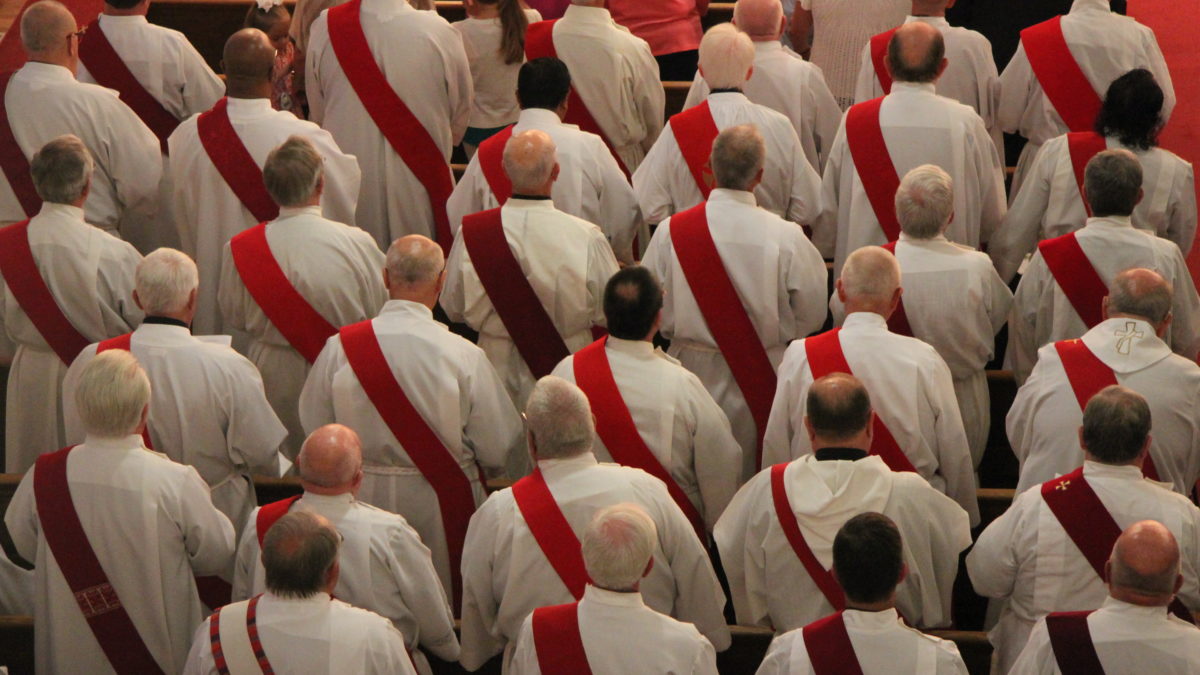

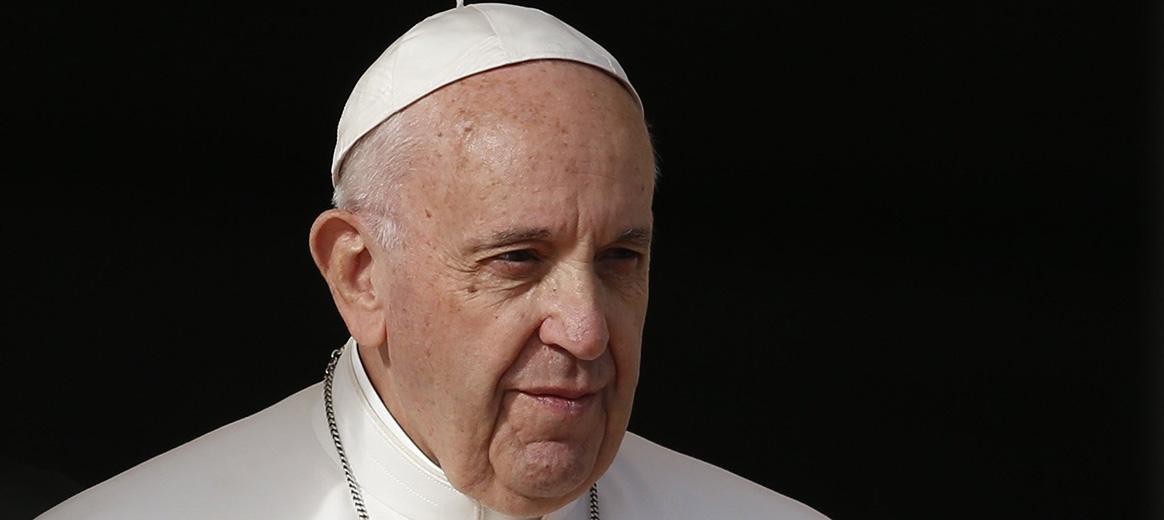
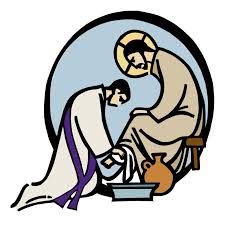




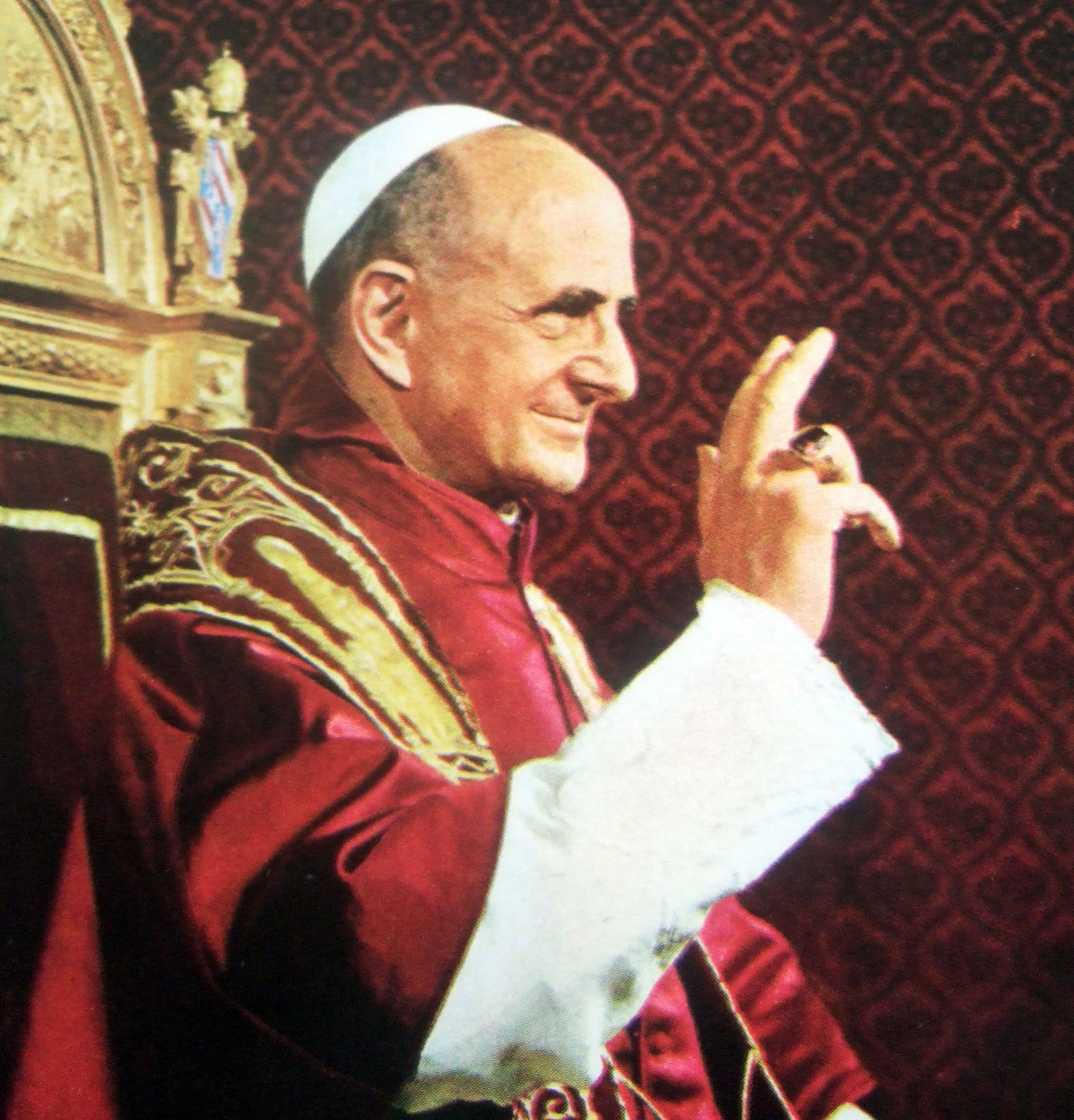 It was just fifty years ago today that the Order of Deacons was renewed as a ministry to be exercised permanently in the Catholic Church. Fifty years ago today, 18 June 1967, Blessed Pope Paul VI acted on the 1964 recommendation of the world’s bishops at the Second Vatican Council. He promulgated motu proprio Sacrum Diaconatus Ordinem,
 INTRODUCTION: “Quod tibi videtur?”
 But words do matter. Especially for Catholics. Imagine a baptism celebrated without words, especially the words “I baptize you in the name of the Father, and of the Son, and of the Holy Spirit”! Imagine an ordination without the prayer of consecration over those being ordained. Imagine the Eucharist without a Eucharistic Prayer of consecration. In all of these examples, we would conclude that a sacrament has not taken place. Words matter to us. They matter a lot. And of course, fundamental to all of that is the understanding that the Christ is, in fact, the Word of God!
 Whether one supported or opposed the candidacy and election of Donald J. Trump to the presidency of the United States is now on a practical level irrelevant. The overall turmoil it has caused, however, is not. His supporters fervently believe that he will take significant actions to ameliorate their concerns. His opponents just as fervently believe that his actions are a danger to the Republic and to our society at large. The polarity that has afflicted our discourse for so long has, if possible, descended to new levels.
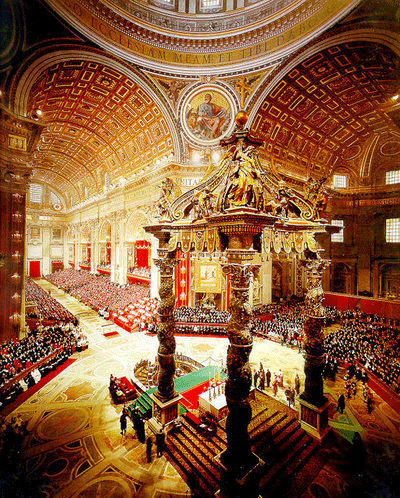 BACKGROUND: “Quid nunc?”
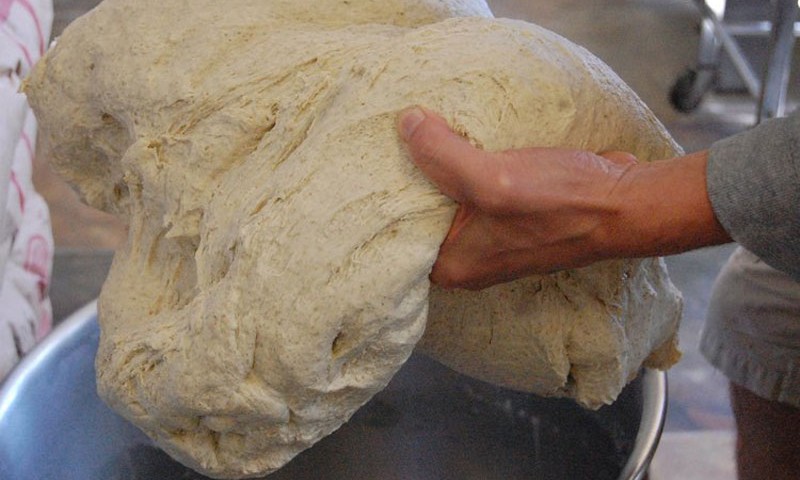 We must be engaged and knowledgeable about our world today. If we are to be the yeast in that messy lump of dough, if we would attempt to make a difference, we have to get ourselves involved with it. We should be critical of society when necessary, and supportive of reasonable attempts when possible. The leaven doesn’t take over the dough, it helps it rise!
 Jesuit Father Thomas Reese has published an interesting piece over at NCRonline entitled
 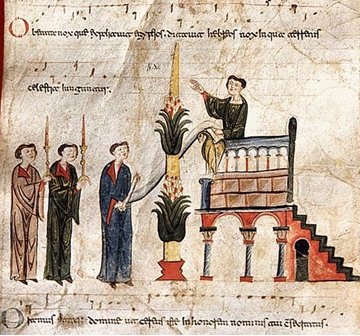 Father states that “[Women deacons] disappeared in the West around the same time as male deacons.” On the contrary, male deacons remained a distinct order of ministry (and one not automatically destined for the presbyterate) until at least the 9th Century in the West. This is attested to by a variety of sources. Certainly, throughout these centuries, many deacons — the prime assistants to bishops — were elected to succeed their bishops. Later in this period, as the Roman cursus honorum took hold more definitively, deacons were often ordained to the presbyterate, leading to what is incorrectly referred to as the “transitional” diaconate. However, both in a “permanent” sense and a “transitional” sense, male deacons never disappeared.
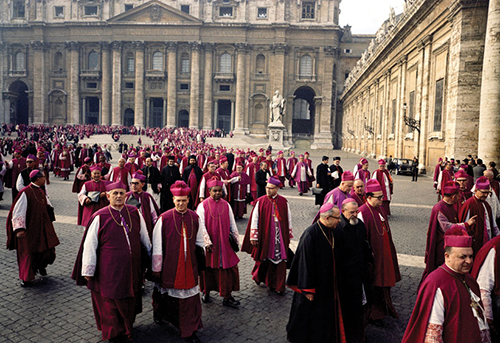 Father Tom writes that his hesitancy concerning the diaconate itself “is not with women deacons, but with the whole idea of deacons as currently practiced in the United States.” (I would suggest that this narrow focus misses the richness of the diaconate worldwide.) He then turns to the Council to provide a foundation for what follows. He writes, “The renewal of the diaconate was proposed at the Second Vatican Council as a solution to the shortage of native priests in missionary territories. In fact, the bishops of Africa said, no thank you. They preferred to use lay catechists rather than deacons.” This statement simply is not true and does not reflect the history leading up to the Council or the discussions that took place during the Council on the question of the diaconate.
 As I and others have written extensively, the origins of the contemporary diaconate lie in the early 19th Century, especially in Germany and France. In fact there is considerable linkage between the early liturgical movement (such as the Benedictine liturgical reforms at Solesmes) and the early discussions about a renewed diaconate: both stemmed from a desire to increase participation of the faithful in the life of the Church, both at liturgy and in life. In Germany, frequent allusion was made to the gulf that existed between priests and bishops and their people. Deacons were discussed as early as 1840 as a possible way to reconnect people with their pastoral leadership. This discussion continued throughout the 19th Century and into the 20th. It became a common topic of the Deutschercaritasberband (the German Caritas organization) before and during the early years of the Nazi regime, and it would recur in the conversations held by priest-prisoners in Dachau. Following the war, these survivors wrote articles and books on the need for a renewed diaconate — NOT because of a priest shortage, but because of a desire to present a more complete image of Christ to the world: not only Christ the High Priest, but the kenotic Christ the Servant as well. As Father Joseph Komonchak famously quipped, “Vatican II did not restore the diaconate because of a shortage of priests but because of a shortage of deacons.”
 Certainly, there was some modest interest in this question by missionary bishops before the Council. But it remained largely a European proposal. Consider some statistics. During the antepreparatory stage leading up to the Council (1960-1961), during which time close to 9,000 proposals were presented from the world’s bishops, deans of schools of theology, and heads of men’s religious congregations, 101 proposals concerned the possible renewal of the diaconate. Eleven of these proposals were against the idea of having the diaconate (either as a transitional or as a permanent order), while 90 were in favor of a renewed, stable (“permanent”) diaconate. Nearly 500 bishops from around the world supported some form of these 90 proposals, with only about 100 of them from Latin America and Africa. Nearly 400 bishops, almost entirely from both Western and Eastern Europe, were the principal proponents of a renewed diaconate (by the way, the bishops of the United States, who had not had the benefit of the century-long conversation about the diaconate, were largely silent on the matter, and the handful who spoke were generally against the idea). Notice how these statistics relate to Father Tom’s observation. First, the renewed diaconate was largely a European proposal, not surprising given the history I’ve outlined above. Second, notice that despite this fact, it is also wrong to say that “the African bishops said no thank you” to the idea. Large numbers of them wanted a renewed diaconate, and even today, the diaconate has been renewed in a growing number of African dioceses.
 Let’s break this down. First, there never has been, nor will there ever be, a “part-time deacon.” We’re all full-time ministers. Here’s the problem: Because the Catholic Church did not have the advantage of the extensive conversation on diaconate that was held in other parts of the world, we have not fully accepted the notion that ministry extends BEYOND the boundaries of the institutional church itself. Some of the rationale behind the renewal of the diaconate in the 19th Century and forward has been to place the Church’s sacred ministers in places where the clergy had previously not been able to go! Consider the “worker-priest” movement in France. This was based on a similar desire to extend the reach of the Church’s official ministry outside of the parish and outside of the sanctuary. However, if we can only envision “ministry” as something that takes place within the sanctuary or within the parish, then we miss a huge point of the reforms of the Second Vatican Council and, I would suggest, the papal magisterium of Pope Francis. The point of the diaconate is to extend the reach of the bishop into places the bishop can’t normally be present. That means that no matter what the deacon is doing, no matter where the deacon is working or serving, the deacon is ministering to those around him.
 Not unlike the previous point, this is a common misperception. However, it is only made if one reduces “being a deacon” to the functions one performs. Let’s ponder that a moment. We live in a sacramental Church. This means that there’s more to things than outward appearances. Consider the sacrament of matrimony. Those of us who are married know that there is much, much more to “being married” than simply the sum of the functions associated with marriage. Those who are priests or bishops know that there is more to who they are as priests and bishops than simply the sum of what they do. So, why can’t they see that about deacons? There is more to “being deacon” than simply the sum of what we do. And, frankly, do we want priests to stop visiting the sick in hospitals or the incarcerated in prisons simply because a lay person can (and should!) be doing that? Shall we have Father stop being a college professor because now we have lay people who can do that? Shall we simply reduce Father to the sacraments over which he presides? What a sacramentally arid Church we would become!
 With all respect to a man I deeply admire, I expect that most deacons who read this part of the column are still chuckling. Yes, I have been treated with great respect by most of the people with whom I’ve served, including laity, religious, priests and bishops. On the other hand, the experience of most deacons does not sustain Father’s observation. The fact is, most people, especially if they’re not used to the ministry of deacons, don’t associate deacons with ordination. I can’t tell the number of times that I’ve been asked by someone, “When will you be ordained?” — meaning ordination to the priesthood. They know I am a deacon, but, as some people will say, “but that one really doesn’t count, does it?” I had another priest once tell me, “Being a deacon isn’t a real vocation like the priesthood.” If it’s respect a person is after “beyond their competence” (to quote Father Reese), then it’s best to avoid the diaconate.
 As I write this, reports are coming in from Baton Rouge about yet another attack with multiple casualties. The world is reeling from the endless chain of violence and death of recent months. On Friday, the PBS series Religion and Ethics Newsweekly ran a program on the Order of Deacons in the Catholic Church. Given the state of the world, one might think this an odd or even irrelevant topic. Upon reflection, however, I believe that there are some important dots to connect. It is precisely because of the current state of violent death, destruction and havoc that the diaconate — properly understood — might offer a glimmer of hope. After all, it was precisely because of the “abyss of violence, destruction and death unlike anything previously known” (John Paul II, referring to World Word II) that the Order of Deacons was renewed in the first place; we’re here to help do something about it. So we shall review the PBS story against that critical backdrop.
 THE PBS PROGRAM: Religion & Ethics Newsweekly
 Now, on the PLUS side: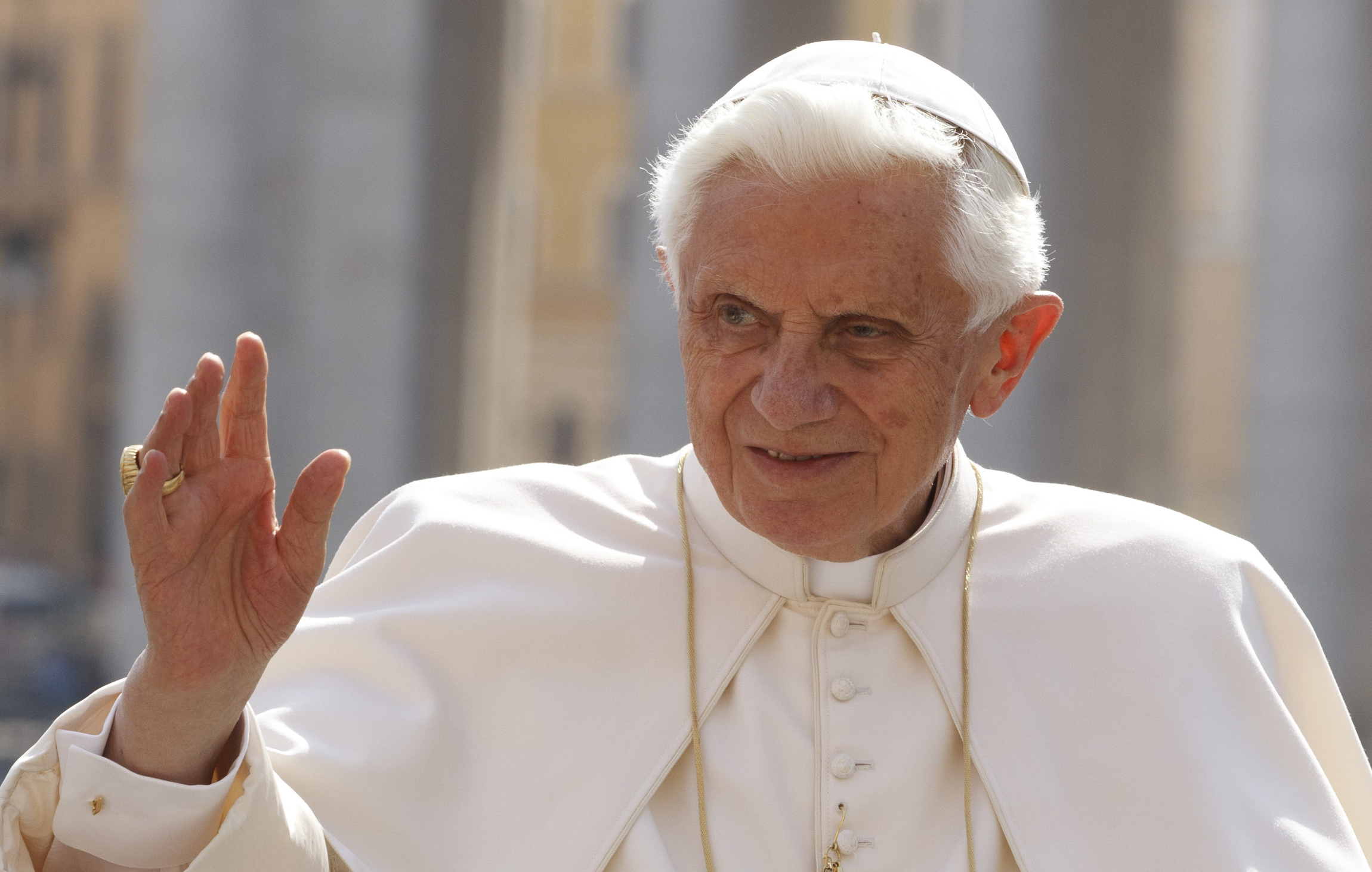
 So, what is the connection? How can the diaconate be understood against that much larger and violent backdrop? The most important question of all is perhaps, why do we have deacons in the first place?
 In our time, as I’ve written about extensively, the Second Vatican Council decided overwhelmingly that the diaconate should be renewed as a permanent ministry in the church once again, even to the extent of opening ordination to married as well as celibate men. The bishops in Council did this largely because of the insights gleaned from the priest-survivors of Dachau Concentration Camp. Following the war, these survivors wrote of how the Church would have to adapt itself to better meet the needs of the contemporary world if the horrors of the first half of the 20th Century were to be avoided in the future. Deacons were seen as a critical component of that strategy of ecclesial renewal. Why? Because deacons were understood as being grounded in their communities in practical and substantial ways, while priests and bishops had gradually become perceived as being too distant and remote from the people they were there to serve.
 The diaconate today, fifty years after the Council, has matured greatly. Those who would talk intelligently about the diaconate need to keep that in mind. Over the past fifty years, formation standards have evolved to better equip deacons for our myriad responsibilities, for example. The diaconate has, at least in those dioceses which have had deacons for several generations, become part of the ecclesial imagination. In some dioceses we have brothers who are deacons, fathers-in-law and sons-in-law who are deacons, fathers and sons who are deacons. In one archdiocese, an auxiliary bishop is the son of that archdiocese’s long-time director of the diaconate. As I mentioned above, the diaconate looks and feels different from one diocese to another and while it is tempting to generalize whenever possible, it is particularly dangerous.
 Here is my point: If we deacons were restored in response to Dachau and similar world shattering violence, translate “Dachau” to Baton Rouge. “Dachau” to Nice. “Dachau” to “Black Lives Matter”. “Dachau” to 9/11. “Dachau” to every act of senseless terror and random violence. What are we doing to confront these tragedies? What are we doing to work toward a world in which THEY can no longer exist? This is so much more than who gets to exercise “governance” (a technical canonical term) in the Church, or who gets to proclaim the Gospel in the midst of the community of disciples.
  The “O Antiphons” are titles to be associated with the Messiah, the Anointed One; on 18 December, the Messiah is linked to the Lord of Israel who saved Israel. The connection continues through the allusion to Moses, called to lead the people to freedom in God’s name, and to whom God would give the Torah on Sinai. Although in English we tend to interpret “law” in a sense of “rules”, that is not the way it is understood in Hebrew and the Jewish tradition. Torah refers to instruction or teaching. In the covenant relationship with God, these instructions describe the practical nature of how the covenant is to be lived.
 God’s part of the covenant is to rescue us. When Pope Francis promulgated Misericordiae Vultus announcing the Extraordinary Year of Mercy, he chose to evoke this scene of the all-powerful God with Moses: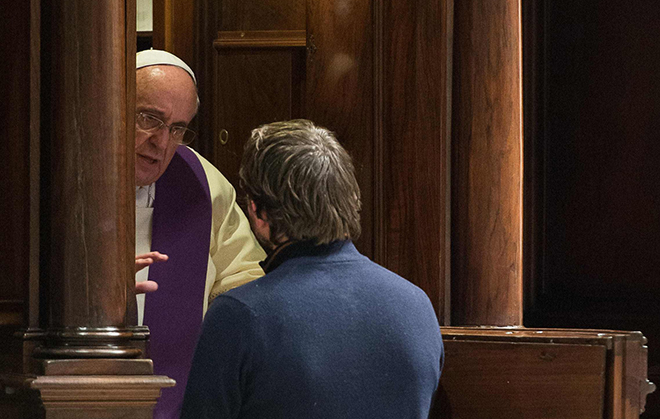
 The Church, the pope reminds his readers, is always open because God is always open to all. “The Church is called to be the house of the Father, with doors always wide open” (#47). In addressing the pastoral consequences of this radical openness, the pope tackles a current issue head on:
 The Extraordinary Jubilee of Mercy, proclaimed by Pope Francis today in Rome, actually began fifty years ago with the solemn closing of the Second Vatican Council on 8 December 1965. When dealing with the Catholic Church it is always good to step back and take a long view on what is going on, and today’s events in Rome are no exception. Let’s connect some dots.
 The Church’s teaching about Mary was originally crafted as a separate document by the curia before the Council began. However, the world’s bishops rejected this arrangement, rightly including Mary at the heart and climax of its dogmatic Constitution on the Church, Lumen gentium. Mary, our sister and our mother, the first disciple of the Christ, is held up to all as the model of Christian discipleship. Fifty years ago, therefore, standing on the same spot where Pope Francis stood earlier this morning, Pope Paul VI ended his homily with the following observation:
 Another point we must stress is this: all this rich teaching is channeled in one direction, the service of mankind, of every condition, in every weakness and need. The Church has, so to say, declared herself the servant of humanity, at the very time when her teaching role and her pastoral government have, by reason of the council’s solemnity, assumed greater splendor and vigor: the idea of service has been central.
 Finally, at the end of the Mass closing the Council, a remarkable thing happened. Most people today are unaware that it even took place, and that is a real tragedy, for it sheds a light on the whole proceedings, and points the way to our contemporary Jubilee. A series of messages from the Council Fathers was read to the world. The bishops of the Council prepared these messages because they wanted the world to realize that the Council had not been simply an exercise of ecclesiastical navel-gazing; rather, the work of the Council was focused outward, to the very real needs of the people and the world. In the introduction to the messages, the bishops write:
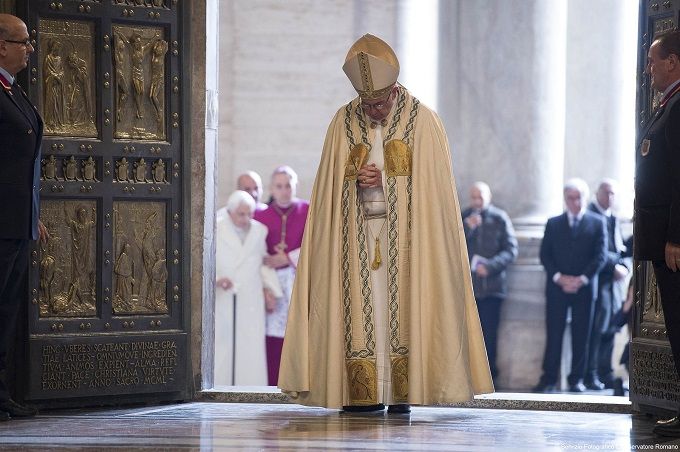 Today, here in Rome and in all the dioceses of the world, as we pass through the Holy Door, we also want to remember another door, which fifty years ago the Fathers of the Second Vatican Council opened to the world. This anniversary cannot be remembered only for the legacy of the Council’s documents, which testify to a great advance in faith. Before all else the Council was an encounter. A genuine encounter between the Church and the men and women of our time. An encounter marked by the power of the Spirit, who impelled the Church to emerge from the shoals which for years had kept her self-enclosed so as to set out once again, with enthusiasm, on her missionary journey. . . Wherever there are people, the Church is called to reach out to them and to bring the joy of the Gospel, ,and the mercy and forgiveness of God. After these decades, we again take up this missionary drive with the same power and enthusiasm. The Jubilee challenges us to this openness, and demands that we not neglect the spirit which emerged from Vatican II, the spirit of the Samaritan, as Blessed Paul VI expressed it at the conclusion of the Council. May our passing through the Holy Door today commit us to making our own the mercy of the Good Samaritan.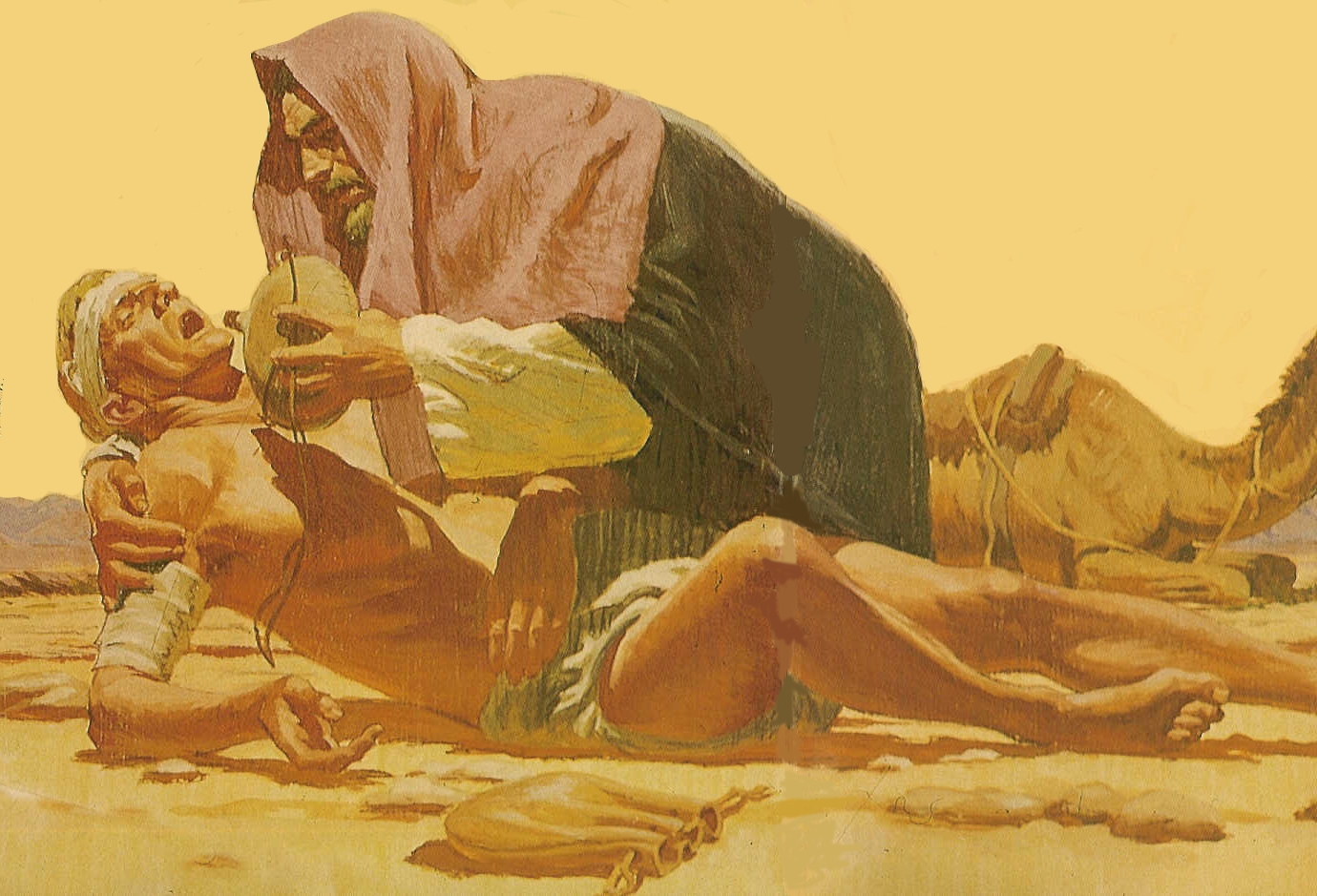
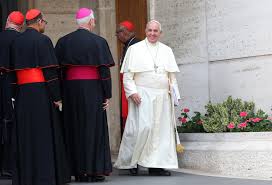
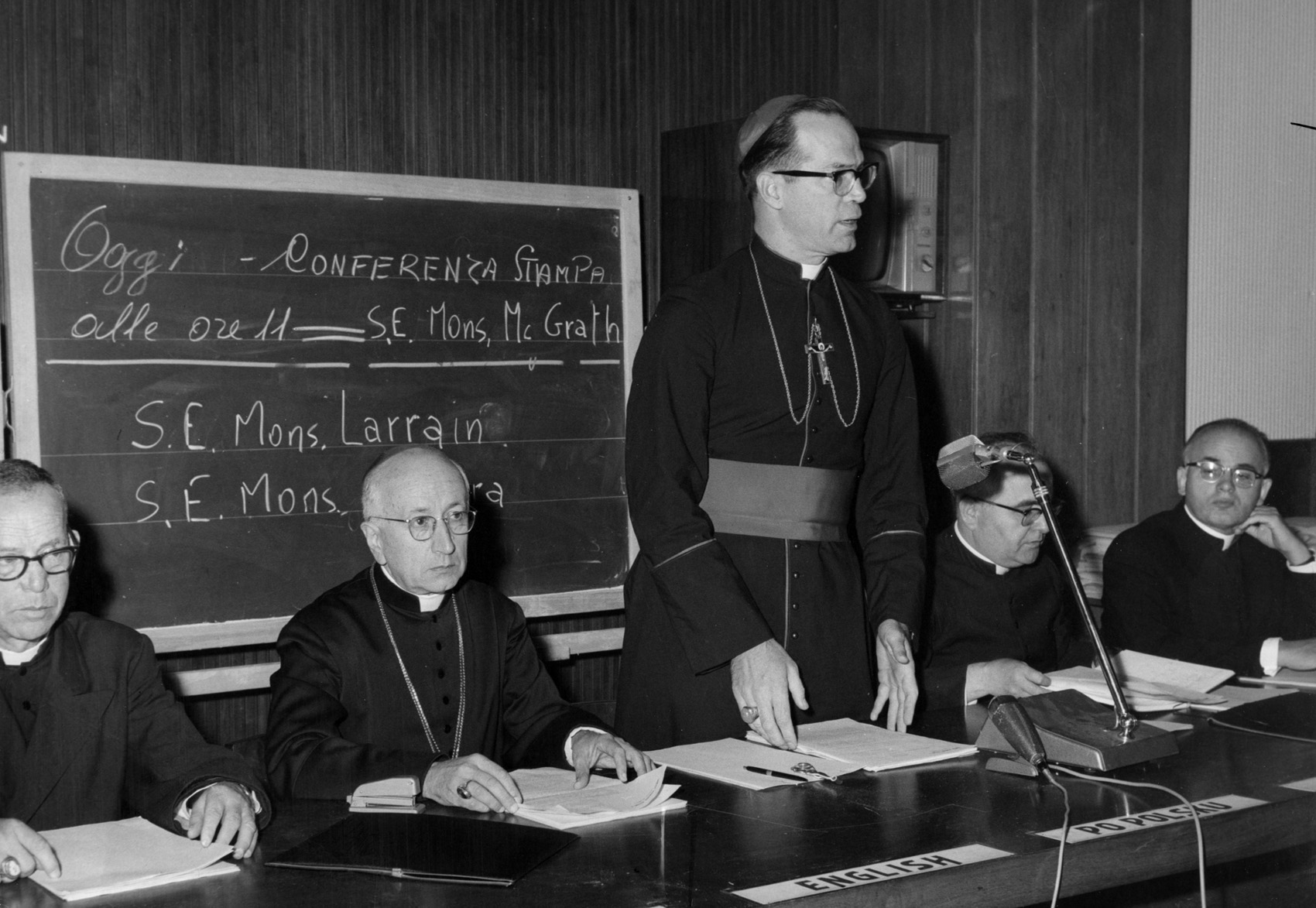


 Deacons Today: Servants in a Servant Church