 INTRODUCTION
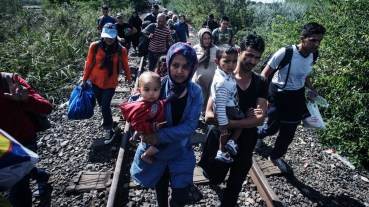
Few topics have so occupied the fears and attention of so many in recent months than the issue of immigration. I almost wrote “in the United States” but caught myself in time: this is a global phenomenon, which some observers state is at its worst since 1945 and the end of the Second World War. The United Nations Refugee Agency reports that there are 21.3 million refugees in the world, of which 10 million are reported as “stateless”; only 107,100 were resettled in 2015. Almost 34,000 people PER DAY are forced to leave their homes, and of those 21.3 million refugees, more than half are under the age of 18. Check out some additional statistics here.
Yesterday, Pope Francis addressed the International Forum on “Migration and Peace.” You can — and should! — read the whole text here. Immigration has been a constant concern for this Holy Father since his election (all you have to do is Google “Pope Francis and Immigration” to see his many statements on the subject), but it is also a concern he’s shared with his predecessors and, indeed, the papal magisterium is reflecting longstanding principles of Catholic social teaching. In short, the pope’s concerns are  nothing new, although he has been particularly passionate in reminding the world of the moral principles involved.
In my last blog post, I repeated the teaching of the Second Vatican Council that we are supposed to be “a leaven and kind of soul” for society. This means that we are immersed in the messy dough of human existence, helping each other find God in the rising. In this post, I want to summarize and review the pope’s most recent teaching with a view toward how we might implement its provisions in our own concrete circumstances, our own doughy mess.
I should also point out that the pope has repeatedly re-affirmed the right, duty and obligation that countries have to protect their citizens. Nothing he promotes would ever deny that, although some commentators have suggested this. However, as we will see, legitimate measures to protect society at large must still take into account the moral obligations we have to all people and not simply our own citizens.
Finally, we realize that whenever any pope teaches on a volatile subject, such as immigration, reactions range from enthusiastic support to enthusiastic disagreement. This instance is no different, which critics opining that the pope has no business talking about these things. On the contrary, the pope has every obligation to address matters of faith and morals, perhaps most especially because people need to hear it even when they don’t want to, or when it makes them feel uncomfortable. Just as parents must speak truth to their children even when the children don’t like it, so too religious leaders (not only the pope!) must be prophetic even when unpopular.
 THE ADDRESS OF POPE FRANCIS
The outline of the pope’s address yesterday is a powerful statement in itself. With seven major points, the pope offers an outline for pastoral action. The pope observes:
Migration, in its various forms, is not a new phenomenon in humanity’s history. It has left its mark on every age, encouraging encounter between peoples and the birth of new civilizations. In its essence, to migrate is the expression of that inherent desire for the happiness proper to every human being, a happiness that is to be sought and pursued. For us Christians, all human life is an itinerant journey towards our heavenly homeland. . . . Contemporary movements of migration represent the largest movement of individuals, if not of peoples, in history.”
Francis therefore speaks of an “urgency for a coordinated and effective response to these challenges,” a response marked by four verbs: to welcome, to protect, to promote and integrate. After he discusses each them, he continues that we need to “conjugate these four verbs in the first person singular [‘I welcome, I protect, I promote, I integrate’] and in the first person plural [‘We welcome, we protect, we promote, we integrate’]. In this way we discover our own responsibility, our own duty, “a duty we have towards our brothers and sisters who, for various reasons, have been forced to leave their homeland: a duty of justice, of civility and of solidarity.”
Let’s take a closer look at each of these four responses with their related duties.
 To Welcome
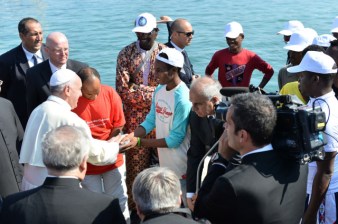
Francis pulls no punches, speaking of a rejection of others that is “rooted ultimately in self-centeredness and amplified by populist rhetoric.” What is needed, he says, is a change of attitude which overcomes indifference and counters fears. A changed attitude will be generous in welcoming those “who knock at our doors.”
For those who flee conflicts and terrible persecutions, often trapped within the grip of criminal organisations who have no scruples, we need to open accessible and secure humanitarian channels. A responsible and dignified welcome of our brothers and sisters begins by offering them decent and appropriate shelter. The enormous gathering together of persons seeking asylum and of refugees has not produced positive results. Instead these gatherings have created new situations of vulnerability and hardship. More widespread programs of welcome, already initiated in different places, seem to favor a personal encounter and allow for greater quality of service and increased guarantees of success.
In the first person singular, then, how am I welcoming the stranger? Not in some general, theoretical and antiseptic way, but in a concrete, leaven-in-the-dough way. In the first person plural, how do we join together in groups, parishes, and communities (and not simply in governmental ways) to initiate, support and sustain “more widespread programs of welcome”?
To Protect
Pope Francis cites his predecessor, Pope Benedict, who stressed that migration makes people “more vulnerable to exploitation, abuse and violence.” Pope Francis builds on this teaching by referring to our need to protect the dispossessed:
Defending their inalienable rights, ensuring their fundamental freedoms and respecting their dignity are duties from which no one can be exempted. Protecting these brothers and sisters is a moral imperative which translates into
— adopting juridical instruments, both international and national, that must be clear and relevant;
— implementing just and far reaching political choices;
— prioritizing constructive processes, which perhaps are slower, over immediate results of consensus;
— implementing timely and humane programs in the fight against “the trafficking of human flesh” which profits off others’ misfortune;
— coordinating the efforts of all actors, among which, you may be assured will always be the Church.
Turning again to my/our personal responsibility: in what specific ways can I help in any or all of these areas of protection? Perhaps I can’t do much alone, but I can at least join my efforts with those of others. And, if there is nothing in our community, perhaps I can initiate something.
 To Promote
To welcome and to protect is not sufficient, according to Pope Francis, who turns to the Compendium of the Social Doctrine of the Church, which describes human development as “an undeniable right of every human being.” This is not a right granted by a government or an agency, but by God.
As such, it must be guaranteed by ensuring the necessary conditions for its exercise, both in the individual and social context, providing fair access to fundamental goods for all people and offering the possibility of choice and growth. Also here a coordinated effort is needed, one which envisages all the parties involved: from the political community to civil society, from international organizations to religious institutions. . . . Efforts must be encouraged that lead to the implementation of programs of international cooperation, free from partisan interests, and programs of transnational development which involve migrants as active protagonists.
The Holy Father stresses that such rights ought first to be guaranteed in a person’s place of origin, but if they are not, people must be free it emigrate to places where they will find this opportunity. How do I work now to guarantee to rights of all persons who are here, both citizens and non-citizens alike, but all human persons created in the image and likeness of God, and all endowed with the same human rights? What could I be doing that I’m not? What could we do together, perhaps as a parish community, to contribute to this effort?
 To Integrate
The pope teaches that integration is a two-way process “rooted essentially in the joint recognition of the other’s cultural richness: it is not the superimposing of one culture over another, nor mutual isolation, with the insidious and dangerous risk of creating ghettoes.” Those who come to a new country must be open to the culture of the new country, “respecting above all its laws.”
Citing Pope John Paul II, Pope Francis highlights the responsibility toward the family in the process of integration, citing John Paul’s message that policies must be developed that “favor and benefit the reunion of families.” In addition, again citing John Paul II, proper integration “requires specific programs which foster significant encounters with others. Furthermore: for Christians:
The peaceful integration of persons of various cultures is, in some way, a reflection of its catholicity, since unity, which does not nullify ethnic and cultural diversity, constitutes a part of the life of the Church, who in the Spirit of Pentecost is open to all and desires to embrace all.
Perhaps these last two areas are the more challenging of the four in practical application. So often, our policies regarding displaced persons involve screening and “vetting” and are less concerned (if at all) in how we might “promote and integrate” our sisters and brothers. In what concrete ways can I serve to help with this integration? Perhaps I can help with the process of reuniting families; perhaps our parish might sponsor families who have been apart, and help bring them together again.
Here is where Pope Francis challenges us all further, speaking of three duties or obligations related to welcoming, protecting, promoting, and integrating. These are the duty of JUSTICE, the duty of CIVILITY, and the duty of SOLIDARITY.
- Justice
The pope points out:
We can no longer sustain unacceptable economic inequality. . . .We are all called to undertake processes of apportionment which are respectful, responsible and inspired by the precepts of distributive justice. . . . One group of individuals cannot control half of the world’s resources. We cannot allow for persons and entire peoples to have a right only to gather the remaining crumbs.
Justice demands that we see with God’s eyes: how does God see his children who are homeless and searching? We can do no less. How would we feel if we found our own children abandoned, abused, homeless and hungry? Suddenly those verbs of welcome, protection, promotion and integration become very personal. They are just as “personal” for God!
Furthermore, popes Francis and Benedict teach that justice challenges us to break down stereotypes:
Ensuring justice means also reconciling history with our present globalized situation, without perpetuating mind-sets which exploit people and places, a consequence of the most cynical use of the market in order to increase the well-being of the few. As Pope Benedict affirmed, the process of decolonization was delayed “both because of new forms of colonialism and continued dependence on old and new foreign powers, and because of grave irresponsibility within the very countries that have achieved independence.”
2. Civility
Civility means so much more than simply being “polite”! Francis again cites St. John Paul II: “an irregular legal status cannot allow the migrant to lose his dignity, since he is endowed with inalienable rights, which can neither be violated nor ignored.” Civility helps us to appreciate the value of the very relational nature of the human person in which every person is “a true sister and brother; without fraternity it is impossible to build a just society and a solid and lasting peace.”
 3. Solidarity
Evoking the book of Genesis, the pope reminds us of God’s question of Cain: “Where is your brother?” We are one with our sisters and brothers, and what affects her or him, affects me.
Solidarity is born precisely from the capacity to understand the needs of our brothers and sisters who are in difficulty and to take responsibility for these needs. Upon this, in short, is based the sacred value of hospitality, present in religious traditions. For us Christians, hospitality offered to the weary traveler is offered to Jesus Christ himself, through the newcomer: “I was a stranger and you welcomed me” (Mt 25:35).
Finally, in language easily recognizable in our contemporary Western culture, the teaches:
The duty of solidarity is to counter the throwaway culture and give greater attention to those who are weakest, poorest and most vulnerable. Thus “a change of attitude towards migrants and refugees is needed on the part of everyone, moving away from attitudes of defensiveness and fear, indifference and marginalization – all typical of a throwaway culture – towards attitudes based on a culture of encounter, the only culture capable of building a better, more just and fraternal world” (Message for the World Day of Migrants and Refugees, 5 August 2013).
CONCLUSION
So, I suggest we prayerfully consider what the pope has to say as we Americans confront the challenges of immigration policies under the current administration. In particular, how can each and every one of us — individually and communally — tale on the responsibility to welcome, to protect, to promote, and to integrate? How well can we respond to these initiatives from a sense of justice, civility, and solidarity?
Here’s the dough: let’s get our hands messy.

 Jesuit Father Thomas Reese has published an interesting piece over at NCRonline entitled
 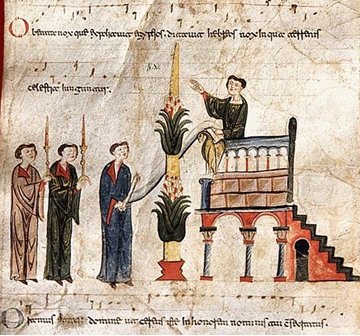 Father states that “[Women deacons] disappeared in the West around the same time as male deacons.” On the contrary, male deacons remained a distinct order of ministry (and one not automatically destined for the presbyterate) until at least the 9th Century in the West. This is attested to by a variety of sources. Certainly, throughout these centuries, many deacons — the prime assistants to bishops — were elected to succeed their bishops. Later in this period, as the Roman cursus honorum took hold more definitively, deacons were often ordained to the presbyterate, leading to what is incorrectly referred to as the “transitional” diaconate. However, both in a “permanent” sense and a “transitional” sense, male deacons never disappeared.
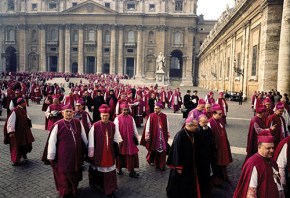 Father Tom writes that his hesitancy concerning the diaconate itself “is not with women deacons, but with the whole idea of deacons as currently practiced in the United States.” (I would suggest that this narrow focus misses the richness of the diaconate worldwide.) He then turns to the Council to provide a foundation for what follows. He writes, “The renewal of the diaconate was proposed at the Second Vatican Council as a solution to the shortage of native priests in missionary territories. In fact, the bishops of Africa said, no thank you. They preferred to use lay catechists rather than deacons.” This statement simply is not true and does not reflect the history leading up to the Council or the discussions that took place during the Council on the question of the diaconate.
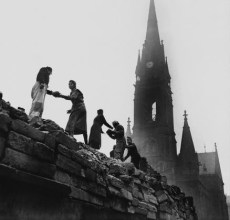 As I and others have written extensively, the origins of the contemporary diaconate lie in the early 19th Century, especially in Germany and France. In fact there is considerable linkage between the early liturgical movement (such as the Benedictine liturgical reforms at Solesmes) and the early discussions about a renewed diaconate: both stemmed from a desire to increase participation of the faithful in the life of the Church, both at liturgy and in life. In Germany, frequent allusion was made to the gulf that existed between priests and bishops and their people. Deacons were discussed as early as 1840 as a possible way to reconnect people with their pastoral leadership. This discussion continued throughout the 19th Century and into the 20th. It became a common topic of the Deutschercaritasberband (the German Caritas organization) before and during the early years of the Nazi regime, and it would recur in the conversations held by priest-prisoners in Dachau. Following the war, these survivors wrote articles and books on the need for a renewed diaconate — NOT because of a priest shortage, but because of a desire to present a more complete image of Christ to the world: not only Christ the High Priest, but the kenotic Christ the Servant as well. As Father Joseph Komonchak famously quipped, “Vatican II did not restore the diaconate because of a shortage of priests but because of a shortage of deacons.”
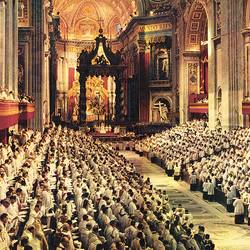 Certainly, there was some modest interest in this question by missionary bishops before the Council. But it remained largely a European proposal. Consider some statistics. During the antepreparatory stage leading up to the Council (1960-1961), during which time close to 9,000 proposals were presented from the world’s bishops, deans of schools of theology, and heads of men’s religious congregations, 101 proposals concerned the possible renewal of the diaconate. Eleven of these proposals were against the idea of having the diaconate (either as a transitional or as a permanent order), while 90 were in favor of a renewed, stable (“permanent”) diaconate. Nearly 500 bishops from around the world supported some form of these 90 proposals, with only about 100 of them from Latin America and Africa. Nearly 400 bishops, almost entirely from both Western and Eastern Europe, were the principal proponents of a renewed diaconate (by the way, the bishops of the United States, who had not had the benefit of the century-long conversation about the diaconate, were largely silent on the matter, and the handful who spoke were generally against the idea). Notice how these statistics relate to Father Tom’s observation. First, the renewed diaconate was largely a European proposal, not surprising given the history I’ve outlined above. Second, notice that despite this fact, it is also wrong to say that “the African bishops said no thank you” to the idea. Large numbers of them wanted a renewed diaconate, and even today, the diaconate has been renewed in a growing number of African dioceses.
 Let’s break this down. First, there never has been, nor will there ever be, a “part-time deacon.” We’re all full-time ministers. Here’s the problem: Because the Catholic Church did not have the advantage of the extensive conversation on diaconate that was held in other parts of the world, we have not fully accepted the notion that ministry extends BEYOND the boundaries of the institutional church itself. Some of the rationale behind the renewal of the diaconate in the 19th Century and forward has been to place the Church’s sacred ministers in places where the clergy had previously not been able to go! Consider the “worker-priest” movement in France. This was based on a similar desire to extend the reach of the Church’s official ministry outside of the parish and outside of the sanctuary. However, if we can only envision “ministry” as something that takes place within the sanctuary or within the parish, then we miss a huge point of the reforms of the Second Vatican Council and, I would suggest, the papal magisterium of Pope Francis. The point of the diaconate is to extend the reach of the bishop into places the bishop can’t normally be present. That means that no matter what the deacon is doing, no matter where the deacon is working or serving, the deacon is ministering to those around him.
 Not unlike the previous point, this is a common misperception. However, it is only made if one reduces “being a deacon” to the functions one performs. Let’s ponder that a moment. We live in a sacramental Church. This means that there’s more to things than outward appearances. Consider the sacrament of matrimony. Those of us who are married know that there is much, much more to “being married” than simply the sum of the functions associated with marriage. Those who are priests or bishops know that there is more to who they are as priests and bishops than simply the sum of what they do. So, why can’t they see that about deacons? There is more to “being deacon” than simply the sum of what we do. And, frankly, do we want priests to stop visiting the sick in hospitals or the incarcerated in prisons simply because a lay person can (and should!) be doing that? Shall we have Father stop being a college professor because now we have lay people who can do that? Shall we simply reduce Father to the sacraments over which he presides? What a sacramentally arid Church we would become!
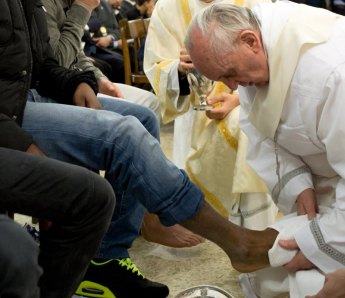 With all respect to a man I deeply admire, I expect that most deacons who read this part of the column are still chuckling. Yes, I have been treated with great respect by most of the people with whom I’ve served, including laity, religious, priests and bishops. On the other hand, the experience of most deacons does not sustain Father’s observation. The fact is, most people, especially if they’re not used to the ministry of deacons, don’t associate deacons with ordination. I can’t tell the number of times that I’ve been asked by someone, “When will you be ordained?” — meaning ordination to the priesthood. They know I am a deacon, but, as some people will say, “but that one really doesn’t count, does it?” I had another priest once tell me, “Being a deacon isn’t a real vocation like the priesthood.” If it’s respect a person is after “beyond their competence” (to quote Father Reese), then it’s best to avoid the diaconate.
 Let me state from the outset that this essay is not pointed at any particular political party or candidate in the United States. I write it, not as a political scientist, but as a Catholic deacon who is trying to understand the current state of American political life; consider this a small reflection undertaken as part of my own formation of conscience.
 a paratrooper in the “Band of Brothers” who jumped into France on D-Day, and his letter to his brother following D-Day had a strong impact on all of us. (
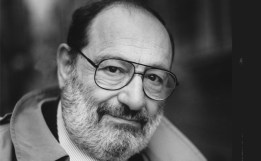 So it was interesting recently to come across a 1995 essay by Umberto Eco, the great Italian author (The Name of the Rose), scholar and philosopher, entitled “Ur-Fascism.” Written for the New York Review of Books (22 June 1995),
  Eco points out the first feature of Ur-Fascism is a cult — worship — of tradition. This of course does not deny the importance of tradition itself, as I read him. Rather it is a question of emphasis and loss of balance: when this emphasis on tradition is taken to an extreme that it becomes traditionalism, an extremist point of view. Traditionalism taken to this extreme is found in other times, cultures and systems beside Fascism, of course. In fascist hands, however, traditionalism becomes focused on past glories, past identities, past expressions of truth understood in radical opposition to various forms of rationalism and rationalistic thought. Eco points out that such a response is ancient, reflected in various schools of thought that reacted negatively to classical Greek rationalism. In fact, perhaps the best way to think of this traditionalism that Eco is talking about would be as a kind of Gnosticism. As a result of this worldview, there is no need for new learning, and it reflects an extreme anti-intellectual stance: “Truth has been already spelled out once and for all, and we can only keep interpreting its obscure message,” Eco writes. So, Ur-Fascism would contend mightily with those who suggest that there might be other points of view to consider: this would explain frequent criticism of “intellectual elites” and others who not only seek to uncover the Truth that has existed for all time, but who might also suggest that this Truth might be understood in various ways under differing circumstances. In short, the Fascist says, “We know the Truth, so don’t listen to the ‘intellectual elites’ who will only confuse you.”
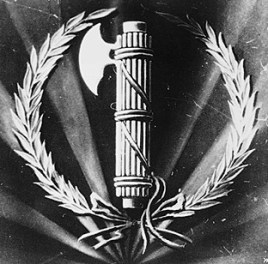 Such irrationalism is based on what Eco calls “the cult of action for action’s sake”. The fascist sees action as good in itself and therefore action is taken “before, or without” any prior reflection. In the fascist view, thinking is a form of emasculation.
 Yet again, Eco is succinct and on point:
 Certainly, sometimes people are out to get us! Terrorists have made that terribly, tragically, and repeatedly obvious. However, look what Eco points out:
 9.
9.  10.
10. 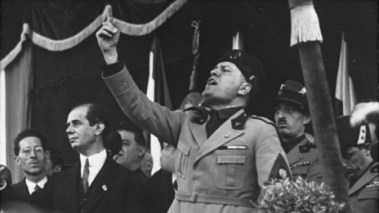 14.
14. 
 “Christmas — who cares?”
 “I just get so depressed at Christmas. I’ve lost the innocence of youth and there’s no connection to family any more — and this just makes it all worse.”
 In my Advent reflection yesterday on the Hebrew expression “Emmanuel” (God-with-us) I stressed the intimacy of this relationship with God. No matter how we may feel at any given moment, the God we have given our hearts to (which is actually the root meaning of “I believe”) is with us through it all — even when we can’t or don’t recognize it. Think of a child in her room playing. Does she realize that her father out in the kitchen is thinking about her, listening for sounds that may mean that she needs his help, pondering her future? Does she realize that her mother at work in her office is also thinking about her, loving her, and making plans for her future? The love of parents for children is constant and goes beyond simply those times when they are physically present to each other.
 The world into which Jesus was born was every bit as violent, abusive, and full of destructive intent as our own. And yet, consider what Christians have maintained from the beginning. God’s saving plan was not brought about through noble families, through the Jewish high priestly caste, or through the structures of the Roman empire. It wasn’t engaged in Greek or Roman philosophies or religions. Instead we find a young Jewish girl from an ordinary family, her slightly older betrothed (there is nothing in scripture that suggests that Joseph was an older man, so we might assume that he was in his late teens, not that much older than Mary), shepherds (who were largely considered outcasts in Jewish society), foreign astrologers avoiding the puppet Jewish king, and on and on. What’s more, the savior of the world sent by God doesn’t show up on a white charger at the head of mighty army, but as a baby.
 And so we return to Dietrich Bonhoeffer. This well-known German Lutheran theologian, pastor, and concentration camp martyr embodies the wedding of of the meaning of Christmas with the real world in which we live. He devoted his life to study, to writing, to opposing injustice — especially the Nazi regime in Germany, ultimately giving the ultimate witness to Christ. Christians like Bonhoeffer, whose best-known work is called The Cost of Discipleship, are not dreamy, wide-eyed innocents who do not connect with the world. In fact, their witness shows us just the opposite. The true Christian is one who — following Christ — engages the world in all of its joys, hopes, pains and suffering. It is with Bonhoeffer, then, that we enter into Christmas 2015, with his wonderful reflection: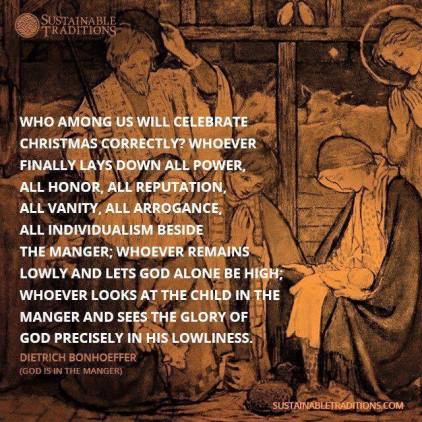



 Deacons Today: Servants in a Servant Church