 One thought has remained with me from the first reading of Pope Francis’ Amoris Laetitia: this is an ADULT document. It is written by a mature adult man who is comfortable in his own relationship with God and with other people, able to see things both as they are and as they could be. Through the lens of his own life’s experience he recognizes his own weaknesses and failures and owns his own need for God’s forgiveness and the help of others to get through any given day. This mature adult man has written a document that presumes his readership is similarly disposed. He writes directly, explicitly, and knowledgeably about the human condition, the role of the Church, and the relationship of the two. It is, in short, a text written by an adult for other adults. As Archbishop Blase Cupich of Chicago observed in his press conference on the release of Amoris Laetitia, Pope Francis is calling us all to “an adult spirituality.”
What does an “adult spirituality” look like? I ask this in connection with these short reflections on the formation of conscience, because I think it lies at the heart of the matter.
 First, I think an adult spirituality is balanced, reasonable and well-integrated. An adult point of view, it seems to me, is found when a person has learned — usually through hard experience — to steer a course between extremes. Consider one simple example. Some people seem naturally disposed to see everything through a negative lens: nothing can ever be done right, some people can just never say anything that is not immediately criticized, and no one can really be trusted. I suppose if one crept along this point of view to its extreme, one would arrive at the home of cynicism. On the other hand, some people are just as disposed to see everything in a positive light: they see the good in what others do and say, giving them the benefit of the doubt. Following this point of view to its extreme, one would arrive at the land of rose-colored glasses. However, the wisdom of maturity would generally find, along with Aristotle, the “golden mean”or, as the ancient Latin has it, “In medio stat virtus“: virtue stands in the middle. Applying this to Pope Francis and Amoris Laetitia: consider some of the online responses one finds everywhere: some people were determined to condemn it even before it was promulgated while others were similarly inclined to “canonize” it, also without reading it. A balanced, reasonable, and well-integrated adult would, of course, read the document and form conclusions both positive and negative. Amoris Laetitia is not Holy Writ; neither is it from Satan.
 Second, an adult spirituality is honest with one’s self and with others, especially about one’s own limitations. When confronting challenges, an adult comes to know that there are limits to his or her abilities: intellectual, affective, and physical. They come to accept that we all need assistance in a variety of ways. In recognizing their own limitations, the mature adult tends to be more understanding of the limitations of others. This is a key theme of Amoris Laetitia. All are weak in various ways and we acknowledge and work within that weakness; we do not demand that a person first become strong before we work with them. God’s grace and mercy is necessary for all and, as the Holy Father stresses, “true charity is always unmerited, unconditional and gratuitous.” (AL 296) A person does not have to “prove” or “earn” our mercy any more than we have deserved God’s mercy in our own lives. Mature adults understand that.
 Third, an adult spirituality acknowledges the contingencies of life. In the sections of Amoris Laetitia which address the specifics of marriage and family life, the Holy Father shows a remarkable understanding of how hard most people struggle with the uncertainties of life: holding a job that can support one’s family, dealing with fatigue and failure, the pressures of being a single parent and on and on. Most people come to understand that the vast majority of folks are simply trying to do the absolute best they can despite whatever challenges they face. Others may come to different decisions than we might, but there is a presumption based on experience that most people are trying to do their best. However, here we find some tension again between those who have a more positive perspective on human nature and those who are more negative, and would never presume that other people would do their best! Pope Francis recognizes this difference of perspective when he writes,
I understand those who prefer a more rigorous pastoral care which leaves no room for confusion. But I sincerely believe that Jesus wants a Church attentive to the goodness which the Holy Spirit sows in the midst of human weakness, a Mother who, while clearly expressing her objective teaching, “always does what good she can, even if in the process, her shoes get soiled by the mud of the street.”

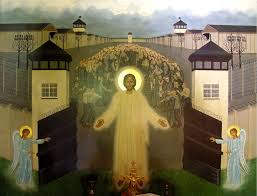
Christ at Dachau
Fourth, an adult spirituality finds God’s presence in all aspects of life. Experience teaches a person of faith that God is active and present even when a person feels alone, abandoned, or powerless. There is a sense of tranquility that comes to a person, even in the midst of suffering, which communicates God’s “accompaniment” (to use one of Pope Francis’ favorite expressions) on that journey. Just as God never abandons us, we are not to abandon others in their own need. The Holy Father spends considerable time in AL reminding us that not only should those who are divorced or in irregular unions are not to feel themselves cut off completely from the church, nor are we to adopt practices and attitudes which convey or support such a feeling of isolation and excommunication. Simply put, God never abandons us, and we cannot abandon others.
Fifth, an adult spirituality deals with the real, not the hypothetical. Hypothetical situations abound, but we generally have to deal with one situation at a time, resolve it as best we can, and move on to the next. While a certain amount of hypothesizing happens with all of us as we try to plan for the future, but in general, we take one very real circumstance on at a time. I keep thinking of St. John XXIII’s famous passage in his opening address to the Second Vatican Council when he proclaims to the thousands of assembled bishops:
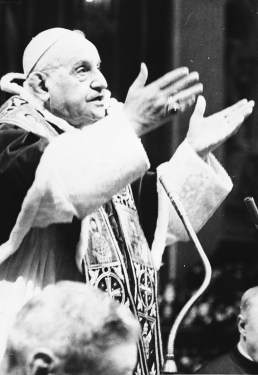
In the daily exercise of our pastoral office, we sometimes have to listen, much to our regret, to voices of persons who, though burning with zeal, are not endowed with too much sense of discretion or measure. In these modern times they can see nothing but prevarication and ruin. They say that our era, in comparison with past eras, is getting worse, and they behave as though they had learned nothing from history, which is, none the less, the teacher of life. They behave as though at the time of former Councils everything was a full triumph for the Christian idea and life and for proper religious liberty.
We feel we must disagree with those prophets of gloom, who are always forecasting disaster, as though the end of the world were at hand. In the present order of things, Divine Providence is leading us to a new order of human relations which, by men’s own efforts and even beyond their very expectations, are directed toward the fulfillment of God’s superior and inscrutable designs. And everything, even human differences, leads to the greater good of the Church.
In much of the criticism of Pope Francis and this Exhortation, one detects the same voice of the “prophets of gloom” which St. John XXIII mentions. I think Pope Francis would agree wholeheartedly with his sainted predecessor that it is still God who is in charge and still “leading us to a new order of human relations” which goes far beyond our poor human attempt to understand fully. Like those earlier critics of the Council, much hand wringing is taking place about “what ifs”: “What if” a pastor just looks for a loophole to let divorced and remarried people back to Communion? “What if” a person doesn’t form their conscience as rigorously as they should? “What if” people abuse this teaching and simply ignore the longstanding teaching of the church? “What if,” indeed. Realistically, will such things happen? Of course they will, and no mature adult would deny that possibility. On the other hand, shouldn’t we adopt a position that we will deal with those situations as they occur, if they occur, and when they occur? In the meantime, as John did with the Council, let’s move forward. “Siempre Adelante!” as Pope Francis challenged us during his homily in Washington, DC.
So, in forming our consciences, we do so as mature adults, striving as best we can and with the help of the Holy Spirit, to discern God’s will for our lives.

 The core of the Church’s teaching on conscience is found in Vatican II’s Gaudium et spes (GS), 16:
 One thing many observers forget, however, is that we are bound to follow our conscience, even if that means we are responsible for errors we make! GS 16 continues:
 We have long thought that simply by stressing doctrinal, bioethical and moral issues, without encouraging openness to grace, we were providing sufficient support to families, strengthening the marriage bond and giving meaning to marital life. . . . We also find it hard to make room for the consciences of the faithful, who very often respond as best they can to the Gospel amid their limitations, and are capable of carrying out their own discernment in complex situations.
  The weekend after AL was presented to the world, a friend presented me just that scenario. “What would happen if a divorced and remarried couple, who had refrained from receiving communion for many years, began receiving communion again? That would be a terrible scandal, and the pope says we are to avoid scandal!” What if John and Jane Doe’s story included the fact that they had gone to the pastor and, under his guidance, pastoral judgment and advice, in consideration of many factors known only to the two individuals involved, both John and Jane decide in conscience that each should return to the reception of Holy Communion? This process of conscience formation, which as the pope reminds us, is not done with a view to sidestepping the law. However, it is done with due consideration of unique aspects of their own past experiences and current responsibilities for their children and so on. And, they each reach a decision point in conscience. And, “according to it [each of them] will be judged. The conscience is a person’s most secret core and sanctuary, in which the person is alone with God, whose voice echoes in his depths.”
 The headlines surrounding a recently-released study scream: “Increasing number of Americans consider Christianity ‘to be extremist'” followed by the quote: “The perception that the Christian faith is extreme,” says Barna Group, “is now firmly entrenched among the nation’s non-Christians.” [
 On the negative side, however, since 1054, some of these Eastern churches (not all of them) broke with Rome and became what is referred to now as the Orthodox Churches. While theology formed a part of the rationale between the split (consider the filioque debate, for example), the larger issues revolved around the authority of the See of Rome. Only over the last 100 years or so have we seen some real progress in restoring full communion. Then, of course, in the 16th Century we find Latin Christianity fracturing even more through the theological and ecclesial reforms demanded by Martin Luther, John Calvin and others. Within the framework of evolving philosophical, theological, political and social trends, these disagreements quickly moved out of the university setting and into the streets, creating the chasms between Christians we still experience today, despite Christ’s prayer at the Last Supper, “that they all may be one, Father, as you and I are one.”
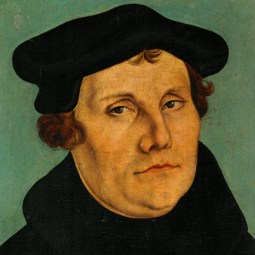
 Consider a basic world view. How do Christians view the world? Some groups of Christians have a very positive view of God’s creation, frequently citing the words of Genesis in which God proclaims creation to be “good.” Creation is, therefore, in this view, good by nature — with evil entering into the picture only later through the deliberate, free will choices of human beings. Other groups of Christians have an opposite view of the world, seeing creation as inherently flawed. Martin Luther, for example, frequently wrote things such as, “our righteousness is dung in the sight of God. Now if God chooses to adorn dung, he can do so.”
 Consider how inclusivist (“catholic”) or exclusivist various Christian groups can be. One of my own saddest experiences in this regard occurred some years ago when I was still on active duty in the Navy. A good friend was part of the Protestant chapel community on our base. He was participating in the annual Holy Thursday reenactment of the Last Supper, put on by the Protestant chaplains. I went over to help get the apostles into their beards and costumes and stuck around to watch it. Shortly before leaving to go to the Catholic chapel for the Mass of the Lord’s Supper, I watched the beginning of the communion service following the reenactment. The senior Protestant chaplain stood and give directions to the assembly on how to come forward for communion. Ministers of particular denominations would be on other side, and adherents of those denominations were to go to “their own” minister; a “general communion” was being offered down the main central aisle of the chapel, and those who were not in the other two churches could receive in the “general” line. Naturally, of course, it struck me that I was about to head over to our own Mass, during which only Catholics could receive Communion. It left me quite saddened to see — at the moment when you would think Christians could be MOST united — we were the most divided.
 So, today, we have Orthodox Christians, Catholic Christians, Evangelical Christians, Pentecostal Christians, Non-Denominational Christians, along with other forms of Baptists, Lutherans, Reformed, and on and on and on. Because of many reasons, such as the “world view” distinctions mentioned above, some of these Christians look for everything to be black and white, clearly distinguished. Sin, for example, is sin. Something is either sinful or it is not. There is no gradation in sinfulness: telling a lie (regardless of situation or intent) is as grave as murder. In this view, you are either with me totally and completely or you are against me totally and completely. Other Christians seem to say that anything goes if it’s what you want. You determine everything yourself about what you will choose to believe and so on. Then there are Christians in the middle, who marry philosophy and theology, reason and faith. Given this diversity then, we come to the question raised by the article: Are Christians extremists?
 That raises the need to define the other term of the argument: How do we define “extremist”? In the list of statements included in the study, I found myself agreeing that some of them certainly reflected “extremism” as I understand it, while others do not. However, ALL them made me think and to reflect, and that is always a good thing.
 “Christmas — who cares?”
 “I just get so depressed at Christmas. I’ve lost the innocence of youth and there’s no connection to family any more — and this just makes it all worse.”
 In my Advent reflection yesterday on the Hebrew expression “Emmanuel” (God-with-us) I stressed the intimacy of this relationship with God. No matter how we may feel at any given moment, the God we have given our hearts to (which is actually the root meaning of “I believe”) is with us through it all — even when we can’t or don’t recognize it. Think of a child in her room playing. Does she realize that her father out in the kitchen is thinking about her, listening for sounds that may mean that she needs his help, pondering her future? Does she realize that her mother at work in her office is also thinking about her, loving her, and making plans for her future? The love of parents for children is constant and goes beyond simply those times when they are physically present to each other.
 The world into which Jesus was born was every bit as violent, abusive, and full of destructive intent as our own. And yet, consider what Christians have maintained from the beginning. God’s saving plan was not brought about through noble families, through the Jewish high priestly caste, or through the structures of the Roman empire. It wasn’t engaged in Greek or Roman philosophies or religions. Instead we find a young Jewish girl from an ordinary family, her slightly older betrothed (there is nothing in scripture that suggests that Joseph was an older man, so we might assume that he was in his late teens, not that much older than Mary), shepherds (who were largely considered outcasts in Jewish society), foreign astrologers avoiding the puppet Jewish king, and on and on. What’s more, the savior of the world sent by God doesn’t show up on a white charger at the head of mighty army, but as a baby.
 And so we return to Dietrich Bonhoeffer. This well-known German Lutheran theologian, pastor, and concentration camp martyr embodies the wedding of of the meaning of Christmas with the real world in which we live. He devoted his life to study, to writing, to opposing injustice — especially the Nazi regime in Germany, ultimately giving the ultimate witness to Christ. Christians like Bonhoeffer, whose best-known work is called The Cost of Discipleship, are not dreamy, wide-eyed innocents who do not connect with the world. In fact, their witness shows us just the opposite. The true Christian is one who — following Christ — engages the world in all of its joys, hopes, pains and suffering. It is with Bonhoeffer, then, that we enter into Christmas 2015, with his wonderful reflection: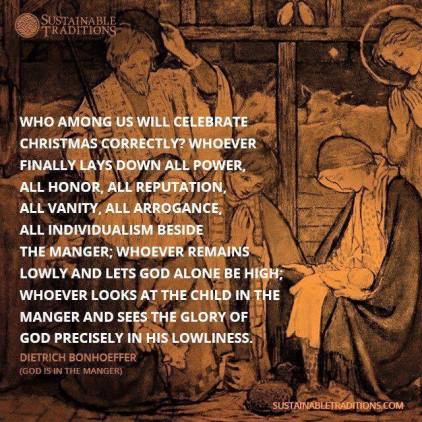
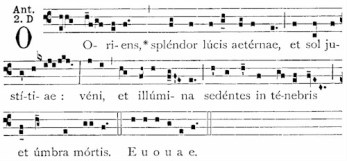 O Morning Star,

 The “O Antiphon” for 19 December begins “O Radix Jesse.” While some translations use the word, “flower” for the Latin “radix,” I prefer the more literal “root” because it signals clearly the Mystery being invoked in this prayer. The point of this ancient antiphon is to identify the coming Messiah as the very root and foundation of creation and covenant. Our connection to Christ and to the world is not a superficial grafting onto a minor branch of the family tree, but to the very root itself. We are grounded, connected and vitally linked to Christ.
 As ministers of the Church’s charity, justice and mercy, we deacons (this is, after all, a blog focused on the diaconate!) must lead in our concern for those who find themselves cut off from society and church and perhaps even cut off from that very Root of Jesse. Pope Francis, in Evangelium Gaudium condemns anything which contributes to such isolation of human beings. Even concerning economies, for example, he condemns any “economy of exclusion and inequality. How can it be that it is not a news item when as elderly homeless person dies of exposure, but it is news when the stock mart loses two points? This is a case of exclusion. Can we continue to stand by when food is thrwon away while people are starving? This is a case of inequality” (#53). We are to be a people of INCLUSION AND EQUALITY, not exclusion and inequality.
 The pope’s message is quite clear and, when considered as part of our Advent reflection on “O Root of Jesse”, particularly on point. As Christians we thrive when we are grafted to the Messiah, the source of life. Our mission of mercy is to serve to graft others to the Messiah as well. Our faith is not merely expressed in a text — no matter how vital those texts are in themselves — but in the concrete encounter of one person with another. The pope even dares to use an expression often mocked by certain Catholics, the “spirit which emerged from Vatican II” and equates that spirit with the spirit that drove the Samaritan, the Samaritan who is our model for the mercy of God.
 Today in Rome the Vatican’s Commission for Religious Relations with Jews released a new document exploring unresolved theological questions at the heart of Christian-Jewish dialogue. According to Vatican Radio,
 It has been a distinct privilege for me over the years to serve as a Hebrew linguist in a variety of contexts, and five years ago I was asked by the Center for Catholic-Jewish Studies to give a very brief reflection on “The Significance of Nostra Aetate” on the occasion of the 45th anniversary of its promulgation by the Second Vatican Council. So what I am about to write should not be read in any way as a criticism of the great efforts that have been made over the past fifty years to celebrate the relationship of Jews and Catholics! And, as the new document released today underscores, so much more remains to be done in this regard, and I fully embrace that effort.
 Let’s take a closer look at the document itself. Much has been written about the genesis of the document, so there is no need to rehearse all of that here. Suffice it to say that Nostra Aetate, in the final analysis, is not the work of one person, as influential as so many individuals were in its inception and development: John XXIII himself, Jules Isaac, Augustin Bea, to name just a few.
 The reason that Pope John called the Council in the first place was so that all the bishops from around the world could together tackle the very real life and death issues that were affecting all people, not just Catholics. This was not some simple superficial ceremonial event; it was, in fact, an attempt to make faith in God something transformative so that the world would never again find itself in the midst of the tragedies of the first half of the 20th century. It is in this light, then, that the significance of Nostra Aetate must be seen.
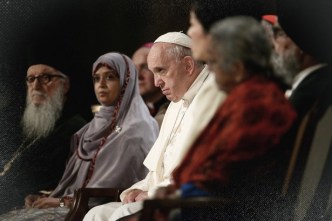
 So far, then, the Council is focused on all people. Now, in paragraph #2 the bishops turn to people who have found “a certain perception of that hidden power which hovers over the course of things and over the events of human history; at times some indeed have come to the recognition of a Supreme Being, or even of a Father. This perception and recognition penetrates their lives with a profound religious sense.” These comments apply to a wide variety of religious expression, from various Eastern forms to Native American and on and on. Then they turn specifically to certain Eastern religions:
 Buddhism, in its various forms, realizes the radical insufficiency of this changeable world; it teaches a way by which people, in a devout and confident spirit, may be able either to acquire the state of perfect liberation, or attain, by their own efforts or through higher help, supreme illumination.
 Paragraph #3 specifically addresses Islam:
 And in language made even more poignant over the last generation, the bishops write:


 The Extraordinary Jubilee of Mercy, proclaimed by Pope Francis today in Rome, actually began fifty years ago with the solemn closing of the Second Vatican Council on 8 December 1965. When dealing with the Catholic Church it is always good to step back and take a long view on what is going on, and today’s events in Rome are no exception. Let’s connect some dots.
 The Church’s teaching about Mary was originally crafted as a separate document by the curia before the Council began. However, the world’s bishops rejected this arrangement, rightly including Mary at the heart and climax of its dogmatic Constitution on the Church, Lumen gentium. Mary, our sister and our mother, the first disciple of the Christ, is held up to all as the model of Christian discipleship. Fifty years ago, therefore, standing on the same spot where Pope Francis stood earlier this morning, Pope Paul VI ended his homily with the following observation:
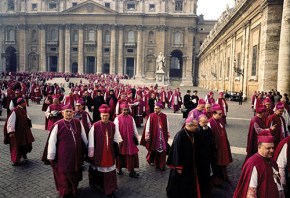 Vatican II is a gift that keeps on giving. The great historian of the Church, Hubert Jedin, once observed that it takes at least a century to implement the teachings and decisions of a general Council. If he is correct, and I believe he is, we have only now just reached the fifty yard line as we say in American football. For all the progress made, much more remains to be done. Let’s take a closer look at those closing ceremonies to the Council, because there are some significant elements there that point the way to what happened earlier today.
 Another point we must stress is this: all this rich teaching is channeled in one direction, the service of mankind, of every condition, in every weakness and need. The Church has, so to say, declared herself the servant of humanity, at the very time when her teaching role and her pastoral government have, by reason of the council’s solemnity, assumed greater splendor and vigor: the idea of service has been central.
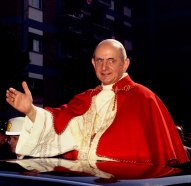 Pope Paul digs deeper, using the image of a bell:
 Finally, at the end of the Mass closing the Council, a remarkable thing happened. Most people today are unaware that it even took place, and that is a real tragedy, for it sheds a light on the whole proceedings, and points the way to our contemporary Jubilee. A series of messages from the Council Fathers was read to the world. The bishops of the Council prepared these messages because they wanted the world to realize that the Council had not been simply an exercise of ecclesiastical navel-gazing; rather, the work of the Council was focused outward, to the very real needs of the people and the world. In the introduction to the messages, the bishops write:
 Today, here in Rome and in all the dioceses of the world, as we pass through the Holy Door, we also want to remember another door, which fifty years ago the Fathers of the Second Vatican Council opened to the world. This anniversary cannot be remembered only for the legacy of the Council’s documents, which testify to a great advance in faith. Before all else the Council was an encounter. A genuine encounter between the Church and the men and women of our time. An encounter marked by the power of the Spirit, who impelled the Church to emerge from the shoals which for years had kept her self-enclosed so as to set out once again, with enthusiasm, on her missionary journey. . . Wherever there are people, the Church is called to reach out to them and to bring the joy of the Gospel, ,and the mercy and forgiveness of God. After these decades, we again take up this missionary drive with the same power and enthusiasm. The Jubilee challenges us to this openness, and demands that we not neglect the spirit which emerged from Vatican II, the spirit of the Samaritan, as Blessed Paul VI expressed it at the conclusion of the Council. May our passing through the Holy Door today commit us to making our own the mercy of the Good Samaritan.



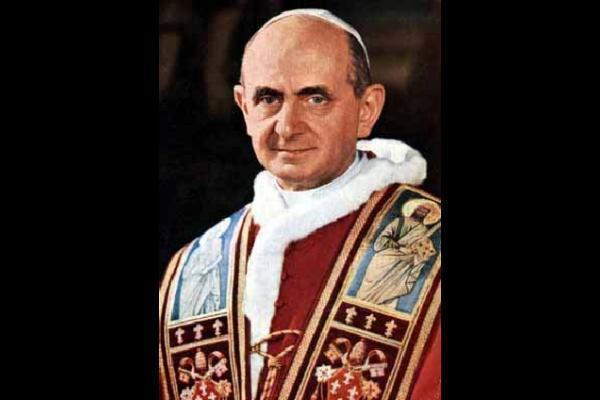


 Deacons Today: Servants in a Servant Church