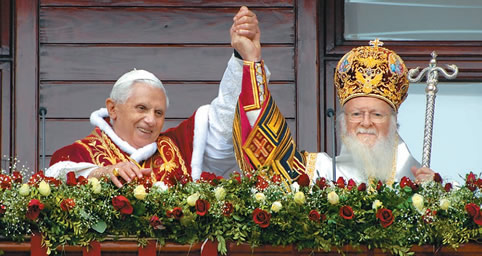
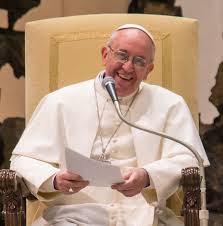
Pope Francis: Sitting on the Dock of the Bay

Pope WaveMany people around the world have begun talking about the so-called “Francis Effect”, which I suppose could best be described as the resurgence of interest and participation in the Catholic Church due to the influence of Pope Francis and his vision for the church.  Especially in Europe, church leaders have noted a demonstrable increase in church attendance, and certainly the Pope’s weekly Wednesday audiences have nearly trebled in size since his election.  Here in the United States, recent studies have not yet documented such a radical increase, although a lot of us serving in parishes have certainly seen a notable increase in interest and enthusiasm.  Last night, I saw first-hand the “Francis Effect” in action, right here at a bar on Fisherman’s Wharf on Monterey Bay.

“Theology on Tap” is a program that’s been around quite a while now across the country, and it’s proved a durable and popular way to Theology on Taptalk about the faith and to answer questions and concerns people have.  That has certainly been the case in the Diocese of Monterey, where for more than four years, Deacon Warren Hoy has been coordinating monthly meetings on topics ranging from a variety of social justice issues, to discussions on exorcisms, just war theory, and so on.  There is a solid core of attendees, and always fresh faces drawn by a particular topic.  In a conversation with Warren a month or so ago, he shared some frustration at finding a topic and speaker for the January gathering, and in desperation, he asked me to be the speaker.  “Talk about whatever you want to,” he said.  I suggested having a conversation about Pope Francis.  That was it.  No further details, no dramatic and sexy topic: just, “let’s talk about Pope Francis.”  That’s how the announcements went out.

Last night, there on the dock of the Bay, a record number of folks turned out.  Estimates ranged between 60-80 people, which for this area, is HUGE.  I have addressed this gathering before, and while there is always good interest, last night there was a palpable difference.  There was great energy and enthusiasm about the pope and what he’s trying to do.  We talked about the nature of reform in the Church, whether that applies to the Roman Curia itself, or just a reform in pastoral approaches.  Some folks came up later to tell me that they weren’t Catholic, but that they too found great hope in the Pope’s approach and were interested in finding out more about how they might get involved and perhaps even become Catholic!  The lifelong Catholics shared how wonderful it was to be focused on POSITIVE issues in the Church these days, and to have a sense of re-commitment to their own involvement in the Church.

So, cue Otis Redding: Sitting on the dock of the bay, here in Monterey, Pope Francis is having a profound effect.

And, as if to underscore that point: next month, a new Theology on Tap venue is opening up down the road in the Salinas.  The word is spreading.

CA583-Monterey Bay At Sunrise -leveled

Priest to Deacon: “Being a deacon is not a REAL vocation.”

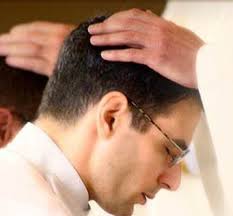
laying on of handsFrom the inbox comes a note from a very concerned brother deacon.  A priest recently told him that there was no real sacramental significance to being a deacon, unlike the ordinations of presbyters or bishops, which change a person at the very core of their being.  As another deacon once remarked to me after a Conference, a priest once told him that “being a deacon is not a REAL vocation, like being a priest or a religious.”  I have heard both of these observations before, and want to reassure my brother deacons that, contrary to the mistaken opinions of some of the priests involved (and others, of course): being a deacon IS a real vocation, and our ordination is just as “sacramentally effective and significant” as any other ordination to the other orders that make up the Sacrament of Holy Orders!

What’s going on here?  Why is there such confusion about this?  Let me suggest a few answers.  Perhaps this could be part of a conversation and ongoing formation offered to our seminarians and priests (and it wouldn’t hurt for deacons and lay folks to remember it, too!).

1) A “theology of the diaconate” is only just now being developed.  This may seem surprising, but when you think about it, it makes sense.  For about a millennium or so, “being ordained” was usually summed up in (reduced to?)  reflections on “being a priest.”  That was the order that mattered the most, since this was the order (of presbyters) who “confected the Eucharist”, and all other orders were preliminary to, and led to, the presbyterate.  For quite a while, even being a bishop was understood primarily through the lens of the priesthood, with the responsibilities of being a bishop understood primarily as a matter of jurisdiction, not sacramental significance.  This point of view was overturned at the Second Vatican Council, which restored a more ancient understanding of Orders, first by reclaiming the more ancient theological understandings of the episcopate (see Lumen gentium, ##18-27), returning the diaconate to an order to be exercised permanently, and by authorizing the restructuring of the entire Sacrament of Holy Orders; Pope Paul VI implemented those decisions between 1967 (when he adjusted canon law to permit the ordination of “permanent” deacons) and 1972 (when he suppressed, in the Latin Church, first tonsure, the minor orders of porter, lector, exorcist and acolyte, and the subdiaconate; he concurrently authorized LAY ministries of lector and acolyte, no longer to be ordinations, but lay institutions).  This means, vis-a-vis the diaconate, that for the first time in more than a millennium, a person could be ordained to a major and permanent order of the ministry (the diaconate) without eventually seeking ordination to the presbyterate.  Therefore, given the large scale absence of “permanent” deacons for so long, there was no proper theology of the diaconate-qua-diaconate.

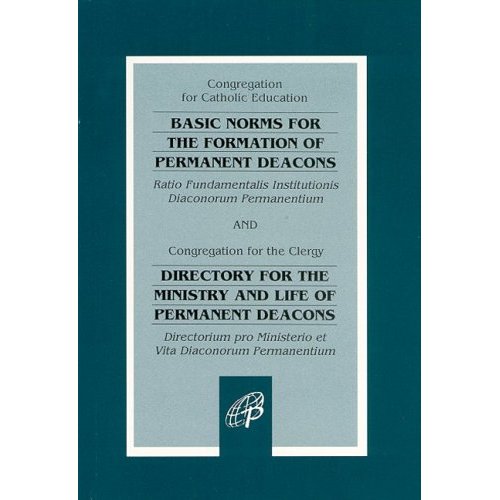
The Holy See recognized this in a 1998 document from the Congregation for Catholic Education (#3):Ratio et Directorium
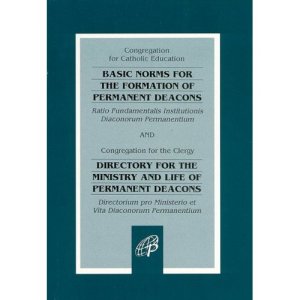
The almost total disappearance of the permanent diaconate from the Church of the West for more than a millennium has certainly made it more difficult to understand the profound reality of this ministry. However, it cannot be said for that reason that the theology of the diaconate has no authoritative points of reference, completely at the mercy of different theological opinions. There are points of reference, and they are very clear, even if they need to be developed and deepened.

So, what are these “points of reference” offered by the Holy See?

A.  First of all we must consider the diaconate, like every other Christian identity, from within the Church which is understood as a mystery of Trinitarian communion in missionary tension. This is a necessary, even if not the first, reference in the definition of the identity of every ordained minister insofar as its full truth consists in being a specific participation in and representation of the ministry of Christ. This is why the deacon receives the laying on of hands and is sustained by a specific sacramental grace which inserts him into the sacrament of Orders.

B. The diaconate is conferred through a special outpouring of the Spirit (ordination), which brings about in the one who receives it a specific conformation to Christ, Lord and servant of all. Quoting a text of the Constitutiones Ecclesiae Aegypticae, Lumen gentium (n. 29) defines the laying on of hands on the deacon as being not “ad sacerdotium sed ad ministerium”,(6) that is, not for the celebration of the eucharist, but for service. This indication, together with the admonition of Saint Polycarp, also taken up again by Lumen gentium, n. 29,(7) outlines the specific theological identity of the deacon: as a participation in the one ecclesiastical ministry, he is a specific sacramental sign, in the Church, of Christ the servant. His role is to “express the needs and desires of the Christian communities” and to be “a driving force for service, or diakonia”, which is an essential part of the mission of the Church.

C.  The matter of diaconal ordination is the laying on of the hands of the Bishop; the form is constituted by the words of the prayer of ordination, which is expressed in the three moments of anamnesis, epiclesis and intercession. . . .  [NOTE: The matter and form of the diaconate, presbyterate and episcopate were clarified and promulgated by Pope Pius XII in his 1947 Sacramentum Ordinis.   One would hope that by now this document would have found its way into seminary curricula! ]

holyorders2D. Insofar as it is a grade of holy orders, the diaconate imprints a character and communicates a specific sacramental grace. The diaconal character is the configurative and distinguishing sign indelibly impressed in the soul, which configures the one ordained to Christ, who made himself the deacon or servant of all. It brings with it a specific sacramental grace, which is strength, vigor specialis, a gift for living the new reality wrought by the sacrament. “With regard to deacons, ‘strengthened by sacramental grace they are dedicated to the People of God, in conjunction with the bishop and his body of priests, in the service (diakonia) of the liturgy, of the Gospel and of works of charity’”.  Just as in all sacraments which imprint character, grace has a permanent virtuality [The Latin original has: Sicut in omnibus sacramentis characterem imprimentibus, gratia permanentem virtualem vim continet]. It flowers again and again in the same measure in which it is received and accepted again and again in faith.

E. In the exercise of their power, deacons, since they share in a lower grade of ecclesiastical ministry, necessarily depend on the Bishops, who have the fullness of the sacrament of orders. In addition, they are placed in a special relationship with the priests, in communion with whom they are called to serve the People of God.

F. From the point of view of discipline, with diaconal ordination, the deacon is incardinated into a particular Church or personal prelature to whose service he has been admitted, or else, as a cleric, into a religious institute of consecrated life or a clerical society of apostolic life.(13) Incardination does not represent something which is more or less accidental, but is characteristically a constant bond of service to a concrete portion of the People of God. This entails ecclesial membership at the juridical, affective and spiritual level and the obligation of ministerial service.

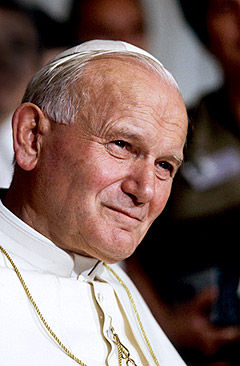
jpii2.  If this were not enough to demonstrate the proper character of a vocation to the diaconate, consider the words of soon-to-be Saint John Paul II, who offered a series of catecheses on the diaconate in 1993.  He observed with great clarity a theme he would make several times during his papacy:

The exercise of the diaconal ministry—like that of other ministries in the Church—requires per se of all deacons, celibate or married, a spiritual attitude of total dedication.  Although in certain cases it is necessary to make the ministry of the diaconate compatible with other obligations, to think of oneself and to act in practice as a ‘part-time deacon’ would make no sense. The deacon is not a part-time employee or ecclesiastical official, but a minister of the Church. His is not a profession, but a mission!  

So, why does any confusion persist on this matter?  Let me offer a couple of suggestions.

3.  The sacramental question of HOW the deacon participates in the one Sacrament of Holy Orders has developed since the release of the documents on the diaconate in 1998.  Following some initial changes to the Latin editio typica of the Catechism of the Catholic Church back in 1994, Pope Benedict in 2009 issued motu proprio Omnium et Mentem.  In this document, canon law (specifically cc. 1008 and 1009) was changed to reflect that only presbyters and bishops act in persona Christi Capitis (“in the person of Christ, the Head of the Church”), while deacons serve in a ministry of word, sacrament and charity.  This distinction, however, does not — and should not — be taken to suggest that deacons are no less ORDAINED into sacred ministry (which is the point of the canons on this point!) or that our ordination is no less sacramentally significant.  The canons simply reflect a theological position that there are two modalities of participation in the ONE Sacrament of Holy Orders. [Here’s an interesting side note: the change to canon law only affected the Code of Canon Law for the Latin Church; the Code of Canons for the Eastern Catholic Churches does not use the language of in persona Christi Capitis, so the distinction did not need to be made there.]

4.  I think that, since the Council, there has been legitimate concern on the part of many presbyters that the specific nature of the presbyterate has been under assault.  One bishop who participated in all four sessions of the Council as a young bishop, once remarked to me that he considered it a great shortcoming of the Council that they did not spend more time on the nature of the priesthood itself.  “After all,” this bishop said, “We spent considerable time talking about the sacramental nature of the episcopate, and we developed wonderful texts on the nature and role of the laity.  We even renewed the diaconate!  But we did not take into proper account the profound impact all of that would have on the presbyterate itself.”  As a result, many of the functions which had become part of the presbyterate prior to the Council now began to be disbursed to other ministers, both lay and, now, deacons.  This means that there is a certain concern that the presbyterate itself is being somehow “eroded” as others assume their own rightful and legitimate places in ministry, both within the Church and in the world.

But the bottom line remains:vocation

Deacons are ordained, and are permanently changed in the core of our being by that ordination (what we used to call in days gone by as “ontologically changed”).  We are always and everywhere full-time ministers, as St. John Paul II so passionately proclaimed, even when that ministry occurs outside the normal institutional structures of the Church.  During those same catecheses in 1993, John Paul II also reminded people that “a deeply felt need in the decision to re-establish the permanent diaconate was and is that of greater and more direct presence of Church ministers in the various spheres of the family, work, school, etc., in addition to existing pastoral structures.”  The diaconate is a sacrament and a proper vocation.  It is perhaps also a useful reminder to many of our sisters and brothers that we are all gifted with many “proper vocations” — calls from God! — in our lifetimes.  Our baptisms themselves constitute our primal vocation, before all others, for example!  Some of us are called to religious life, some are called to matrimony, some are called to Orders, and some of us are called to several of these at the same time!  Our God is a most generous God, and attempts to characterize one vocation over against another is to deny that divine generosity and to misunderstand the nature of vocation in the first place.

Now,  let us all go out and serve one another!
2012012311fishers_of_men_1_inside

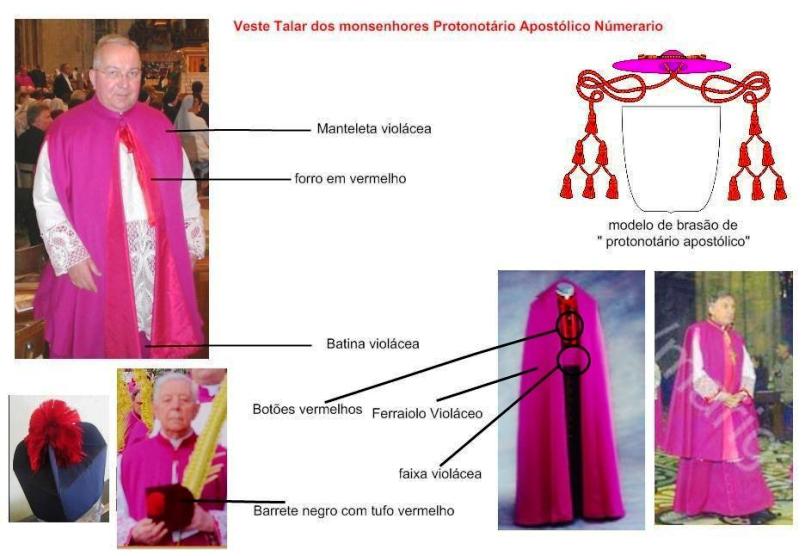
Monsignors and Serving the People of God UPDATED

monsignors

A Ceremony “Robing” New Monsignori

Big “insider baseball” church news was the decision of Pope Francis to eliminate all but the lowest “rank” of Monsignor, and then to restrict even that form to diocesan priests over 65.  There have been all kinds of interesting reactions to this news!  One one side of the spectrum are those who find the move refreshing and a good first step at eliminating a sense of medieval-ism and careerism within the clergy; on the other, heads are exploding over this smack to the side of the clerical heads of those who found becoming a monsignor an affirmation of their personal and ecclesial worth.  One priest-blogger criticized that this decision was not made by the Pope in any kind of consultative manner and that perhaps it would be best for such matters to be dealt with on a local (diocesan) level.  Sorry, Father, it couldn’t work that way: “Being a monsignor” was always a PAPAL prerogative; it was his “gift”, although bishops would nominate men for the honor.  As the maxim has it, “he who gives, takes away.”  Furthermore, the pope DID consult on this decision.  He put a months-long moratorium on making any new monsignors, and I think it’s safe to assume he discussed this with his special group of Cardinal-advisors at their recent meeting.  This shouldn’t have surprised anyone at all!

For those new to this kind of thing, what are we talking about here?

First, Christ didn’t name “monsignors” (monsignori if you want to sound like Father Z).  This was a creation by church leadership as the “course of honors” (cursus honorum) developed through the post-Constantinian marriage of church and state which lasted until the American Revolution.  Just as secular honorifics and structures were created, they were paralleled in church honorifics and structures.  The word itself simply means “my lord”, and in some countries, it is actually a title used for a bishop.  It has absolutely NO connection to the sacrament of Holy Orders, although it is restricted to men who are in the Order of Presbyters.  As a deacon, of course, I never had any hopes of ever being a Monsignor anyway!  But people should understand that if their pastor went from being called “Father” to “Monsignor”, it didn’t mean that he had any more “sacred power” than a simple priest.  It was purely an honorific, usually given to two broad categories of priests: those who were younger and being signaled as those who might someday become bishops, and on those older men whom the bishop wanted to thank for a ministry well served.  As one priest-friend put it when he became a Monsignor, “I asked the bishop why he had done this.  He told me he wanted to thank me.  I asked him, ‘Why not just take me to dinner?’ I can’t even spell ‘Monsignor’!”  Later, my friend was named a bishop.  After his episcopal ordination, he e-mailed me that “at least I can spell ‘bishop.'”

Second, a bit of contemporary perspective.  As I’ve written about before, I’ve been around church and ministry for my whole life, and was in the seminary myself for high school and college (1963-1971).  Even before that time, the majority of the priests I knew in my diocese detested the idea of becoming a Monsignor.  On the one hand, we had a great Monsignor in our parish, and we all loved him.  He was Monsignor Patrick O’Connor Culleton, ordained in Dublin in 1901, came to our Diocese in Illinois early on, and became pastor at our parish in 1920; he remained pastor there until his death in the late 1950’s.  He was the pastor when a young newly-ordained priest named Fulton Sheen came to the parish for his first assignment.  Sheen always said that the Monsignor was the holiest priest he’d ever known.  But the younger priests — most of them anyway — wanted nothing to do with this kind of honorific, claiming that it was a relic of a time gone by that had no relevance whatsoever in the Church serving in the modern world.  It made no difference at all when one was marching for civil rights, or visiting people in an inner city slum.  In short, monsignori were seen as belonging to a different era in the life of the church.

The bishops at the Second Vatican Council agreed.  They were dead set against retaining structures and processes that no longer served any practical, pastoral use in the life of the church, and they directed the Holy Father to streamline things.  Pope Paul VI took this task on, and in 1972, the whole sacrament of Holy Orders was restructured, eliminating in the Latin Church the Rite of First Tonsure, the four minor orders and the major order of the Subdiaconate.  The diaconate was now to be exercised permanently and could be opened to both celibate and married men.  The same pope also reduced the number of “classes” or “ranks” of monsignori.  No one really knows just how many classes there were!  Some sources tally fifteen different classes of monsignor, others have twelve or thirteen.  Popeprotonotarios_zpsc9e4a1b2 Paul reduced them to three only.  Now, Pope Francis has reduced this list to one, and then only for diocesan priests over the age of 65.

What difference will this make?

1) On a practical level, absolutely none.  A priest is a priest is a priest.  That’s always been the case, sacramentally.  This doesn’t change that.  The best news is that priests don’t have to go out and buy all the fancy rig that was associated with being a monsignor.

2) For those men who actually wanted to be monsignori (and, at least in my humble experience, that’s been thankfully a very small number!), it will mean that they can now refocus their efforts on being the best priests they can be without waiting for a title or new clothes.  In honor of their non-selection as monsignori, perhaps these men could join their deacons and lay folks in paying an extra visit to a homeless shelter or in lobbying for a change in unjust laws or for immigration reform.  I’m not saying that these men are not doing good things already; but if they’re not going to have to worry about being a monsignor, they’ll be free to focus on other things.  Like getting the smell of the sheep on their clothes.

Cassock_purpled_zpsc36574403) There IS a negative side to this.  Our good priests DO deserve some kind of recognition and support for their ministry; all people who serve do!  We do need to support our priests and acknowledge their service and commitment.  Some bishops, out of a lack of any other ideas, thought that at least by getting the pope to name a priest a monsignor, this could be a small way of doing that.  But here’s a chance for some grass-roots creativity and initiative!  Being a monsignor was no way to recognize anyone, and in some men it just created more difficulties that it was worth.  What CAN we do, in a positive way, to acknowledge someone’s service?  No one who serves AS CHRIST SERVED needs or wants recognition.  The only human recognition Christ got was to be nailed to a cross, after all.  Still, as human beings, it’s nice to know when something we’ve done has been effective.  What can we do, what can YOU do, to show appreciation to ALL who serve in the name of Christ and in the name of the Church?

UPDATE

As I continue to follow the various blog responses to this issue, I was struck by something.  It seems to me, anecdotally and not based on any scientific analysis, that most of the folks OBJECTING to the loss of new monsignors are people who are converts to Catholicism.  By and large, so-called “cradle Catholics” like myself are all in favor of it; those who have come later to the Church seem to be suffering the loss.  File in the “interesting, for what it’s worth” categories.

Happy New Year!

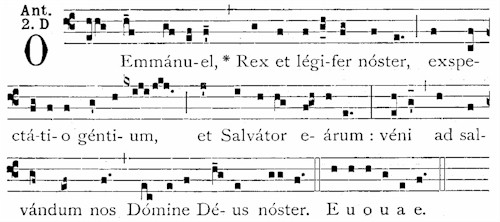
“O Emmanuel”: God with All of Us

23 Dec O EmmanuelFrom Vespers, 23 December:

O Emmanuel, our king and our lawgiver,
the hope of the nations and their Savior:
Come and save us, O Lord our God.

While the original texts of most of the “O Antiphons” were in Latin, here’s one that’s even more ancient (although Latin appropriated it later!).  “Emmanuel” is a Hebrew word taken directly from the original text of Isaiah: “Therefore the Lord himself will give you a sign.  Look, the young woman is with child and shall bear a son, and shall name him Emmanuel” (Isaiah 7:14).

As a teenager and young adult, I studied for eight years (high school and college)  in the seminary, discerning a possible vocation to the priesthood.  When I left the seminary after college, the military draft was still in place, and I was due to be drafted.  Believing that I might have more control over matters if I simply enlisted before I could be drafted, I joined the Navy.  No guarantees were made, and I had no idea where I might be sent after the conclusion of Basic Training. I was stunned and thrilled to find out that my first orders after boot camp were to go to Hebrew language school for a year; I was blessed to serve as a Hebrew linguist for the first couple of years in the Navy, largely on the island of Cyprus in the Mediterranean.immanuel1 (2)

In language school, all of our instructors were native-born Israelis, known as sabra.  They quickly got us chatting away in modern Hebrew, and one of the topics they would ask involved answering the question, “What did you study in school?” (“Ma lamadita bevet sefer?”)   When I responded that I had studied Philosophy, they asked why.  I answered that I had been studying to become a priest.  From that moment on, every afternoon for at least one full hour, we began reading Biblical Hebrew.  What a great joy it was to be able to read the Hebrew scriptures in their original language!  One particular text we read was the prophet Isaiah, including the verse given above.  “Im [“with”] + “anu” [“us”] + “El” [“God”]: God with us!  (The Latin and English sometimes interchange the “I” for an “E”, so either “Immanuel” or “Emmanuel” is acceptable.) The original word order is somewhat interesting, with the word for God coming at the END of the phrase.  While word order is of differing significance in different languages, the fact that God is at the end of the phrase underscores the foundational importance of God to all that goes before.  We see the same thing in many Hebrew names: for example, Michael is “mi” [“who”] + “cha” [“like”] + “El” [“God”].  So, “Immanuel” becomes almost a cry of stunned realization: “With us, GOD!”

At the beginning of the third chapter of Evangelii Gaudium, Pope Francis turns his attention to the nature of the Church. “The Church, as the agent of evangelization, is more than an organic and hierarchical institution; she is first and foremost a people advancing on its pilgrim way toward God.  She is certainly a mystery rooted in the Trinity, yet she exists concretely in history as a people of pilgrims and evangelizers, transcending any institutional expression, however necessary” (#111).  The relationship of the People with God always begins in God’s own initiative: “God, by his sheer grace, draws us to himself and makes us one with him” (#112).  So, the fact that we proclaim that God is with us flows from our realization that God has CHOSEN to be with us in every human condition and need.  We have not earned God’s presence, we have not somehow bargained God int it!  The covenant is always God’s initiative; as Love itself, God extends and provides for all creation.  “The salvation which God has wrought, and the Church joyfully proclaims, is for everyone.  God has found a way to unite himself to every human being in every age” (#113).

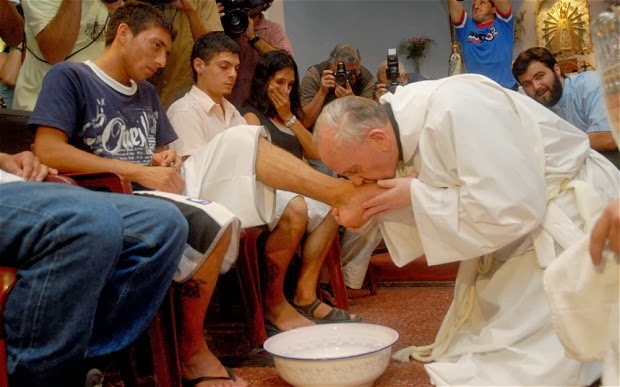
Francis-feet-drugs-poor-EPAThe implications of With-us-GOD are profound!  As we know, “possessing God” and then waiting for the rapture at the end of time are not Catholic concepts!  On the contrary, With-us-God “means that we are to be God’s leaven in the midst of humanity. . . .  The Church must be a place of mercy freely given, where everyone can feel welcomed, loved, forgiven and encouraged to live the good life of the Gospel” (#114).

ADVENT REFLECTION

One this final evening before the Vigil of Christmas, what is the practical, pastoral impact of the realization in our own lives that God has truly come to us and remains with us?  Am I, as an individual believer, and are we, as Church, a place where all people can find “mercy freely given”, universal welcome, love, forgiveness and encouragement?  Or, am I — are we — perceived as people of rules and judgments who tend to exclude rather than include?  This Christmas, as we celebrate the union and universal gift of God-for-all, may we re-dedicate ourselves to the liberating power of the joy of the Gospel!

4 Advent Candles


“O Wisdom”: Mission Embodied Within Human Limits

osapientiaThe O Antiphon (O Sapientia, in Latin) for today, 17 December reads as follows:

O Wisdom, O holy Word of God, you govern all creation with your strong yet gentle care.  Come and show your people the way to salvation.

Providentially, the theme of divine Wisdom seems particularly appropriate as we pick up where we left off with the Pope Apostolic Exhortation; namely, with a section entitled: “A Mission embodied within human limits.”  We are a people constantly in seek of Wisdom, both as individuals and as a People of faith.  This is actually the pope’s starting point.  In paragraph #40, the pope refers to the entire Church as a missionary disciple, a disciple who “needs to grow in her interpretation of the revealed word and in her understanding of truth.”  It is interesting to think of the entire People of God in this way: as a singular disciple on mission.  Just as I, as an individual Christian disciple, need constantly to grow in understanding, so too does the entire Church.  The Pope reminds those of us who serve in the ministry of theology: “It is the task of exegetes and theologians to help ‘the judgment of the Church to mature.'”  This is a quote taken directly from the Second Vatican Council’s monumental Dogmatic Constitution on Divine Revelation (Dei Verbum, #12).

Without specifying particular examples, the pope continues:

Within the Church countless issues are being studied and reflected upon with great freedom. Differing currents of thought in philosophy, theology and pastoral practice, if open to being reconciled by the Spirit in respect and love, can enable the Church to grow, since all of the help to express more clearly the immense riches of God’s word.  For those who long for a monolithic body of doctrine guarded by all and leaving no room for nuance, this might appear as undesirable and leading to confusion.  But in fact such variety serves to bring out and develop different facets of the inexhaustible riches of the Gospel.

This call for a broad and diverse search for wisdom, as we shall see in a moment, once again calls upon the wisdom of the whole Tradition of the Church, with PopeJohnXXIIIathis particular section supported by an extensive reference to St. Thomas Aquinas; shortly, Pope Francis will call to mind the example of St. John XXIII who says essentially the same thing!  Wisdom, in short, is not “monolithic”, nor is it a hoard of theological propositions known in fullness and waiting only to be transmitted verbatim and intact to succeeding generations, cultures and peoples.  The pope writes, in #41: “Today’s vast and rapid cultural changes demand that we constantly seek ways of expressing unchanging truths in a language which brings out their abiding newness. ‘The deposit of the faith is one thing, the way it is expressed is another.'”  That is the voice of St. John XXIII, exhorting the world’s bishops at the beginning of the Second Vatican Council.  Pope Francis cautions that when some people “hold fast to a formulation [which] fails to convey its substance,” we can — with every good intention — “sometimes give them a false god or a human ideal which is not really Christian.”  He then cites St. John Paul II, who wrote that “the expression of truth can take different forms.  The renewal of these forms of expression becomes necessary for the sake of transmitting to the people of today the Gospel message in its unchanging meaning.”

This quest for expressing eternal truth in various ways in order to communicate, not only the words but the meaning of truth, continues  when considering the various customs and practices of the Church, as a missionary disciple.

In her ongoing discernment, the Church can also come to see that certain customs not directly connected to the heart of the Gospel, even some which have deep historical roots, are no longer properly understood and appreciated.  Some of these customs may be beautiful, but they no longer serve as means of communicating the Gospel.  We should not be afraid to re-examine them. . . .  St. Thomas Aquinas pointed out that the precepts which Christ and the apostles gave to the people of God “are very few”.  Citing Saint Augustine, he noted that the precepts subsequently enjoined by the Church should be insisted upon with moderation “so as  not to burden the lives of the faithful” and make our religion of form of servitude, whereas “God’s mercy has willed that should be free.”  This warning, issued many centuries ago, is most timely today.  It ought to be one f the criteria to be taken into account in considering a reform of the Church her preaching would would enable it to reach everyone.

We have already seen in earlier sections of the document that the pope is committed to helping the Church recover her missionary purpose, and that this mission is not only to reach everyone in a general way, but in very concrete ways which are understandable to all people today, regardless of culture or history or age.  Past ages found beautiful and creative ways of expressing eternal truths in their own day and time; we must not do the same for our own, and not merely try to repeat the brilliant work of the past which may no longer be capable of communicating truth as it once did.

ADVENT REFLECTION

As we move more intently into our final preparations for celebrating the coming of Christ anew into our lives, how well do I express my faith to others in ways that are full of meaning, promise and hope?  What about our parish: What customs do we continue to hold onto which — if we were truly honest with each other — no long seem to be capable of expressing the truth of our relationship with Christ and our responsibility to the world around us.  Honestly review our lives as individuals and as parish, and then reflect: Do we unduly “burden” those around us?  Do we have the courage to let go and to let God inspire us with Divine Wisdom in finding new ways to proclaim the Christ to the world. For those of us who serve as deacons, do we continue to grow, not only as disciples, but in our ministerial competence?  Are we open to new ideas, even when those ideas may be challenging to our former ways of thought?   “O Wisdom” is a title given to Christ today; may our own relationship with Wisdom give us the freedom and courage to find new ways of sharing God’s truth.

 Gaudete002

An Advent Remembrance: War and Peace

colour-smoke_2076773i7 December 1941.  Seventy-two years since that particular “Day of Infamy.”  World War II had, of course, begun years earlier.  By the time it ended, at least 70 million people were dead.  Pope John Paul II, in his 2004 Message for the World Day of Peace, referred to the Second World War as “an abyss of violence, destruction and death unlike anything previously known.”  How does a world recover from such madness?  For those of us who were born following the War, we have lived with its effects our whole lives, even though specific memories of the War continue to fade with the passing of the World War II generation.

For Catholics, I believe it is important to understand the Second Vatican Council as the Catholic Church’s response to World War II: the conditions that led to the War and the world that emerged after it.  Pope John XXIII announced his plans for the Council only fourteen years following the end of War.  Opening the Council, he observed:

55725AI

We feel we must disagree with those prophets of gloom, who are always forecasting disaster, as though the end of the world were at hand.  In the present order of things, Divine Providence is leading us to a new order of human relations which, by men’s own efforts and even beyond their very expectations, are directed toward the fulfillment of God’s superior and inscrutable designs. And everything, even human differences, leads to the greater good of the Church.

How do we cooperate with Divine Providence in attaining this “new order of human relations”?  The bishops of the Council were not seeking simple superficial updating of the Church; they were setting out to create a new understanding of the Church in a world already gone mad and in need of the “soul and leaven” a renewed Church might provide.  Pope Paul VI, in his famous speech at the General Assembly of the United Stations in October 1965, famously proclaimed:

paulvi_at_un2

Paul VI at the United Nations

And now We come to the high point of Our message: Negatively, first: the words which you expect from Us and which We cannot pronounce without full awareness of their gravity and solemnity: Never one against the other, never, never again.  Was it not principally for this purpose that the United Nations came into being: against war and for peace?  Listen to the clear words of a great man, the late John Kennedy [himself a veteran of World War II], who declared four years ago: “Mankind must put an end to war, or war will put an end to mankind.”  Long discourses are not necessary to proclaim the supreme goal of your institution.  It is enough to remember that the blood of millions of men, numberless and unprecedented sufferings, useless slaughter and frightful ruin are the sanction of the covenant which unites you, in a solemn pledge which must change the future history of the world No more war, war never again.  It is peace, peace which must guide the destinies of peoples and of all mankind.

What is particularly telling is the fact that when Pope Paul returned to Rome from this trip, he went immediately to the St. Peter’s and shared his insights with the assembled Council Fathers who, in their own turn, adopted the pope’s message as their own.  They were in the midst of their own work on their capstone document, Gaudium et spes, “The Pastoral Constitution on the Church in the Modern World.  In particular, they began working on the section dealing with war and peace, incorporating the insights of Pope John XXIII’s Pacem in Terris and Pope Paul’s speech to the UN.

No more war, war never again!

As we remember the personal, national and global tragedies of the Second World War, may we this Advent renew our commitment and preparation for the new order of human relations foreseen by Pope John.  May we, like Mary pregnant with the Christ, work to bring Christ and his Gospel to the world in the real, concrete terms envisioned by the Council and now renewed for us again by the words and deeds of Pope Francis.

Advent candle 2

Time to Abandon: “We have always done it this way.”

Francis1 Pope Francis has become known since his election for many things, but not the least of these are his homilies.  Whether at the chapel at the Casa Santa Marta, at Lampedusa, at World Youth Day in Rio, or in St. Peter’s, his direct, engaging style is a superb model for all preachers.  As we continue our stroll through his Apostolic Exhortation Evangelii Gaudium (EG), he begins to offer some specific ideas about HOW we communicate the “joy of the Gospel.”  As Pope John XXIII remarked in his opening address to the bishops at Vatican II in 1962, “The deposit of the faith is one thing. . . how it is expressed is another.”  Once again, we find Francis echoing John.

In paragraph #33, the Pope writes, “Pastoral ministry in a missionary key seeks to abandon the complacent attitude that says: “We have always done it this way.”  I invite everyone to be bold and creative in this task of rethinking the goals, structures, styles and methods of evangelization in their respective communities.”  He goes on to say that if we’re going to approach everything is this “missionary key,” then the ways (media) we use to communicate will be affected.  In days of instant communication, distortions can easily occur, resulting in misunderstanding.  For example, he notes, “The biggest problem is when the message we preach then seems identified with those secondary aspects which, important they are, do not in and of themselves convey the heart of Christ’s messfrancis4age.”

Pastoral ministry in a missionary style is not obsessed with the disjointed transmission of a multitude of doctrines to be insistently imposed.  When we adopt a pastoral goal and a missionary style which would actually reach everyone without exception or exclusion, the message has to concentrate on the essentials, on what is most beautiful, most grand, most appealing and at the same time most necessary (#35).

Francis then discusses at some length the long-standing attitude of the Church that there is a hierarchy of truths.  While “all revealed truths derive from the same divine source and are to be believed with the same faith, yet some of them are more important for giving direct expression to the heart of the Gospel.  In this basic core, what shines forth is the beauty of the saving love of God made manifest in Jesus Christ who died and rose from the dead.  The existence of a hierarchy of truths, he writes, “holds true as much for the dogmas of faith as for the whole corpus of the Church’s teaching, including her moral teaching” (#37).

The pope then becomes a teacher of homiletics.  While he will provide a more extensive “curriculum” later in the document, he introduces the subject here in paragraphs ##38-39.  First, he writes, “in preaching the Gospel a fitting sense of proportion has to be maintained.”  He brings up a very interesting approach: how often do we preach on certain subjects, perhaps to the exclusion of others?   This struck home with me in a particular way.

Once, while serving as tGospel on USS Reagan 2009he Director of Deacons for a large Archdiocese, I was approached by a man interested in discerning a possible vocation to the diaconate.  As we were talking, I asked him what he thought he might do as a deacon that he was not already doing as a committed lay person in the Church.  He responded immediately, “Preaching!”  I acknowledged that preaching was certainly one of the deacon’s ministries, and asked him what he thought the topic of his first homily might be.  He responded with great passion that he would preach about the evils of abortion as the topic of his first homily.  I asked him why, and he said that the rest of us (current priests and deacons) were not preaching about it, and that he wanted to correct that omission.  OK, then.  So I asked him to continue: what would he want to talk about in his next homily?  Once again: the evils of abortion.  And your third?  Same answer.  It became obvious to both of us after a while that he really was not responding to a possible call to the diaconate, but to his great passion for trying to eliminate abortion; his was a single-issue focus, and I tried to explain to him that, as clergy, we have an obligation to try to be as comprehensive as humanly possible in dealing with the totality of what the church teaches.  However, his comments were still challenging to me.  Was I guilty of NEVER discussing certain moral issues in my preaching or teaching?  Was I being, in the words of Pope Francis, “proportionate” in my preaching?  The pope’s examples are on point:

For example, if in the course of the liturgical year a parish priest [or deacon] speaks about temperance ten times but only mentions charity or justice two or three times, an imbalance results, and precisely those virtues which ought to be most present in preaching and catechesis are overlooked.  The same thing happens when we speak more about law than about grace, more about the Church than about Christ, more about the Pope than about God’s word (#38).

Francis is very concerned that “the integrity of the Gospel message must not be deformed. . . . Before all else, the Gospel invites us to respond to the God of love who saves us, to see God in others and to go forth from ourselves to seek the good others.  Under no circumstances can this invitation be obscured” (#39)!

ADVENT REFLECTION

Do I see pastoral ministry in a missionary key?  How faithful have I been in proclaiming the Gospel with balance and integrity?  While this section has clear resonance for the ordained who preach in the midst of our assemblies on a regular basis, it applies to each of us as disciples as well.  When we’re “preaching” about our faith at work, in school, at home, do we do so in a balanced way?  If we completely ignore our relationship with God in the “secular” aspects of of lives, what does THAT say about the importance of the relationship?  Does that kind of compartmentalization also “deform” (to use the pope’s word) the integrity of the Gospel?  Do we have pet opinions about certain church teachings that are the only things we want to work on or to be profess?  How might I become more balanced and integrated in my own mission territory?

advent candle 1

The Pope Exhorts: This Could Be the Heart of the Matter

ImageEvery page of Evangelii Gaudium brings fresh insights into the road map being sketched by Pope Francis.  As we continue deeper into Chapter One, we come to a section entitled “Pastoral Activity and Conversion,” which takes us from paragraphs 25 to 33.  In these few paragraphs, however, I think we see the seeds of the institutional reform the Pope is undertaking.  In my opinion, the structural reforms being suggested here might wind up being the very heart of the document itself.

The pope’s humor begins the section. “I am aware that nowadays documents do not arouse the same interest as in the past and that they are quickly forgotten.”  But he’s going write one anyway; why? “I want to emphasize that what I am trying to express here has a programmatic significance and important consequences” (#25).  It seems clear that the pope is not interested in writing something that only scholars will read in a theoretical context and then put back on the dusty shelf.  This document is different: it is a call to action that he hopes will affect every person, parish, diocese, religious community and even his own ministry as successor to Peter.  It is supposed to be a PRACTICAL document, one that could used to develop new structures, new programs, new pastoral activities.

I hope that all communities will devote the necessary effort to advancing along the path of a pastoral and missionary conversion which cannot leave things as they presently are. ‘Mere administration’ can no longer be enough.  Throughout the world, let us be ‘permanently in a state of mission’.  

This citation is from the so-called “Aparecida Document”, which was the closing statement of the last gathering of the bishops of Latin America, held in Brazil in 2007, and in which then-Cardinal Bergoglio played a major role.  Some have already referred to this Document as a blueprint for Pope Francis’ papacy; you may read it all here.

Francis invokes Pope Paul VI, who, early in his own papacy, spoke not only of personal, individual renewal and conversion, but of a renewal which affects the entire Church.  This will mean digging deeply into the very nature of who we are as Church, and purging ourselves of those things which are not in keeping with that nature, or which impede us from living out the implications of that identity.  Pope Francis cites Vatican II’s document on Ecumenism: “Christ summons the Church as she goes her pilgrim way. . . to that continual reformation of which she is always has need, in so far as she is a human institution here on earth.”  Pope Francis then adds his own voice: “There are ecclesial structures which can hamper efforts at evangelization, yet even good structures are only helpful when there is a life constantly driving, sustaining and assessing them.”

For Pope Francis, all renewal in the Church must be assessed by how well (or not) the Church is able to evangelize: that’s the standard.  If something helps us to be better evangelizers, fine; if it is holding us back from evangelizing, or is distorting the message, it must be abandoned.

“I dream of a ‘missionary option’, that is, a missionary impulse capable of transforming everything…. The renewal of structures demanded by pastoral conversion can only be understood in this light: as part of an effort to make them more mission-oriented, to make ordinary pastoral activity on every level more inclusive and open, to inspire in pastoral workers a constant desire to go forth and in this way to elicit a positive response for all those whom Jesus summons to friendship with himself” (#27).

This is not a new idea, of course.  Pope John XXIII often spoke of this great mission, and Paul VI, cited here by Francis, once said, “All renewal in the Church must have mission as its goal if it is not to fall prey to a kind of ecclesial introversion.”

OK, so mission is the standard that we are to use.  The Pope now applies this standard to parishes, other religious groups and movements, and dioceses.  He writes of the parish, for example, as NOT being an outdated institution “precisely because it possesses great flexibility, it can assume quite different contours depending on the openness and missionary creativity of the pastor and the community.”  Notice that the pope seemed willing to accuse parishes of being an “outdated institution”: he is doing what some people in the business world refer to as a “zero based review”, not taking anything as a given.  Parishes, however, are NOT outdated for the reasons he gives.  But he’s not done yet.  “This presumes that [the parish] really is in contact with the homes and the lives of its people, and does not become a useless structure out of touch with people or a self-absorbed group made up of a chosen few” (#28).  Parishes, he writes are to be a community of evangelizing communities, but he admits that “the call to review and renew our parishes has not yet sufficed to bring them nearer to people. . . to make them completely mission-oriented.”

The Pope applies this same standard to “other Church institutions, basic communities and small communities, movements, and forms of association”, and he also challenges them all to stay connected with the local parish and to be part of the local community.  Frequently certain movements have become divisive and present themselves as alternatives to a local parish; the pope is saying this must not happen.  He then turns to the renewal of dioceses and their bishops — always with the language of pastoral, evangelizing mission.popeandpatriarch

However, this section ends with what I believe may wind up being one of the most significant parts of the entire document; namely, the pope’s comments on his own ministry.  In paragraph #32, he writes, “Since I am called to put into practice what I ask of others, I too must think about a conversion of the papacy.”  To understand what is going on here in proper context, it is useful to remember two other documents.  First, Pope John Paul II’s encyclical, Ut Unum Sint (“That All May Be One”), promulgated in 1995; you can read it all here.  In that document, John Paul asked theologians, bishops and others for help in finding “a way of exercising the primacy which, while in no way renouncing what is essential to its mission, is nonetheless open to a new situation.”  Unfortunately, Pope Francis acknowledges, “we have made little progress in this regard.”  Retired San Francisco Archbishop John Quinn has written and spoken extensively in response to this call, on how more ancient patterns of church governance might be adapted to contemporary needs, but in practical terms, little has been done to implement such changes.  You can find Archbishop Quinn’s books here and here.

The pope, however, suggests that movement may lie ahead.  He cites Vatican II’s recognition of the various regional episcopal conferences, but acknowledges that things have not gone far enough in that regard. “[A] juridical status of episcopal conferences which would see them as subjects of specific attributions, including genuine doctrinal authority, has not yet been sufficiently elaborated. Excessive centralization, rather than proving helpful, complicates he Church’s life and her missionary outreach.”  Here’s where the second text may be helpful.  In 1988, Pope John Paul II promulgated a document entitled Apostolos Suos “On the Theological and Juridical Nature of Episcopal Conferences.”  Read it here.  In this document, the pope directs that an episcopal conference can only issue genuine doctrinal statements of magisterial authority if all the bishops are unanimous in their support of such teaching; if at least 2/3 of the bishops are in support, the the matter is to be referred to the Holy See for promulgation.  This is the very document that would have to be addressed as the pope and his advisors initiate renewal of the structures of the Holy See, and as he proceeds with the “sound decentralization” he spoke of in the Introduction to this text.Image

Imagine, for example, if matters related to episcopal appointments were handled — as they were until the 19th Century — by the local churches?  How might liturgical matters be handled in the future?

This is a classic reflection on the nature of collegiality and subsidiarity within the Church.  What are those matters which are best handled at a national, regional, diocesan or even parish level, and which are those matters best dealt with by the Holy See?  It is quite clear that Pope Francis is committed, and is committing all church structures, to a reform that will prune away those aspects which impede the church’s mission of evangelization.

It will be interesting and exciting to see how matters develop!

ADVENT REFLECTION

Personally, I find it very helpful to be reminded that it all boils down to mission, to evangelization.  Starting at a personal level, I must always be ready to spread the Good News; being a part of the Church is about being part of a People who are dedicated to the service of others in THEIR need, not my own.  As an “evangelizing community”, our parishes are also subject to conversion and renewal with one view in mind: the care of others in the name of Christ.  We don’t exist for ourselves but for others.  During this Advent, how can I and how can we better streamline ourselves for mission?  What do we need to reform in our personal and church lives to be evangelizers who take the initiative, are involved and supportive of people in their need, are patient and fruitful, and full of joy?  FOCUS ON THE MISSION!

advent candle 1

The Pope Exhorts: The Church’s Missionary Transformation

Papafrancescolampedusa_1373394935That’s the title of the first chapter of Pope Francis’ Apostolic Exhortation Evangelii Gaudium (EG): “The Church’s Missionary Transformation”.  The title alone is pregnant with possibility.  The chapter covers paragraphs 19-49.

The overarching theme is MISSION — being sent out.  While the Pope begins with the Great Commission of the apostles to “go and make disciples of all nations, baptizing them in the name of the Father and of the Son and of the Holy Spirit,” he also cites the calls of Abraham, Moses and Jeremiah.  He quickly links this missionary spirit with the JOY that goes along with it.  He recalls the joy of the returning 72 disciples, the joy of the first converts on Pentecost, and the joy of Jesus that God has revealed God’s very self to the poor and little ones.  This missionary attitude never ends: “Once the seed has been sown in one place, Jesus does not stay behind to explain things or to perform more signs; the Spirit moves him to go forth to other towns” (#21).

I hear again an echo of Pope John XXIII when Pope Francis speaks next of the unpredictable power of God’s word, “a seed which, once sown, grows by itself, even as the farmer sleeps” (Mk 4:26-29).  Francis writes, “The Church has to accept this unruly freedom of the word, which accomplishes what it wills in ways that surpass our calculations and ways of thinking.”  Now read the words of Pope John XXIII from his opening address to the bishops of the Second Vatican Council: 0073a1d09f8dd5b8995cbcb2d125dfe1

We feel we must disagree with those prophets of gloom, who are always forecasting disaster, as though the end of the world were at hand.  In the present order of things, Divine Providence is leading us to a new order of human relations which, by men’s own efforts and even beyond their very expectations, are directed toward the fulfillment of God’s superior and inscrutable designs.  And everything, even human differences, leads to the greater good of the Church.

No one is to be excluded from the missionary activity and concern of the Church: “In fidelity to the example of the Master, it is vitally important for the Church today to go forth and preach the Gospel to all: to all places, on all occasions, without hesitation, reluctance or fear.  The joy of the Gospel is for all people: no one can be excluded” (#23).  He recalls this non-exclusionary stance by recalling the angel’s proclamation to the shepherds in Bethlehem (“a great joy which will come to all the people”) all the way to the book of Revelation: “an eternal Gospel to proclaim to those who dwell on earth, to every nation and tongue and tribe and people” (Rev 14:6).

The pope then lays out four characteristics of this universal missionary task, and they are all, not surprisingly, eminently practical in approach.

1. Taking the first step

Evangelizers know that God has taken the initiative already, so we are simply following that lead by going out to others.  As he has already said repeatedly, the pope does not want people waiting in church for people to come in; just as God already ran out to meet us, so too we are to run out to meet others where they are.

2. Getting involved and being supportive

Once we’ve reached people, the next step is to get involved with them and their lives.  He writes, “Let us try a little harder to take the first step and to become involved. . . . An evangelizing community gets involved by word and deed in people’s daily lives; it bridges distances, it is willing to abase itself if necessary, and it embraces human life, touching the suffering flesh of Christ in others.”  This is where we begin, to use his famous phrase, repeated here, to take on “the smell of the sheep.”  An evangelizing community is one that gets involved and is supportive of people, whatever their struggles and circumstances, “standing by people at every step of the way, no matter how difficult or lengthy this may prove to be.”

3. Being fruitful

We seek to bear fruit because Christ wants us all to be fruitful.  It is here that the pope offers some very interesting words of encouragement:

It cares for the grain and does not grow impatient at the weeds.  The sower, when he sees weeds sprouting among the grain does not grumble or overreact.  He or she finds a way to let the word take flesh in a particular situation and bear fruits of new life, however, imperfect or incomplete these may appear.  The disciple is ready to put his or her whole life on the line, even to accepting martyrdom, in bearing witness to Jesus Christ, yet the goal is not to make enemies but to see God’s word accepted and its capacity for liberation and renewal revealed.

4. Being joyful

An evangelizing community is filled with joy, knowing “how to rejoice always.”  Here the pope become Eucharistic in tone, reminding his readers that this rejoicing finds expression in the liturgy as “evangelization with joy becomes beauty in the liturgy. . . . The Church evangelizes and is herself evangelized though the beauty of the liturgy, which is both a celebration of the task of evangelization and the source of her renewed self-giving.”

Advent Reflection

I’m going to stop here now before getting into the specific structural ideas the pope presents next.  I think it would be a mistake not to pause and reflect here, especially as we begin the season of Advent.  Can we can find ourselves on this road map of joyful evangelization the pope is describing?  I ask myself: Am I truly missionary?  Do I leave behind my own “comfort zones”?   Do I focus on inclusion, or exclusion?  Am I a risk-taker, especially with regard to what the Pope calls “the unruly freedom of the world”?  What about those four additional characteristics?  All of these are characteristics of every evangelizing community.  Are they evident in ourselves and in our own local parishes and communities?  What would it take to make them even more readily present, active and apparent?

advent candle 1

The Pope’s Exhortation: Digging Deeper

francis3At the end of the Introduction to Evangelii Gaudium (EG), shortly after he writes that he will NOT be addressing every possible issue (since much of that will be the responsibility of diocesan bishops in their own territories), Pope Francis outlines “some guidelines which can encourage and guide the whole Church in a new phase of evangelization, one marked by enthusiasm and vitality.  In this context, and on the basis of the teaching of the Dogmatic Constitution Lumen Gentium [one of the foundational texts of the Second Vatican Council], I have decided, among other themes, to discuss at length the following questions” (#17).

Let’s consider this a bit more closely.  First, the issues selected by the pope are ones that he sees as universal and applicable throughout the entire Church (since in the previous paragraph he had already ruled  out regional or diocesan matters).  Second, he is launching a new movement in the mission of evangelization.  Many people were somewhat concerned when Pope Benedict declared  a year focused on the New Evangelization, not because it wasn’t needed, but because it could lead some people to conclude (erroneously, of course!) that the work of evangelization would “end” with the end of the Year!  Pope Francis is not only correcting that misperception, but going a huge step further.  He is taking us even further and opening a whole new portal of evangelization, and this new phase is to be characterized by enthusiasm and vitality.  Third, he is grounding everything in the teaching of the Second Vatican Council, especially the Dogmatic Constitution on the Church, Lumen Gentium CoverLumen gentium.  This in an interesting and significant choice.  One could reasonably assume that he would have chosen the Pastoral Constitution on the Church in the Modern World, Gaudium et spes, since its focus is on the relationship of the Church to contemporary society.  Instead, he is focusing on the fundamental conciliar document which deals directly and substantively with the inner nature of the Church herself.  With this in mind, let’s look at the seven questions the pope is going to emphasize with the rest of the document.

1.  The reform of the Church in her missionary outreach;

2.  The temptations faced by pastoral workers;

3.  The Church, understood as the entire People of God which evangelizes;

4.  The homily and its preparation;

5.  The inclusion of the poor in society;

6.  Peace and dialogue within society;

7.  The spiritual motivations  for mission.

Pope Francis writes that he is going to detail his thoughts on these issues not as a kind of theological treatise but to underscore their importance to the Church and the Church’s mission of evangelization today.  Furthermore, he sees them as a way to give a definite shape to this new chapter of the evangelical mission “which I ask you to adopt in every activity which you undertake [emphasis in the original]” (#18).

What a great and challenging message for all Christians, and in a particular way, for those of us who serve in any kind of ministry in and for the Church in the world!  These seven points can serve as a disciple-evangelist “checklist” of sorts, and as we continue this reflection, we’ll see what the pope has in mind for each of us.