Deacon William T. Ditewig, Ph.D.
[Posted here with permission. It will be published in the next issue of OSV’s The Deacon.]

This essay is, in many ways, a kind of lament. Many of us have written extensively on the disappointing and even disheartening lack of deacons in attendance at the first General Assembly of the Synod either as participants or as theological or canonical consultants. As hurtful as it is, we must certainly continue in our wonderful and grace-filled ministry to those most in need around us. To grieve over missed opportunities does not relieve us of those obligations.

My mentor at the Catholic University of America, Father Joseph A. Komonchak, has written and spoken often of the gap between the glorious words we sometimes use to describe the Church, and the reality of the Church as many people experience it. He wrote, “If there is a single question that has haunted me for the forty years that I have now been teaching ecclesiology, it concerns the relationship between the glorious things that are said in the Bible and in the tradition about the Church – ‘Gloriosa dicta sunt de te, civitas Dei!’ (Ps 86:3) – and the concrete community of limited and sinful men and women who gather as the Church at any time or place all around the world.” He described how people’s eyes “seemed to glaze over when someone spoke of the ‘Mystical Body of Christ’ or ‘Mother Church’ or ‘Bride.’ Theologians might have found it interesting to explore such notions, but what could they have to do with the people in the pew?” In this essay, then, we will “mind the gap” between those “gloriosa dicta” about the diaconate along with the frequent “de profundis” (Ps 130:1) sometimes experienced by the Church’s deacons.
Ah, the gloriosa dicta!

Throughout the patristic literature we find repeated references to the deacon serving “in the very ministry of Christ,” that the relationship of the deacon and bishop should be like the relationship between God the Father and God the Son, and that the deacon should be the eyes and ears, heart of soul of the bishop, that deacon and bishop should be like “one soul in two bodies.”
In our own time, we have the language of Vatican II, which includes the statement that diaconal duties are “ad vitam Ecclesiae summopere necessaria” – supremely necessary to the life of the Church. The Council continues by describing the diaconate itself as “a proper and permanent grade of the hierarchy.”
Moving beyond the Council, popes and theologians continued to say glorious things about the diaconate. Pope Paul VI referred to the diaconate as the “driving force” for the Church’s service, and Pope St. John Paul II repeated that description before adding that the diaconate is “the Church’s service sacramentalized.” Church documents and the work of contemporary theologians built on that language, using terms like “the deacon is an icon of Christ the Servant”, while James Barnett’s classic work on the diaconate refers to us as a “full and equal order.” Another early text even makes the claim that, “A parish, which is a local incarnation of Church and of Jesus, is not sacramentally whole if it is without either priest or deacon.”
Such marvelous and glorious and humbling words! A lexicon of service to inspire and drive the diakonia of the Church!
But then, de profundis….

But is this how deacons experience things in their daily exercise of ministry? Is this how the lived reality reflects these glorious words? Is this how our parishioners and fellow ministers, lay and ordained, see us? If it is, praise God! If it isn’t, what can we do, as the English say, to “mind the gap” between theory and practice? Deacons are happy and fulfilled in their various ministries, while at the same time, there are stories of presbyters, religious, and laity who do not seem to “get” the diaconate and even, in some cases, are antagonistic toward it. Deacons report instances where pastors “don’t want” the bishop to assign a deacon to the parish, and still other cases where deacons are accused of perpetuating clericalism in the Church. Still others have been told that “the diaconate isn’t a true vocation.” In short, the gap between the gloriosa dicta of theory and the de profundis of praxis is, in many cases, wide and deep. And so we come to the question: how might we close the gap?
Enter the Synod on Synodality.
What an opportunity for representatives of all God’s People to gather and discern together the future of the Church! But when the time came to assemble for the 16th Ordinary Assembly of the Synod of Bishops, where were the deacons?
Certainly, the Synod Secretariat faced a massive challenge: ensuring participants and consultants representing the universal Church in all its richness of laity, religious, and clergy. Delegates were chosen by episcopal conferences, from the Eastern Catholic Churches, selected leaders from the Roman Curia, and 120 delegates personally selected by Pope Francis. In total, 363 people were voting members, including 54 women. In addition to the voting members, 75 additional participants acted as facilitators, experts, or spiritual assistants. Wonderful!
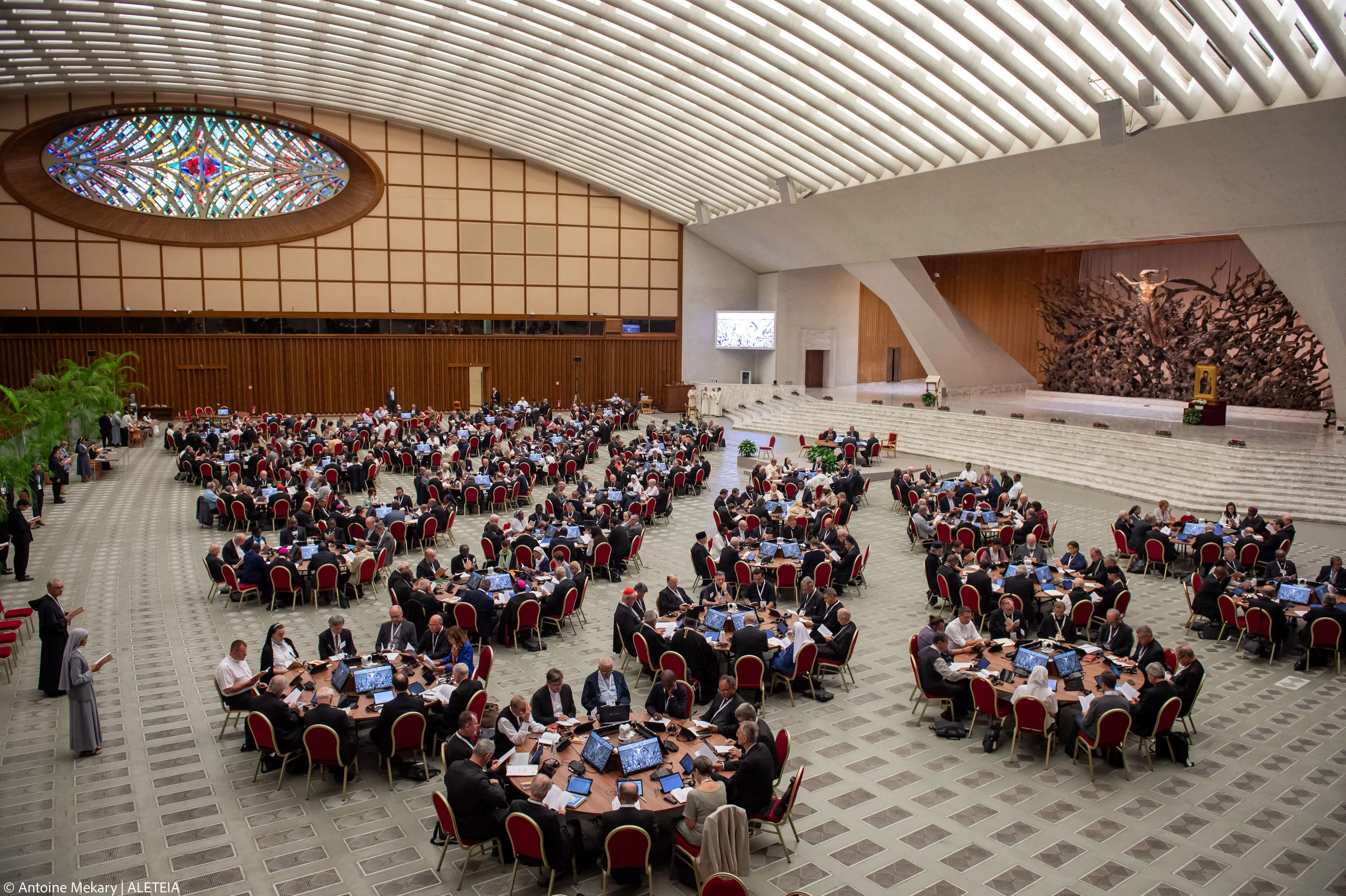
And one deacon. (Actually, two: one was from Syria about to be ordained to the presbyterate.)
There were other lacunae. Many observers noted the lack of parish priests, the poor, and even the lack of substantive influence of the assembled theological consultants when contrasted with the influence of the periti at the Second Vatican Council. But nowhere was the inequity more glaring than that of the diaconate. Imagine a group of men calling a meeting to talk about women, but with no women present. Imagine a meeting about the priesthood, with no priests participating. And imagine a meeting about the diaconate with no deacons. In a choir, each singer has their own voice, and yet each one must listen to the others to form beautiful harmony. If the Church were a choir, the same applies: everyone would have a voice, while listening to all the other voices. Deacons have been told, in glorious terms, that they are part of the choir. But, in terms of the Synod, they have no voice. In a choir, is it better to talk about a tenor or to hear one? In the church, is it better to talk about deacons, or to hear them?
Someone seems to be listening, at least about the lack of parish priests at the Synod. The Synod Secretariat has announced recently an extraordinary 5-day gathering of some 300 priests convening in late April. According to the Secretariat, this is to respond to the desire of the Synod participants to “develop ways for a more active involvement of deacons, priests, and bishops in the synodal process during the coming year. A synodal Church cannot do without their voices, their experiences, and their contribution.” The announced gathering is therefore good news. But once again the question recurs: Where is the gathering of the deacons?
Once again, there is the gap between glorious words and actual practice. When you tell someone that they are valued and that “their voices, their experiences, and their contribution” are vital, and then do nothing to open the door to those voices, why should the nice words be believed? To be excluded again, after the gap is pointed out, feels hurtful and dismissive, conveying clearly that deacons have no voice worth hearing, no experience worth sharing, and no insights to give or to receive. It sends the clear message that deacons are unnecessary, with nothing to contribute. The gap between “gloriosa dicta” and “de profundis” remains.
In conclusion, what may be done? Some will rightly say that none of this impedes our responsibility to care humbly for others and that we do not need a seat at the Synodal tables. I fully affirm the first part of that claim. But serving does not mean we should not also have a share in the Synodal process. As I have suggested elsewhere, perhaps one course of action might be to have conversations within our own parishes and dioceses and pass those insights along to our bishops. Perhaps theologians and canonists might direct the results of their research on the diaconate to the Synod Secretariat for their use. No matter what we do, however, we must do everything we can to bridge the gap between words and actions. As heralds of the Gospel, we can do no less.

 Jesuit Father Thomas Reese has published an interesting piece over at NCRonline entitled
 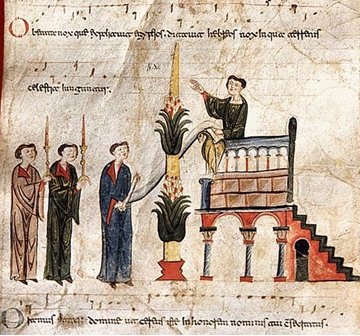 Father states that “[Women deacons] disappeared in the West around the same time as male deacons.” On the contrary, male deacons remained a distinct order of ministry (and one not automatically destined for the presbyterate) until at least the 9th Century in the West. This is attested to by a variety of sources. Certainly, throughout these centuries, many deacons — the prime assistants to bishops — were elected to succeed their bishops. Later in this period, as the Roman cursus honorum took hold more definitively, deacons were often ordained to the presbyterate, leading to what is incorrectly referred to as the “transitional” diaconate. However, both in a “permanent” sense and a “transitional” sense, male deacons never disappeared.
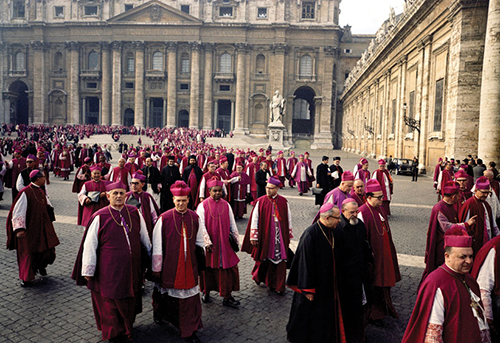 Father Tom writes that his hesitancy concerning the diaconate itself “is not with women deacons, but with the whole idea of deacons as currently practiced in the United States.” (I would suggest that this narrow focus misses the richness of the diaconate worldwide.) He then turns to the Council to provide a foundation for what follows. He writes, “The renewal of the diaconate was proposed at the Second Vatican Council as a solution to the shortage of native priests in missionary territories. In fact, the bishops of Africa said, no thank you. They preferred to use lay catechists rather than deacons.” This statement simply is not true and does not reflect the history leading up to the Council or the discussions that took place during the Council on the question of the diaconate.
 As I and others have written extensively, the origins of the contemporary diaconate lie in the early 19th Century, especially in Germany and France. In fact there is considerable linkage between the early liturgical movement (such as the Benedictine liturgical reforms at Solesmes) and the early discussions about a renewed diaconate: both stemmed from a desire to increase participation of the faithful in the life of the Church, both at liturgy and in life. In Germany, frequent allusion was made to the gulf that existed between priests and bishops and their people. Deacons were discussed as early as 1840 as a possible way to reconnect people with their pastoral leadership. This discussion continued throughout the 19th Century and into the 20th. It became a common topic of the Deutschercaritasberband (the German Caritas organization) before and during the early years of the Nazi regime, and it would recur in the conversations held by priest-prisoners in Dachau. Following the war, these survivors wrote articles and books on the need for a renewed diaconate — NOT because of a priest shortage, but because of a desire to present a more complete image of Christ to the world: not only Christ the High Priest, but the kenotic Christ the Servant as well. As Father Joseph Komonchak famously quipped, “Vatican II did not restore the diaconate because of a shortage of priests but because of a shortage of deacons.”
 Certainly, there was some modest interest in this question by missionary bishops before the Council. But it remained largely a European proposal. Consider some statistics. During the antepreparatory stage leading up to the Council (1960-1961), during which time close to 9,000 proposals were presented from the world’s bishops, deans of schools of theology, and heads of men’s religious congregations, 101 proposals concerned the possible renewal of the diaconate. Eleven of these proposals were against the idea of having the diaconate (either as a transitional or as a permanent order), while 90 were in favor of a renewed, stable (“permanent”) diaconate. Nearly 500 bishops from around the world supported some form of these 90 proposals, with only about 100 of them from Latin America and Africa. Nearly 400 bishops, almost entirely from both Western and Eastern Europe, were the principal proponents of a renewed diaconate (by the way, the bishops of the United States, who had not had the benefit of the century-long conversation about the diaconate, were largely silent on the matter, and the handful who spoke were generally against the idea). Notice how these statistics relate to Father Tom’s observation. First, the renewed diaconate was largely a European proposal, not surprising given the history I’ve outlined above. Second, notice that despite this fact, it is also wrong to say that “the African bishops said no thank you” to the idea. Large numbers of them wanted a renewed diaconate, and even today, the diaconate has been renewed in a growing number of African dioceses.
 Let’s break this down. First, there never has been, nor will there ever be, a “part-time deacon.” We’re all full-time ministers. Here’s the problem: Because the Catholic Church did not have the advantage of the extensive conversation on diaconate that was held in other parts of the world, we have not fully accepted the notion that ministry extends BEYOND the boundaries of the institutional church itself. Some of the rationale behind the renewal of the diaconate in the 19th Century and forward has been to place the Church’s sacred ministers in places where the clergy had previously not been able to go! Consider the “worker-priest” movement in France. This was based on a similar desire to extend the reach of the Church’s official ministry outside of the parish and outside of the sanctuary. However, if we can only envision “ministry” as something that takes place within the sanctuary or within the parish, then we miss a huge point of the reforms of the Second Vatican Council and, I would suggest, the papal magisterium of Pope Francis. The point of the diaconate is to extend the reach of the bishop into places the bishop can’t normally be present. That means that no matter what the deacon is doing, no matter where the deacon is working or serving, the deacon is ministering to those around him.
 Not unlike the previous point, this is a common misperception. However, it is only made if one reduces “being a deacon” to the functions one performs. Let’s ponder that a moment. We live in a sacramental Church. This means that there’s more to things than outward appearances. Consider the sacrament of matrimony. Those of us who are married know that there is much, much more to “being married” than simply the sum of the functions associated with marriage. Those who are priests or bishops know that there is more to who they are as priests and bishops than simply the sum of what they do. So, why can’t they see that about deacons? There is more to “being deacon” than simply the sum of what we do. And, frankly, do we want priests to stop visiting the sick in hospitals or the incarcerated in prisons simply because a lay person can (and should!) be doing that? Shall we have Father stop being a college professor because now we have lay people who can do that? Shall we simply reduce Father to the sacraments over which he presides? What a sacramentally arid Church we would become!
 With all respect to a man I deeply admire, I expect that most deacons who read this part of the column are still chuckling. Yes, I have been treated with great respect by most of the people with whom I’ve served, including laity, religious, priests and bishops. On the other hand, the experience of most deacons does not sustain Father’s observation. The fact is, most people, especially if they’re not used to the ministry of deacons, don’t associate deacons with ordination. I can’t tell the number of times that I’ve been asked by someone, “When will you be ordained?” — meaning ordination to the priesthood. They know I am a deacon, but, as some people will say, “but that one really doesn’t count, does it?” I had another priest once tell me, “Being a deacon isn’t a real vocation like the priesthood.” If it’s respect a person is after “beyond their competence” (to quote Father Reese), then it’s best to avoid the diaconate.







 Deacons Today: Servants in a Servant Church