Pope Francis and Changing the Church

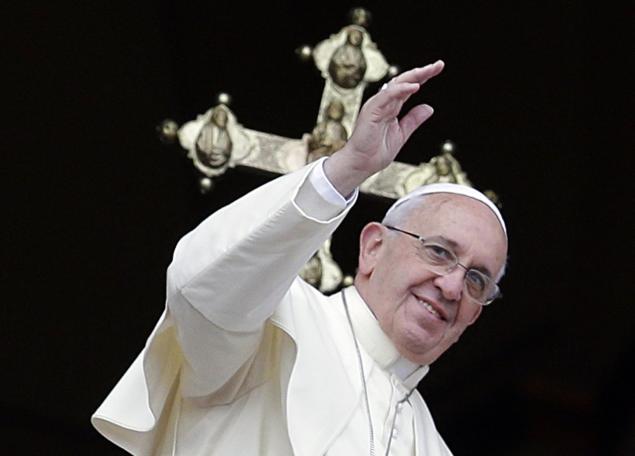
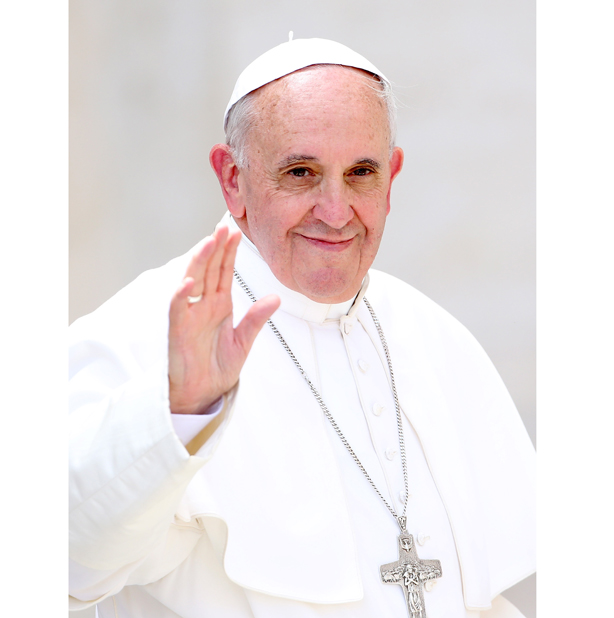
Pope Francis smilingOver on CatholicVote.org, John White has a piece entitled “Year in Review: Church Teachings the Pope Francis Has Changed.”  After some rather pointed (snarky?) comments, he leaves a large white space to communicate that — surprise, surprise! — the Pope has not changed any teachings at all.  It’s not particularly original: many folks who are nervous about Pope Francis try to emphasize that he has not changed any doctrines or dogmas of the Church.  They also characterize those who are excited about the Francis papacy as people who are somehow “anti-Benedict”.  Without naming names, many more “conservative” commentators seem to thrive on mocking this attitude.  I mention all of this, NOT as a way to exacerbate such polarization, simply to acknowledge that the polarization exists.  Certainly some people HAVE gone too far in their enthusiasms — on both sides.  However, it seems to me that most people find themselves rightly in the middle of things: We can love and respect previous popes while also loving and respecting the current pope.  So why bring up this particular attitude at all?

trinity_1I do so because there is a danger with articles like Mr. White’s.  With the snide, defensive tone often employed in pieces like this leading to the conclusion that “the Pope hasn’t changed any teachings,” one can easily come away with the sense that nothing significant has been going on over the last year!

But here’s the point.  The Church is so much more than her official teachings, as important as they are.  To permit an inference that “no change in teaching” means “no change in the church” is dangerously misleading.  The Church is a Trinitarian communio: the People of God, the Mystical Body of Christ, and the Temple of the Holy Spirit.  Yes, we have a body of teachings, but we are more than the doctrines themselves.  To suggest that we are the sum of our teachings is specious; to suggest that our teachings are the most fundamental of our attributes is misleading.  I am of course not minimizing the importance of church teaching, but simply acknowledging the far deeper Mystery involved.

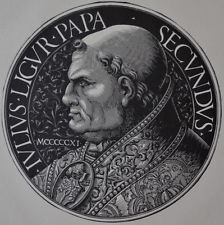
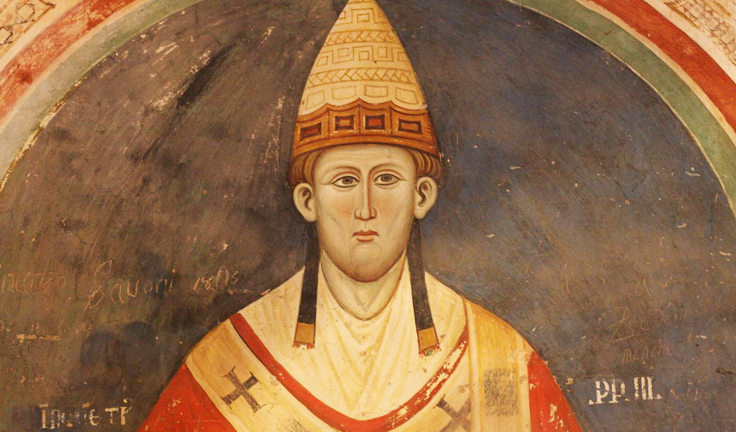
Pope Julius II Pope Innocent IIIAnd this, I think, is precisely where Pope Francis is making a huge difference in the Church.  Each pope contributes to the life of the Church as his talents and gifts permit.  We have had warrior popes in the past, deeply spiritual popes, scoundrel popes, charismatic popes and intellectual popes.  Some have focused on teaching; others have focused on law, and still others have focused on structural matters.  At this point in our history, we happen to be blessed with a pope who has his own unique set of gifts and strengths, and he is changing the Church in ways just as substantive as prior popes, and his focus on the radical servant nature of the Church — as described by Pope Paul VI in his closing homily to the bishops of the Second Vatican Council — is serving to recast the face of the Church in the 21st Century.  He IS challenging all of us — the Church — to change.

francesco blessing

Lenten Reflection on Lenten Reflection

lectionarySince 1995 I have been blessed to serve as retreat director for gatherings of deacons and their wives, deacon candidates and their wives, priests and even bishops.  These have ranged from annual retreats, canonical retreats prior to ordination, anniversary retreats and so on.  It has always been such a wonderful experience: the sessions themselves, the quiet conversations, meal times, the socials, and most especially, the time for prayer.


At Salvatorian Seminary, Bill Ditewig and Bob Woyach, 1966

At Salvatorian Seminary: Bill Ditewig (left) and Bob Woyach (right), 1966

There have been unusual moments, too!  Like the time I discovered that one of the men who would be on retreat was an old high school seminary classmate whom I hadn’t seen since 1967 when we graduated!  It was hard not to look out at him and think, “What a road we have all been on, and we could never have imagined that we would be together again all these years later as deacons.”  Since that experience a few years ago, several more similar encounters with former seminary classmates have taken place: always a humbling experience!

In a similar experience, I remember the first public academic lecture I was asked to give at the Catholic University of America after I received my Ph.D. there.  The topic of the lecture concerned ecclesiology and catechesis, and the audience was full of my former professors, mentors and advisors: now they were there to hear what I had to say as a colleague.  As a retired Navy officer who frequently briefed senior military and government officials and did all sorts of other challenging things at sea and ashore, I don’t think any of those experiences were any more frightening that preparing for that lecture and looking out at those particular people who had taught and inspired me so much.

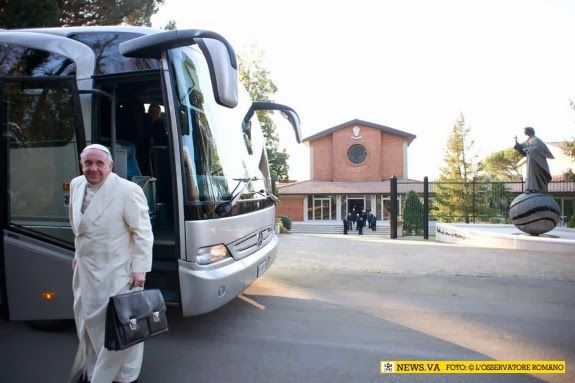
Pope on retreatIt was with those thoughts in mind that I came across the following images of Pope Francis arriving for the Lenten Retreat for the senior curia this year.  Smiling broadly as he steps off the bus from Rome, the pope seems happy to be away from the city, and one can only wonder what books he has brought with him in his briefcase!

The retreat director is a parish priest from Rome, Msgr. Angelo De Donatis.  Imagine looking out at the community of retreatants and seeing the humble figure in white listening to your every word!

The pope definitely came to be on retreat.  It is significant to see that he is wearing the papal cassock without the pellegrina, the short cape usually worn over the cassock.  It was widely reported after Pope-emeritus Benedict went into retirement that he would no longer wear the pellegrina; it is a sign of the jurisdictional authoPope on Retreat 3rity of the bishop, and the pope-emeritus wanted it to be clear to everyone that he no longer exercises papal jurisdiction.  In this case, it seems safe to say that Pope Francis has come with an attitude of leaving the burdens of the papal office behind him for a few days so that he can re-charge his spiritual batteries while on retreat (Now before anyone takes offense by my comments: no one, and certainly not me, is suggesting that he is no longer exercising papal jurisdictional authority while he’s on retreat!  Of course he is the pope and continues to be while he’s on retreat!  I’m simply suggesting a kind of spiritual attitude that focuses at this time more on spiritual renewal than on papal authority.)

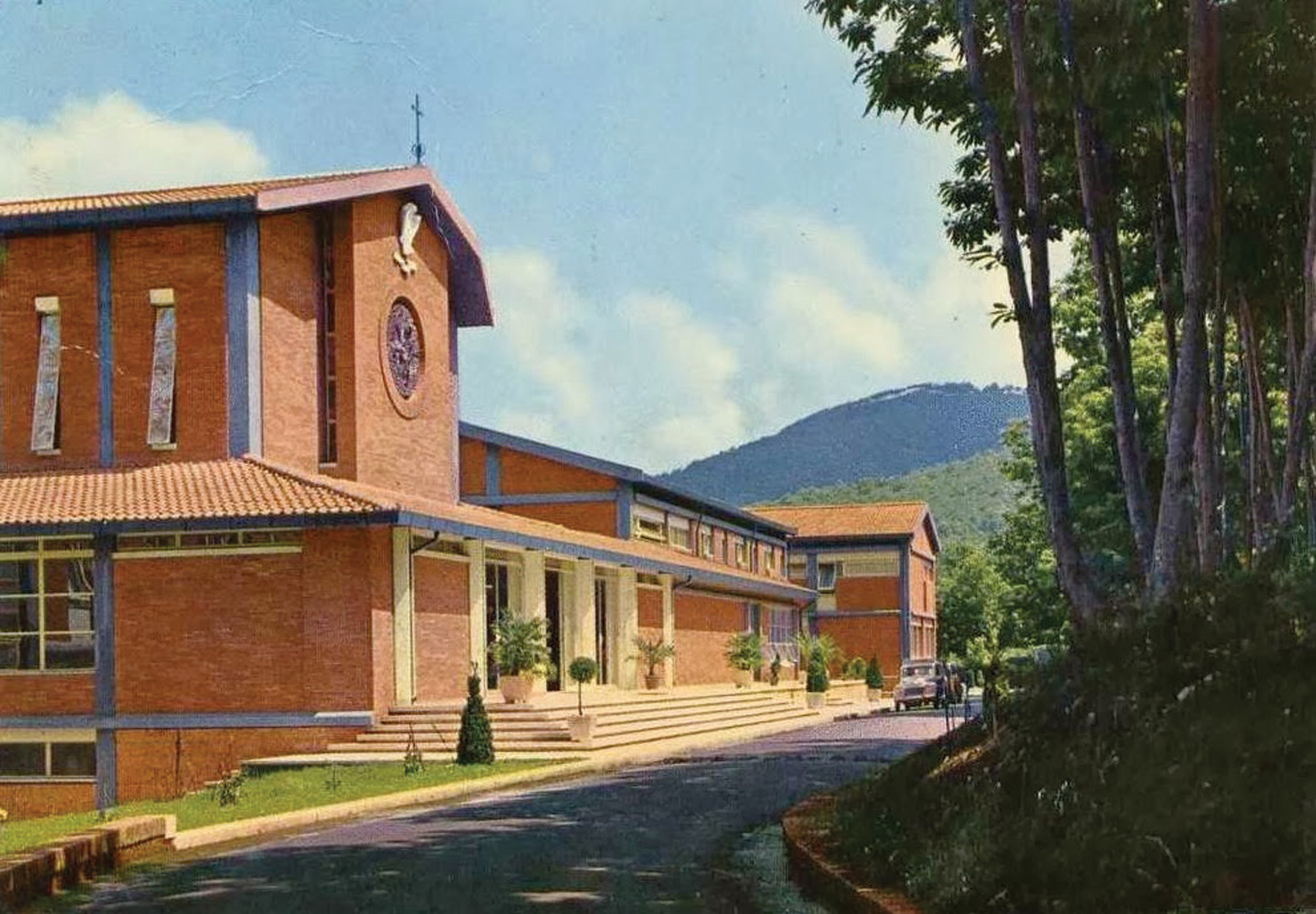
Pope on Retreat 5The Pope has also arranged this retreat away from the Vatican, in order to help the retreatants leave their own familiar environs behind.  He and the curia will be on retreat from March 9-14 at the Pauline Fathers’ retreat and conference center in Ariccia, a small medieval town not far from the papal summer residence of Castel Gandolfo.

REFLECTION:

May we also find creative ways of retreating during Lent.  Most of us may not be able to go off to a nice retreat location, but how might be walk a similar path nonetheless?  Perhaps we can find ways to rearrange our work schedules a bit; maybe we take a lunch break and make a quiet visit to the Blessed Sacrament at a nearby church.  Perhaps instead of going for that extra cup of coffee, we take that time and say a quiet decade of the rosary.  Certainly our parishes offer opportunities as well: go to Confession, make the Stations of the Cross, sit quietly in prayer, take advantage of Lenten speakers or days of recollection.  The benefits of finding a way to “retreat” are incalculable.  The Pope himself said a few days ago that persons who can be on retreat “experience the attraction and fascination of God and return renewed and transfigured in their daily lives, their ministry and their relationships.”  Even if we can’t go on a five-day directed retreat in a beautiful medieval town by a lake, perhaps we can break up our normal routine enough to open ourselves to this transfiguration during Lent.

And, forget the elderly man in white sitting next to you!

Pope on Retreat 1

Forty Days To Get Ready: Ash Wednesday Reflection

lent-40-daysWhile lots of folks are able to get to church on Ash Wednesday, even more cannot.  So, especially for those who could not be present, here are the Mass readings for today.  Before turning to them, however, we might consider the nature of the season of Lent itself.

Every Lent, as we sing about “these forty days” and refer to “the forty days” of Lent, we get questions:  “Why are there more than forty days between Ash Wednesday and Easter?”  “Do the Sundays of Lent ‘count’ as days of Lent?” “Do we ‘count’ Holy Week as part of Lent?”  All of these questions, and so many more, reflect a misplaced understanding of the significance of the number “40” itself.  By looking at it so literalistically, trying to treat it as a kind of math problem, we miss the fundamental point.

Like other ancient languages, the letters that make up the alef-bet (“alphabet”) of the Hebrew language do double duty.  Consider the letters of the Latin language first as an example.  When we see “I” or “V” or “XII” we see both literal and numerical meanings: the letter “I” or the (Roman) numeral for “1”; the letter “v” or the numeral for “5”; the letters “x – i – i” or the numeral for “12”, and so on.

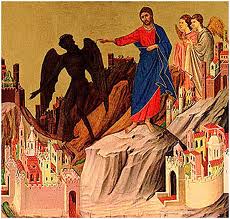
Hebrew alefbetHebrew letters do the same kind of thing, but there is a kind of TRIPLE duty involved: the literal, the numerical, and the symbolical.  Hebrew numbers have symbolic meaning: 1 is a Divine number, as is 3.  The number 2 represents life and strength; the number 4 represents the universe created by YHWH.  3 plus 4, in Hebrew numerology represents the union of the God with God’s creation, making 7 a perfect number.  3 times 4 (12) represents God’s own community.  Since 7 is perfection, 6 represents IMPERFECTION or SIN, since it just doesn’t quite “make the mark” of getting to 7.  Consider some examples: YHWH is always emphasized as ONE God; the animals go into the Ark 2 by 2; 3 is a divine number — not in the later Christian sense of Trinity, but Divine nonetheless.  The 12 tribes of Israel.  And on and on, including the number 40.  The people wander in the desert for 40 years; the rains of the great flood last for 40 days and 40 nights.  We see these things carried forward into Christian Scripture as well.  The very first thing that the apostles have to do following the Resurrection is select a replacement for Judas in order to return their number to 12!  Jesus goes to the desert himself for 40 days where he is tempted.

lent2 temptationsSo what does all of this mean for us for the “forty days of Lent”?

The number 40 is used to designate a period of human preparation and testing in readiness for a MISSION which follows.  After the Israelites wander in the desert for 40 years, the enter the Promised Land; after the rains stop, YHWH and Noah enter into a whole new covenant; after his own sojourn in the desert, Jesus embarks on his public ministry as the Christ.  So the period of time represented by “40” always points to what is to come: a renewal of covenant relationships as we enter into a new phase of mission.

lent 40 days noahThat’s the role of the forty days of Lent: it is not a goal in and of itself.  It is to be a time of preparation for whatever the Lord is calling us to be and to do after Easter!  How are we being formed for post-Easter mission?  Just as we refer to Lent as the period of Purification and Enlightenment for the candidates for sacramental initiation at the Eastern Vigil, so too it is for the rest of us as well.  This is a time of spiritual “boot camp” in which we are refined, formed and empowered for the mission to come.

So we come to today’s readings.  The prophet Joel proclaims:

Even now, says the LORD,
return to me with your whole heart,
with fasting, and weeping, and mourning;
Rend your hearts, not your garments,
and return to the LORD, your God.

Lent1While we often talk about the external things we’re “going to give up” for Lent, Joel reminds us that the true purpose is the journey back to the Lord God “with our whole heart.”  External observances, while they can be important, are not nearly as important as our internal conversion: “rend your hearts, not your garments.”

Matthew makes the same point in the Gospel:

Take care not to perform righteous deeds
in order that people may see them;
otherwise, you will have no recompense from your heavenly Father.

Whether in giving alms, praying, or fasting, the conversion to God is internal and not the result of “doing” the right things during Lent.  Unless the outward observance reflects an internal “return to the Lord with your whole heart” we have missed the point!

But then there’s that whole “40 days” thing to consider.  How does this interior conversion prepare us for the mission to come?  Pope Francis, in his Ash Wednesday homily earlier today, issued the challenge:

We run the risk of closing ourselves to others also: we risk forgetting them, too – but only when the difficulties and sufferings of our brothers challenge us, only then we can start our journey of conversion towards Easter. It is an itinerary that includes the cross and sacrifice. Today’s Gospel shows the elements of this spiritual journey: prayer , fasting and almsgiving (cf. Mt 6,1-6.16-18 ). All three involve the need not to be dominated by the appearance of things: the appearance of things does not matter – nor does the value of life depend on the approval of others or on success, but from how much we have inside. . . .

With its calls to conversion, Lent comes providentially to rouse us, to shake us from our torpor, from the risk of moving forward [merely] by inertia. The exhortation that the Lord speaks to us through the prophet Joel is loud and clear: “Return to me with all your heart” (Joel 2:12). Why must we return to God? Because something is wrong in us, in society, in the Church – and we need to change, to turn things around, to repent! Once again Lent comes to make its prophetic appeal, to remind us that it is possible to realize something new within ourselves and around us, simply because God is faithful, continues to be full of goodness and mercy, and is always ready to forgive and start over from scratch. With this filial confidence, let us set out on our way!

Read his whole homily here.

Blessed Lenten journey to all!


Preaching Like the Pope in Nine Easy Lessons

Francis preaching 3Within the context of a universal call to proclaim the Gospel by all the baptized, the Pope now turns his attention to the liturgical homily.  He refers to the homily as “the touchstone” for judging a minister’s (he specifies “pastor” but given what he is about to say, it would apply as well to all bishops, deacons and presbyters) “closeness and ability to communicate to his people.”  And so he begins his short course on homiletics.

Lesson #1:  The Homily as Experience, Encounter, and Source of Renewal
Youth-PossibilityPope Francis reminds all homilists of the potential of the homily.  Rather than something to be dreaded by all concerned, the homily should be “an intense and happy experience of the Spirit, a consoling encounter with God’s word, a constant source of renewal and growth.”  The initiative is all on God’s part: God wishes to communicate with God’s People, using the preacher as His instrument.  The homily is, therefore first and foremost, God’s loving outreach to His People.  Once the preacher thinks he is preaching his own message, the homily is doomed.  This is a great comfort to preachers!  A homily is not just another speech we might devise; it is an attempt to find God’s will and God’s words.  Our focus is on God and on the People: we’re just a go-between trying to help the connection between the two.

Lesson #2:  The Liturgical Context
Francis preaching 2The homily occurs during a liturgical celebration, and this further assists the homilist.  Pope Francis quotes Pope John Paul II: “the liturgical proclamation of the word of God, especially in the Eucharistic assembly, is not so much a time for meditation and catechesis as a dialogue between God and his people, a dialogue in which the great deeds of salvation are proclaimed and the demands of the covenant are continually restated.”  But Pope Francis goes further: “The homily has special importance due to its Eucharistic context: it surpasses all forms of catechesis as the supreme moment in the dialogue between God and his people which leads up to sacramental communion.”  We are told in the liturgical books that when the scriptures are read in Church, it is Christ who proclaims: in the homily during the Eucharist, Christ continues that conversation.  Furthermore, the homily for us is not the only action of Christ during the liturgy!  The pope reminds us that, even though the human skill of the preacher might permit him to drone on and on (well, OK, so the Pope doesn’t say “drone”; but he does say that the homily “should be brief” because if it goes on too long it will affect “the balance and the rhythm” of the liturgy.  Since the homily is itself liturgical, it should “guide the assembly, and the preacher, to a life-changing communion with Christ in the Eucharist.”

Lesson #3: Talk With Your Mother

mother and childIn a lovely passage (##139-141) the Pope reminds us that the Church is a mother, and so “she preaches in the same way that a mother speaks to her child, knowing that the child trusts that what she is teaching is for his or her benefit, for children know that they are loved.”  But he also points out that the good mother listens to the concerns of her children and learns from them.  The preacher is “to hear the faith of God’s people. . . . The language is a kind of music which inspires encouragement, strength and enthusiasm.”  All of this should be found through “the closeness of the preacher, the warmth of his tone of voice, the unpretentiousness of his manner of speaking, the joy of his gestures.”  Pope Francis speaks of the great dialogue Christ had with the people of his day, a dialogue he wishes to continue.  The secret to Christ’s approach, he says, “lies in the way Jesus looked at people, seeing beyond their weaknesses and failings.”  He is full of the joy of his relationship with his Father.

Lesson #4: Choose Words of the Heart
holding the lightOnce again the pope uses the language of dialogue, which “is so much more than the communication of a truth.  It arises from the enjoyment of speaking and it enriches those who express their love for one another through the medium of words.”  This enjoyment is not simply in “objects” but in the persons participating in the dialogue.  The pope cautions that we are not dealing with “abstract truths or cold syllogisms” but through the beauty of images and wonder, a source of hope from the joyful and practical exercise of the love they have received.  “The challenge of an inculturated preaching consists in proclaiming a synthesis, not ideas or detached values.  Where your synthesis is, there lies your heart” (#143).   Words mediate meaning, but the right words also join two hearts: God and the People.  It falls to the preacher, who should know both God and the People so well, to find the right words to build up this loving covenant of Heart to hearts.

Lesson #5: Reverence for Truth

preachingorgheader1Turning his attention to the actual preparation of the homily, the pope encourages a “prolonged time of study, prayer, reflection and pastoral creativity.”  Almost apologetically, the pope says, “I wish to stop for a moment and offer a method of preparing homilies.”  He knows that most preachers are so busy with pastoral responsibilities that it is often hard to find the time to devote to this proper preparation.

Nonetheless, I presume to ask that each week a sufficient portion of personal and community time be dedicated to this task, even if less time has to be given to other important activities. . . .  A preacher who does not prepare is not ‘spiritual’; his is dishonest and irresponsible with the gifts he has received.

After prayer, our entire attention is to be given to the biblical text, “which needs to be the basis of our preaching.”  In great humility, we are to pause often and seek a greater understanding of the text.  This is what the Pope calls “reverence for the Truth.”  “To interpret a biblical text, we need to be patient, to put aside all other concerns, and to give it our time, interest and undivided attention.”  The pope is clear: if you’re looking for quick results, you are going about it all wrong.  “Preparation for preaching requires love.  We only devote periods of quiet time to the things or the people whom we love; and here we are speaking of the God whom we love, a God who wishes to speak to us. . . . ‘Speak, Lord, for your servant is listening'” (1 Sam 3:9).

Next, we must understand the meaning of the words we read.  However, the pope says, while we do want to use all of our critical tools in analyzing the text, the single most important thing is to find its principal message, “the message which gives structure and unity to the text.”  The preacher should also use the text as it was intended:

If a text was written to console, it should not be used to correct errors; if it was written as an exhortation, it should not be employed to teach doctrine; if it was written to teach something about God, it should not be used to expound various theological opinions; it it was written as a summons to praise or missionary outreach, let us not use it to talk about the latest news.

Lesson #6: Personalize the Word
kneeling_in_prayer1The preacher needs a “great personal familiarity with the word of God.”  We must approach the word “with a docile and prayerful heart so that it may deeply penetrate his thoughts and feelings and about a new outlook. . . .”

It is good for us to renew our fervor each day and every Sunday as we prepare the homily, examining ourselves to see if we have grown in love for the word which we preach. . . .  If we have a lively desire to be the first to hear the word which we must preach, this will surely be communicated to God’s faithful people. . . .”

This wonderful examination of conscience helps us to avoid the anger of Jesus who “was angered by those supposed teachers who demanded much of others, teaching God’s word but without being enlightened by it. . . . The apostle James exhorted: ‘Not many of you should become teachers, my brethren, for you know that we who teach shall be judged with greater strictness” (Jas 3:1).  The word of God must become incarnate in the daily life of the preacher.

The preacher’s attitude is one of total humility and dependence upon the Holy Spirit: “the Holy Spirit places on his lips the words which he could not find by himself.”

Lesson #7: Spiritual Reading: Lectio Divina

Fully integrated into the search for the scripture passage’s principal message is the prayerful reading of scripture and finding its application in the preacher’s own life.   The pope offers a wonderful series of questions for reflection:

  1. What does this text say to me?
  2. What is it about my life that you want to change by this text?
  3. What troubles me about this text?
  4. Why am I not interested in this?
  5. What do I find pleasant in this text?
  6. What is it about this word that moves me?
  7. What attracts me?
  8. Why does it attract me?

Lesson #8:  An Ear to the People

Pope Francis, as we have seen so many times in the past, always speaks in terms resonating with the ideas of the Second Vatican Council.  Consider the following citations from the beginning of Vatican II’s Gaudium et spes:

1. The joys and the hopes, the griefs and the anxieties of the men of this age, especially those who are poor or in any way afflicted, these are the joys and hopes, the griefs and anxieties of the followers of Christ. Indeed, nothing genuinely human fails to raise an echo in their hearts. . . .

4. The Church has always had the duty of scrutinizing the signs of the times and of interpreting them in the light of the Gospel. Thus, in language intelligible to each generation, she can respond to the perennial questions which men ask about this present life and the life to come, and about the relationship of the one to the other. We must therefore recognize and understand the world in which we live, its explanations, its longings, and its often dramatic characteristics. . . .

Now hear Pope Francis (citing Pope Paul VI’s landmark Evangelii Nuntiandi) as he exhorts preachers to have “an ear to the people.”  “A preacher has to contemplate the word, but he also has to contemplate his people.  In this way he learns ‘of the aspirations, of riches and limitations, of ways of praying, of loving, of looking at life and world, which distinguish this or that human gathering,’ while paying attention ‘to actual people, to using their language, their signs and symbols, to answering the questions they ask.’

The pope notes that we need to truly understand what really affects people’s lives: their experience is what matters, and the pope remarks that “we should never respond to questions that nobody asks”!  The homily is more than a simple challenge of current affairs: we are to respond to human experience “in light of the Gospel”: challenging what needs to be challenged, affirming what is to be affirmed.

Lesson #9: Homiletic Resources

Here the pope challenges preachers to attend to the technical aspects of homily preparation and delivery.  While the primary focus is always spiritual, even these technical components have a spiritual foundation.  He first lists “imagery”: how well do we find and use appropriate images in our homilies?  Not merely examples, which appeal to the mind, but images, which appeal to the whole person.  Again citing Paul VI, preaching should be “simple, clear, direct, well-adapted.”  He cautions that many preachers fall into the trap of using the technical and theological words learned through years of formation and education; we must adapt our language accordingly to be understood.  It must be well-organized as well: there should be “thematic unity, clear order and correlation between sentences.”  Finally, the homily must be positive.  We should focus less on what should not be done, but with what we can do better.  “Positive preaching always offers hope, points to the future, does not leave us trapped in negativity.”  Let me recap the resources the pope highlights:

  1. Use of imagery more than examples
  2. Simple language
  3. Clearly presented
  4. Well-Adapted
  5. Thematic Unity
  6. Clear Order and Correlation in Structure
  7. Positive

That’s it!  Preaching Like the Pope in Nine Easy Lessons!

“How good it is when priests, deacons and the laity gather periodically to discover resources which can make preaching more attractive.”
bible.17

Preaching Like the Pope, Part One

Francis preaching 4Want to preach like the Pope?

Many images have been filling ecclesial cyberspace over the last few days: Pope Francis sending a video to a Kenneth Copeland charismatic rally of Evangelical Christians in Texas, the creation of new Cardinals from around the world, his homilies, his Angelus message and so much more.  During the Angelus this weekend, for example, the Pope observed that “a community does not belong to the preacher, but to Christ”.

Francis to EvangelicalsPope Francis has become renowned for his preaching: not just in his content, but in the way he does it.  Want to preach like the Pope?  Francis gives us all a homiletics class in his Apostolic Exhortation Evangelii Gaudium, so I’d like to take a closer look at that section of the Exhortation.

The pope’s teaching on the homily is part of a grand chapter on “The Proclamation of the Gospel.”  The chapter consists of four major sections, each of which demands significant attention: “The Entire People of God Proclaims the Gospel,” “The Homily,” “Preparing to Preach,” and “Evangelization and the Deeper Understanding of the Kerygma.”  The homily is the heart of the chapter.  But this heart beats within the larger body of the Gospel, so let’s look a bit at the first section of the chapter.  That will be the subject of this blog post; I’ll follow up with another on the homily itself.

The Entire People of God Proclaims the Gospel

DisciplesPope Francis begins by reminding his readers that “the Church. . . is more than an organic and hierarchical institution; she is first and foremost a people advancing on its pilgrim way toward God.”  Acknowledging the Church as a Trinitarian mystery, the pope emphasizes that “she exists concretely in history as a people of pilgrims and evangelizers, transcending any institutional expression, however necessary.”

Everything about the Church begins with God: not simply a human desire for community, but God’s offer of communion and eternal life, an offer that the pope stresses “for everyone”:

Jesus did not tell the apostles to form an exclusive and elite group.  He said: “God and make disciples of all nations” (Mt 28:19).  St. Paul us in the people of God, in the Church, “there is neither Jew or Greek. . . for you are all one in Christ Jesus” (Gal 3:28).

Not long ago, reports emerged from several locations about bishops who were objecting to certain songs and hymns on theological grounds.  One example was the song, “All are Welcome.”  The apparent argument is that, in fact, NOT “all are welcome.”  I do not critique the musical appropriateness of certain hymns and songs, but certainly a theology which suggests that the Church is not a place where “all are welcome” is certainly flawed.  All of us are sinners, and all of us need the “hospital” that is the Church.  And, despite recent liturgical translations to the contrary, Christ did indeed die and rise for all.  To suggest that his soteriological mission was selective in intent and effect is likewise flawed.  This is not a facile “universalism”; rather it speaks to the scope and intent of Christ’s kenosis and mission.

The great themes of the Second Vatican Council have always formed the foundation of this pope’s teaching.  Consider this paragraph from Vatican II’s Gaudium et spes, #40:

Coming forth from the eternal Father’s love, founded in time by Christ the Redeemer and made one in the Holy Spirit, the Church has a saving and an eschatological purpose which can be fully attained only in the future world. But she is already present in this world, and is composed of men, that is, of members of the earthly city who have a call to form the family of God’s children during the present history of the human race, and to keep increasing it until the Lord returns. United on behalf of heavenly values and enriched by them, this family has been “constituted and structured as a society in this world” by Christ, and is equipped “by appropriate means for visible and social union.” Thus the Church, at once “a visible association and a spiritual community,” goes forward together with humanity and experiences the same earthly lot which the world does. She serves as a leaven and as a kind of soul for human society as it is to be renewed in Christ and transformed into God’s family.

Now, here is Pope Francis, fleshing out that last sentence:

Being Church means being God’s people, in accordance with the great plan of his fatherly love.  This means that we are to be God’s leaven in the midst of humanity.  It means proclaiming and bring God’s salvation into our world, which often goes astray and needs to be encouraged, given hope and strengthened on the way.  The Church must be a place of mercy freely given, where everyone can feel welcomed, loved, forgiven and encouraged to live the good life of the Gospel.

The Pope then turns to the role of culture in evangelization, stressing that no one culture incarnates the Gospel; rather, “Grace supposes culture, and God’s gift becomes flesh in the culture of those who receive it.”  He speaks of the “logic of the incarnation,” the whole design and effect of God’s becoming human: “Evangelization joyfully acknowledges these varied treasures which the Holy Spirit pours out upon the Church.  We would not do justice to the logic of the incarnation if we thought of Christianity as monocultural and monotonous. . . .  it’s content is transcultural.”

hulaSuch a teaching raises many questions, challenges and opportunities, of course.  Take just one example from the so-called “liturgy wars”: the elements of liturgy are nothing if not culturally expressive!  While a particular culture may find meaning through particular forms of chant or movement, other cultures — expressing the same religious truths — would be better served by their own cultural lens.  For example, a European-based community might find Gregorian chant and processions evocative and full of meaning.  A Hawaiian community might find mele and hula better suited to expressing the richness of Christianity.  The gesture of striking one’s breast as a sign of penitence has meaning in certain cultures, but in certain African traditions the same gesture is a sign of threat and challenge: to prescribe one gesture over another would make no cultural sense and might actually serve to distort religious truth!  The Pope puts its this way:

We cannot demand that peoples of every continent, in expressing their Christian faith, imitate modes of expression which European nations developed at a particular moment in their history, because the faith cannot be constricted to the limits of understanding and expression of any one culture.  It is an indisputable fact that no single culture can exhaust the mystery of our redemption in Christ.

The pope then turns to the notion that all are missionary disciples, each and every baptized person.  Furthermore, “all of us are called to mature in our work as evangelizers.  We want to have have better training, a deepening love and a clearer witness to the Gospel. . . . Our falling short of perfection should be no excuse; on the contrary, mission is a constant stimulus not to remain mired in mediocrity but to continue growing.”

Finally, Pope Francis presents a strong reflection on “the evangelizing power of popular piety.”  More than simple expressions of faith, forms of personal piety incarnate powerful theological richness: “Nor is it devoid of content; rather it discovers and expresses that content more by way of symbols than by discursive reasoning, and in the act of faith greater accent is placed on credere in Deum than on credere Deum.”  It appeals to the heart as well as the head.

Francis preachingIn his treatment of personal testimony and the charisms available to each one as an evangelizer, the pope stresses a mufti-faceted approach: through the specific forms of each culture and the varied means of communication: “We should not think, however, that the Gospel message must always be communicated by fixed formulations learned by heart or by specific words which express an absolutely invariable content.  This communication takes place in so many different ways that it would be impossible to describe or catalogue them all, and God’s people, with all their many gestures and signs, are its collective subject.”

It is within this context that the Pope turns his attention to the subject of the liturgical homily.  So do we.

Francis preaching 3


Pope Francis: Sitting on the Dock of the Bay

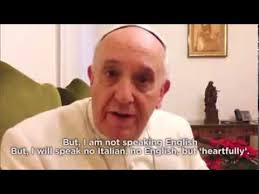
Pope WaveMany people around the world have begun talking about the so-called “Francis Effect”, which I suppose could best be described as the resurgence of interest and participation in the Catholic Church due to the influence of Pope Francis and his vision for the church.  Especially in Europe, church leaders have noted a demonstrable increase in church attendance, and certainly the Pope’s weekly Wednesday audiences have nearly trebled in size since his election.  Here in the United States, recent studies have not yet documented such a radical increase, although a lot of us serving in parishes have certainly seen a notable increase in interest and enthusiasm.  Last night, I saw first-hand the “Francis Effect” in action, right here at a bar on Fisherman’s Wharf on Monterey Bay.

“Theology on Tap” is a program that’s been around quite a while now across the country, and it’s proved a durable and popular way to Theology on Taptalk about the faith and to answer questions and concerns people have.  That has certainly been the case in the Diocese of Monterey, where for more than four years, Deacon Warren Hoy has been coordinating monthly meetings on topics ranging from a variety of social justice issues, to discussions on exorcisms, just war theory, and so on.  There is a solid core of attendees, and always fresh faces drawn by a particular topic.  In a conversation with Warren a month or so ago, he shared some frustration at finding a topic and speaker for the January gathering, and in desperation, he asked me to be the speaker.  “Talk about whatever you want to,” he said.  I suggested having a conversation about Pope Francis.  That was it.  No further details, no dramatic and sexy topic: just, “let’s talk about Pope Francis.”  That’s how the announcements went out.

Last night, there on the dock of the Bay, a record number of folks turned out.  Estimates ranged between 60-80 people, which for this area, is HUGE.  I have addressed this gathering before, and while there is always good interest, last night there was a palpable difference.  There was great energy and enthusiasm about the pope and what he’s trying to do.  We talked about the nature of reform in the Church, whether that applies to the Roman Curia itself, or just a reform in pastoral approaches.  Some folks came up later to tell me that they weren’t Catholic, but that they too found great hope in the Pope’s approach and were interested in finding out more about how they might get involved and perhaps even become Catholic!  The lifelong Catholics shared how wonderful it was to be focused on POSITIVE issues in the Church these days, and to have a sense of re-commitment to their own involvement in the Church.

So, cue Otis Redding: Sitting on the dock of the bay, here in Monterey, Pope Francis is having a profound effect.

And, as if to underscore that point: next month, a new Theology on Tap venue is opening up down the road in the Salinas.  The word is spreading.

CA583-Monterey Bay At Sunrise -leveled

A Simple, Lovely Gesture: Cardinal Loris Capovilla

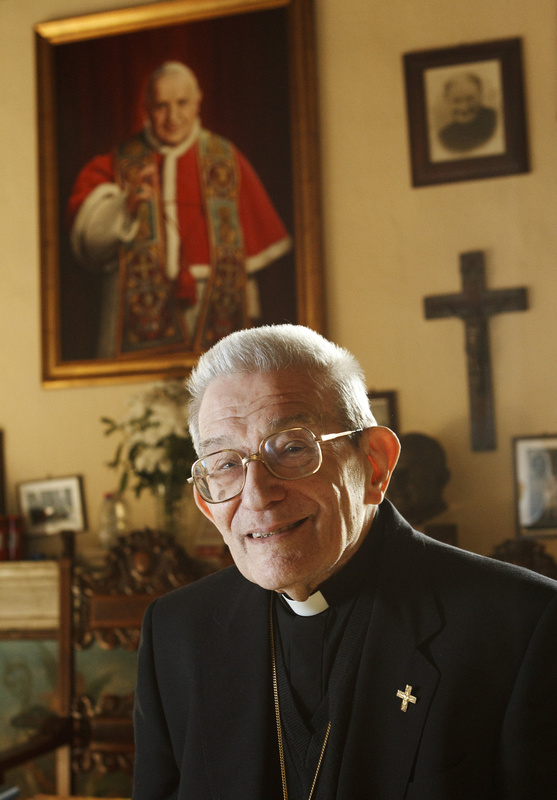
ARCHBISHOP LORIS CAPOVILLA, PERSONAL SECRETARY OF BLESSED JOHN XXIII, PICTURED AT RESIDENCE

Retired Archbishop Capovilla under Portrait of John XXIII

Pope Francis has now announced his selections to be named Cardinals at the next Consistory on 22 February 2014.  There were no real surprises in the list, but there was an unusual tribute paid to Pope John XXIII, who will be canonized in company with Pope John Paul II next April.  On the list of new cardinals was the name of Loris Francesco Capovilla, formerly a priest of the Archdiocese of Venice and long-time secretary to Cardinal Roncalli during his service as the Patriarch of Venice and then during his tenure as Pope John XXIII.

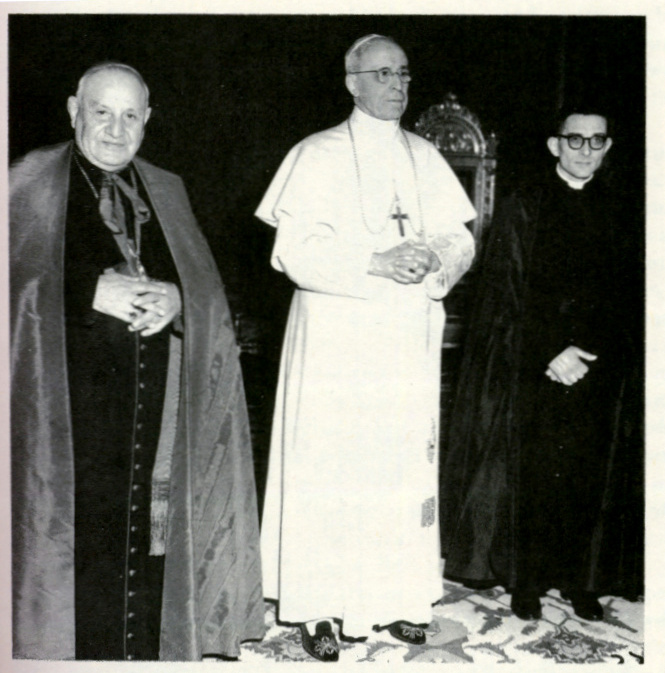
Roncalli and Capovilla and Pacelli

Last Audience with Pope Pius XII. Cardinal Roncall and Father Capovilla, 1957

Loris was ordained a priest for the Archdiocese of Venice in 1940.  When newly-appointed Cardinal Angelo Roncalli arrived in Venice in 1953 to take over as Patriarch, he tapped Fr. Capovilla to be his priest-secretary.  He accompanied the Cardinal to Rome on many occasions, including Roncalli’s trip to Rome for Conclave following the death of Pope Pius XII in 1958.  Following his boss’s election to the papacy, Fr. Loris remained at his side until Pope John’s death on the feast of Pentecost, 1963.

Father Capovilla was ordained a bishop in 1967 and retired in 1988.  He now resides in a community named after the birthplace of his old friend.  Over the years, he has been an invaluable resource for scholars studying the ministry of Papa Giovanni, and his selection to be a Cardinal is simply one more sign of Pope Francis’ own devotion to Pope John.  The pope, of course, already waived the necessity of a second miracle to be attributed to Pope John, and coupled his canonization with that Pope John Paul II.

roncalli e capovilla

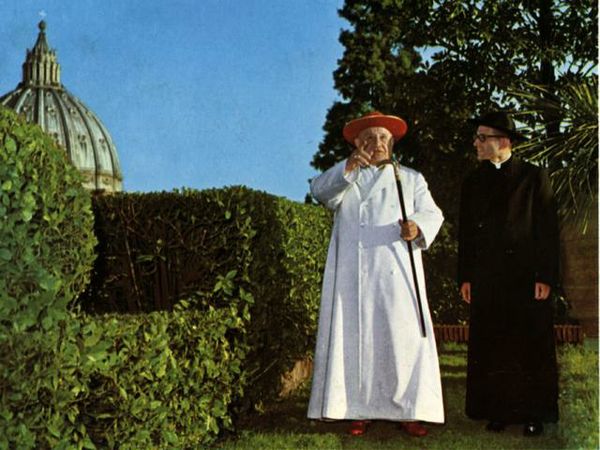
Capovilla walking in the Vatican Gardens with Pope John

Amidst all of the armchair analysis of the other cadinalatial selections and their possible impact on the Church, this particular selection is a simple, lovely gesture of humility and respect.


Sotto il Monte Giovanni XXIII

The Community of “Sotto il Monte Giovanni XXIII”

Monsignors and Serving the People of God UPDATED

monsignors

A Ceremony “Robing” New Monsignori

Big “insider baseball” church news was the decision of Pope Francis to eliminate all but the lowest “rank” of Monsignor, and then to restrict even that form to diocesan priests over 65.  There have been all kinds of interesting reactions to this news!  One one side of the spectrum are those who find the move refreshing and a good first step at eliminating a sense of medieval-ism and careerism within the clergy; on the other, heads are exploding over this smack to the side of the clerical heads of those who found becoming a monsignor an affirmation of their personal and ecclesial worth.  One priest-blogger criticized that this decision was not made by the Pope in any kind of consultative manner and that perhaps it would be best for such matters to be dealt with on a local (diocesan) level.  Sorry, Father, it couldn’t work that way: “Being a monsignor” was always a PAPAL prerogative; it was his “gift”, although bishops would nominate men for the honor.  As the maxim has it, “he who gives, takes away.”  Furthermore, the pope DID consult on this decision.  He put a months-long moratorium on making any new monsignors, and I think it’s safe to assume he discussed this with his special group of Cardinal-advisors at their recent meeting.  This shouldn’t have surprised anyone at all!

For those new to this kind of thing, what are we talking about here?

First, Christ didn’t name “monsignors” (monsignori if you want to sound like Father Z).  This was a creation by church leadership as the “course of honors” (cursus honorum) developed through the post-Constantinian marriage of church and state which lasted until the American Revolution.  Just as secular honorifics and structures were created, they were paralleled in church honorifics and structures.  The word itself simply means “my lord”, and in some countries, it is actually a title used for a bishop.  It has absolutely NO connection to the sacrament of Holy Orders, although it is restricted to men who are in the Order of Presbyters.  As a deacon, of course, I never had any hopes of ever being a Monsignor anyway!  But people should understand that if their pastor went from being called “Father” to “Monsignor”, it didn’t mean that he had any more “sacred power” than a simple priest.  It was purely an honorific, usually given to two broad categories of priests: those who were younger and being signaled as those who might someday become bishops, and on those older men whom the bishop wanted to thank for a ministry well served.  As one priest-friend put it when he became a Monsignor, “I asked the bishop why he had done this.  He told me he wanted to thank me.  I asked him, ‘Why not just take me to dinner?’ I can’t even spell ‘Monsignor’!”  Later, my friend was named a bishop.  After his episcopal ordination, he e-mailed me that “at least I can spell ‘bishop.'”

Second, a bit of contemporary perspective.  As I’ve written about before, I’ve been around church and ministry for my whole life, and was in the seminary myself for high school and college (1963-1971).  Even before that time, the majority of the priests I knew in my diocese detested the idea of becoming a Monsignor.  On the one hand, we had a great Monsignor in our parish, and we all loved him.  He was Monsignor Patrick O’Connor Culleton, ordained in Dublin in 1901, came to our Diocese in Illinois early on, and became pastor at our parish in 1920; he remained pastor there until his death in the late 1950’s.  He was the pastor when a young newly-ordained priest named Fulton Sheen came to the parish for his first assignment.  Sheen always said that the Monsignor was the holiest priest he’d ever known.  But the younger priests — most of them anyway — wanted nothing to do with this kind of honorific, claiming that it was a relic of a time gone by that had no relevance whatsoever in the Church serving in the modern world.  It made no difference at all when one was marching for civil rights, or visiting people in an inner city slum.  In short, monsignori were seen as belonging to a different era in the life of the church.

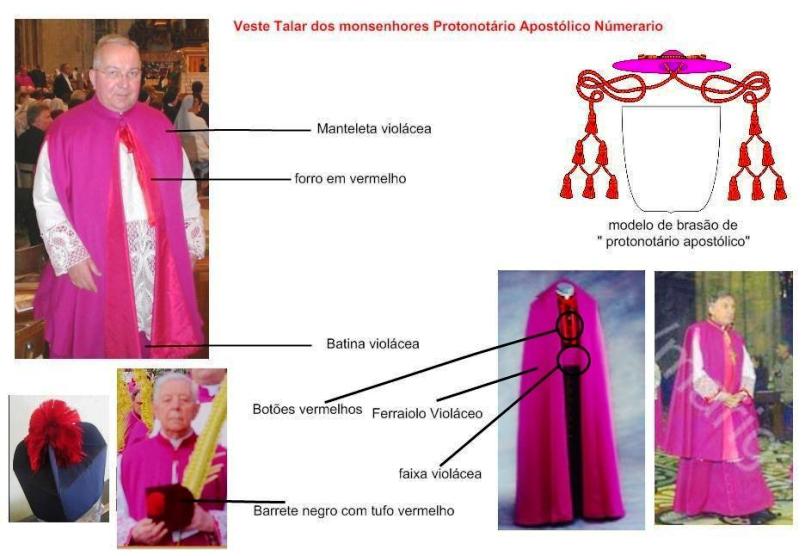
The bishops at the Second Vatican Council agreed.  They were dead set against retaining structures and processes that no longer served any practical, pastoral use in the life of the church, and they directed the Holy Father to streamline things.  Pope Paul VI took this task on, and in 1972, the whole sacrament of Holy Orders was restructured, eliminating in the Latin Church the Rite of First Tonsure, the four minor orders and the major order of the Subdiaconate.  The diaconate was now to be exercised permanently and could be opened to both celibate and married men.  The same pope also reduced the number of “classes” or “ranks” of monsignori.  No one really knows just how many classes there were!  Some sources tally fifteen different classes of monsignor, others have twelve or thirteen.  Popeprotonotarios_zpsc9e4a1b2 Paul reduced them to three only.  Now, Pope Francis has reduced this list to one, and then only for diocesan priests over the age of 65.

What difference will this make?

1) On a practical level, absolutely none.  A priest is a priest is a priest.  That’s always been the case, sacramentally.  This doesn’t change that.  The best news is that priests don’t have to go out and buy all the fancy rig that was associated with being a monsignor.

2) For those men who actually wanted to be monsignori (and, at least in my humble experience, that’s been thankfully a very small number!), it will mean that they can now refocus their efforts on being the best priests they can be without waiting for a title or new clothes.  In honor of their non-selection as monsignori, perhaps these men could join their deacons and lay folks in paying an extra visit to a homeless shelter or in lobbying for a change in unjust laws or for immigration reform.  I’m not saying that these men are not doing good things already; but if they’re not going to have to worry about being a monsignor, they’ll be free to focus on other things.  Like getting the smell of the sheep on their clothes.

Cassock_purpled_zpsc36574403) There IS a negative side to this.  Our good priests DO deserve some kind of recognition and support for their ministry; all people who serve do!  We do need to support our priests and acknowledge their service and commitment.  Some bishops, out of a lack of any other ideas, thought that at least by getting the pope to name a priest a monsignor, this could be a small way of doing that.  But here’s a chance for some grass-roots creativity and initiative!  Being a monsignor was no way to recognize anyone, and in some men it just created more difficulties that it was worth.  What CAN we do, in a positive way, to acknowledge someone’s service?  No one who serves AS CHRIST SERVED needs or wants recognition.  The only human recognition Christ got was to be nailed to a cross, after all.  Still, as human beings, it’s nice to know when something we’ve done has been effective.  What can we do, what can YOU do, to show appreciation to ALL who serve in the name of Christ and in the name of the Church?

UPDATE

As I continue to follow the various blog responses to this issue, I was struck by something.  It seems to me, anecdotally and not based on any scientific analysis, that most of the folks OBJECTING to the loss of new monsignors are people who are converts to Catholicism.  By and large, so-called “cradle Catholics” like myself are all in favor of it; those who have come later to the Church seem to be suffering the loss.  File in the “interesting, for what it’s worth” categories.

Happy New Year!

The Once and Future Pope Francis

It seems like Pope Francis is everywhere in the media these days.  Not only is he Time Magazine’s “Person of the Year”, he was named “Person of the Year” as well by the London Times, and even “The Advocate.”  Just today, I noticed today that Esquire Magazine has name him the Best-Dressed Man of 2013!  For a man who less than a year ago was a retired Archbishop in South America, this is quite a switch.

Over on Facebook, a friend noticed wryly that the media was now focused on Pope Francis’ Urbi et Orbi (“to the city and to the world”)message of world peace, as if this were a dramatic new statement launching the Church into hitherto unknown directions seeking peace and justice around the world.  Obviously, all prior popes, especially those of the past century or so, have focused on the same themes; there is nothing new in that.

But there IS something new going on, and I think we miss it at our peril: what’s new is not what the Pope is saying, but that people are hearing what he’s saying.  Rightly or wrongly, justifiably or not, many of our contemporaries had tuned out the messages and words of previous popes; now they’re inclined to tune back in.  It’s not that the message has changed one whit.  But the messenger has, and the way the messenger crafts his message has.  The classic words of the Second Vatican Council, echoing Pope St. John XXIII, told us that the Church

has always had the duty of scrutinizing the signs of the times and of interpreting them in the light of the Gospel. Thus, in language intelligible to each generation, she can respond to the perennial questions which people ask about this present life and the life to come, and about the relationship of the one to the other. We must therefore recognize and understand the world in which we live, its explanations, its longings, and its often dramatic characteristics (Gaudium et spes, #4).

Francis2selfieIt seems to me that the key to Pope Francis lies in that paragraph.  As a Church, we’ve been blessed with popes who could, since the Council, focus on certain “signs of the times” and their interpretation.  But that’s only the first part of what we need to do if we’re going to be proper evangelizers.  Many teachers are good at giving students the facts of things, but that doesn’t guarantee that simply knowing those facts will lead to life-changing wisdom.  We have to take the next steps in addition to a “just the facts, ma’am” approach.  So, in addition to reading the signs of the times in light of the Gospel, here’s the rest:

  1. We have to find “language intelligible to each generation,” and I would further interpret this to mean “language intelligible to each generation and culture”; the fact is, all people should be able to understand and comprehend what’s being said.
  2. The point of this understanding is to find what the Church proposes in response to the basic questions of life and the meaning of life.  If this connection is not made, then we are failing at the task!  But there’s still more.
  3. In order to make this connection for folks, we need to recognize and understand the world, and what it proposes to people.  But in addition, we need to understand what people in the world are longing for, and the way the world works.  I have frequently met deacons who, somewhat proudly, proclaim that they no longer have TVs in their homes, that they don’t watch the news or other secular programming, or that they only watch religious programming.  I submit that this is a huge misjudgment, especially for ministers of the Gospel in today’s world.

This is where Pope Francis is proving himself to be a master catechist an evangelist.  He clearly understands the the scriptures (beautifully so, I might add) and official church teachings.  However, what he is bringing to the task is a profound understanding of the rest of the mission: his words, his demeanor, his life style choices, his actions, all point to a messenger that is committed to the content and the context of the mission.  This is not in the least a criticism of previous popes.  No person can do everything.  However, those who assert that the pope’s change of style is unimportant because “the message” remains the same are missing the whole point.  The message is never just about the content  the message; the style and context of the message is equally important.

We call this evangelization.  If people who previously not “heard” the message are now able to “hear” it, God bless them, and God bless the messenger!

Merry Christmas!

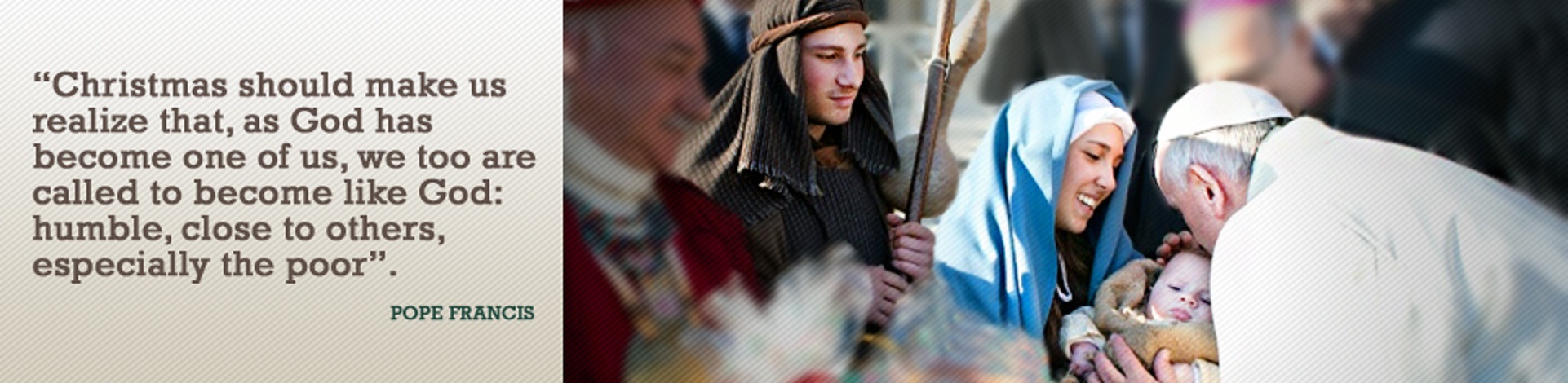
banners_frase-para-NAVIDAD-EN large for blog

Now that our reflections on the “O Antiphons” are complete, and since the next couple of days will be rather busy with celebrations in the parish, I’m violating liturgical nicety by wishing everyone early Christmas blessings!  I am thankful to the Vatican News agency for the lovely picture and quote from Pope Francis:

Christmas should make us realize that, as God has become one of us, we too are called to become like God: humble, close to others, especially the poor. — Pope Francis

Merry Christmas!