The Pope’s Exhortation and the “O” Antiphons: Final Advent Reflections

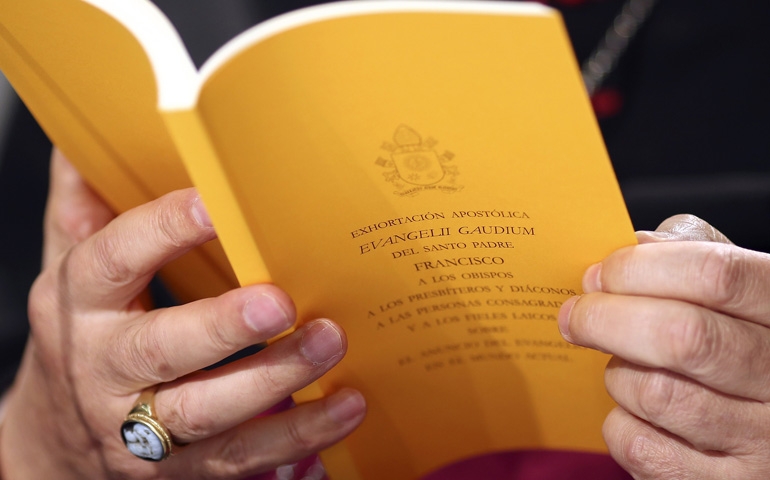
ExhortationWe haven’t looked at the Pope’s Apostolic Exhortation Evangelii Gaudium since December 4 and here we are in the final week before Christmas.  I thought this might be a good time, as we have entered into the period of the “O” Antiphons, to reflect on aspects of the Exhortation through the lens of those Antiphons.  Since they started yesterday (December 17), I’m already a day behind!  I’ll try to catch up with two reflections today.

But first, a bit about the “O” Antiphons.  They are the seven daily refrains used with the recitation of the Magnificat at Vespers (Evening Prayer) from December 17-23.  They are very ancient and go back to the earliest years of the Church.

They are called the “O Antiphons” because each begins with the the interjection “O”. Each antiphon is a name of the Messiah (Christ) and they are drawn from the prophecies of Isaiah:o_antiphons_all

  • December 17: O Sapientia (O Wisdom)
  • December 18: O Adonai (O God of Power)
  • December 19: O Radix Jesse (O Root of Jesse)
  • December 20: O Clavis David (O Key of David)
  • December 21: O Oriens (O Dayspring)
  • December 22: O Rex Gentium (O King of the nations)
  • December 23: O Emmanuel (O God With Us)

If these titles look familiar, you may recognize them as the various stanzas of “O Come, O Come, Emmanuel”, which is based on them. In subsequent posts, I’ll reflect on Evangelii Gaudium in light of each antiphon.

adventcandlesweek3

Thanks for all the prayers!

ImageI am happy to report healing on all fronts, thanks to the amazing outpouring of prayer and concern of so many people.

First, our four-year old grandson, Vinny, is recovering from successful brain surgery, during which the surgeon removed a tumor the size of the surgeon’s fist.  Vinny is in for a long recovery, but he’s already out of bed a bit, eating solid food and being delightfully cranky to everyone around him!  The surgeon told our daughter and son-in-law that, if he hadn’t operated when he did, he doubted that Vinny would have survived last weekend.  So, thanks to all the prayer warriors out there!

Second, my sister Jeannie, who is no longer four years old, is also successfully recuperating from cancer surgery.  My two sisters and I were blessed to have some quality time together during this same trip, and we ask for your continued prayer for her ongoing recovery.

Third, my wife’s health appears to be on the mend as well, so thanks for all the prayers for her as well!

All in all, a stressful time, but one that has proven the extraordinary power of love and prayer.

Our humble thanks to you all.

Tomorrow, back to Pope Francis!

Prayers for Vincent

Today our four year old grandson Vincent Arthur Hurd — Vinny — is undergoing a 6 1/2 hour surgery to remove a large mass from his brain. His Mom (our daughter) and Dad are being strong but prayers are requested. I’ll keep you posted. Here’s a picture from last night, as he was getting ready!

20131212-090450.jpg

Thank you, Melody!

Before returning to the more serious work reflecting on the Pope’s Apostolic  Exhortation Evangelii Gaudium, I thought I’d post something just for fun.  But it’s also something of the great joy of serving God’s people as a deacon.

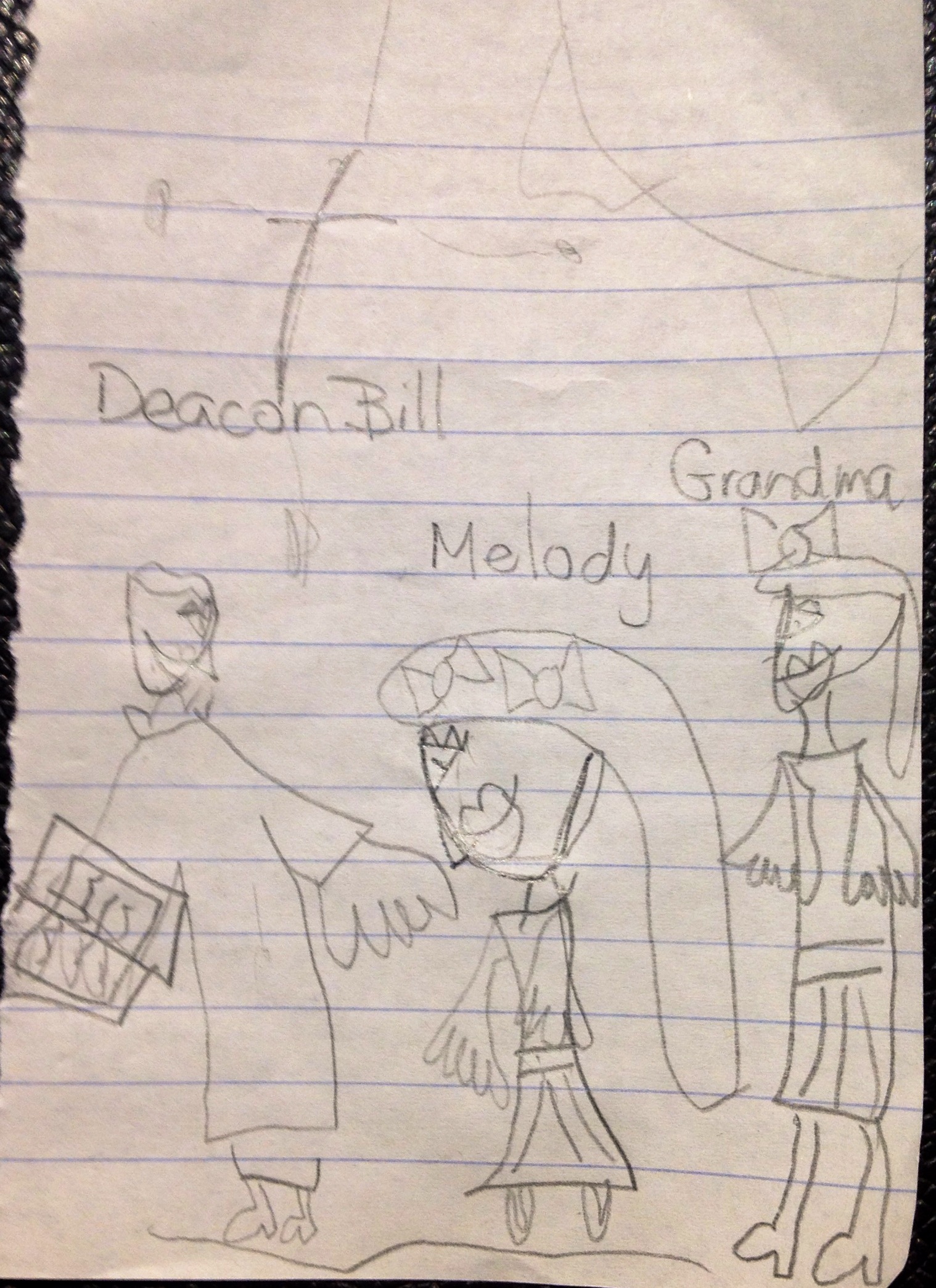
This morning, after our 9:00 AM Mass, a very shy little girl approached me with her grandmother.  With Grandma encouraging her, she handed over the attached sketch.  It is such a wonderful, joyful gift!  She captured the Book of the Gospels, the smiles, everything!  Thank you, Melody!

Melody Art

An Advent Remembrance: War and Peace

colour-smoke_2076773i7 December 1941.  Seventy-two years since that particular “Day of Infamy.”  World War II had, of course, begun years earlier.  By the time it ended, at least 70 million people were dead.  Pope John Paul II, in his 2004 Message for the World Day of Peace, referred to the Second World War as “an abyss of violence, destruction and death unlike anything previously known.”  How does a world recover from such madness?  For those of us who were born following the War, we have lived with its effects our whole lives, even though specific memories of the War continue to fade with the passing of the World War II generation.

For Catholics, I believe it is important to understand the Second Vatican Council as the Catholic Church’s response to World War II: the conditions that led to the War and the world that emerged after it.  Pope John XXIII announced his plans for the Council only fourteen years following the end of War.  Opening the Council, he observed:

55725AI

We feel we must disagree with those prophets of gloom, who are always forecasting disaster, as though the end of the world were at hand.  In the present order of things, Divine Providence is leading us to a new order of human relations which, by men’s own efforts and even beyond their very expectations, are directed toward the fulfillment of God’s superior and inscrutable designs. And everything, even human differences, leads to the greater good of the Church.

How do we cooperate with Divine Providence in attaining this “new order of human relations”?  The bishops of the Council were not seeking simple superficial updating of the Church; they were setting out to create a new understanding of the Church in a world already gone mad and in need of the “soul and leaven” a renewed Church might provide.  Pope Paul VI, in his famous speech at the General Assembly of the United Stations in October 1965, famously proclaimed:

paulvi_at_un2

Paul VI at the United Nations

And now We come to the high point of Our message: Negatively, first: the words which you expect from Us and which We cannot pronounce without full awareness of their gravity and solemnity: Never one against the other, never, never again.  Was it not principally for this purpose that the United Nations came into being: against war and for peace?  Listen to the clear words of a great man, the late John Kennedy [himself a veteran of World War II], who declared four years ago: “Mankind must put an end to war, or war will put an end to mankind.”  Long discourses are not necessary to proclaim the supreme goal of your institution.  It is enough to remember that the blood of millions of men, numberless and unprecedented sufferings, useless slaughter and frightful ruin are the sanction of the covenant which unites you, in a solemn pledge which must change the future history of the world No more war, war never again.  It is peace, peace which must guide the destinies of peoples and of all mankind.

What is particularly telling is the fact that when Pope Paul returned to Rome from this trip, he went immediately to the St. Peter’s and shared his insights with the assembled Council Fathers who, in their own turn, adopted the pope’s message as their own.  They were in the midst of their own work on their capstone document, Gaudium et spes, “The Pastoral Constitution on the Church in the Modern World.  In particular, they began working on the section dealing with war and peace, incorporating the insights of Pope John XXIII’s Pacem in Terris and Pope Paul’s speech to the UN.

No more war, war never again!

As we remember the personal, national and global tragedies of the Second World War, may we this Advent renew our commitment and preparation for the new order of human relations foreseen by Pope John.  May we, like Mary pregnant with the Christ, work to bring Christ and his Gospel to the world in the real, concrete terms envisioned by the Council and now renewed for us again by the words and deeds of Pope Francis.

Advent candle 2

The Deacon at Mass: Second Edition is Available

I’m happy to report that the Second Edition of my book, The Deacon at Mass: A Theological and Pastoral Guide, has now been been released by Paulist Press.  I just thought some of you might be interested!Image

What’s different in the Second Edition, you may ask?

The first edition was already based on latest General Instruction on the Roman Missal (GIRM), but it was released before the final English translation of the Order of Mass was promulgated.  The second edition expands the text accordingly, now taking the translation into account.

I was able to address several questions raised by readers and reviewers on the first edition.

I expanded the introduction to address specific issues related to the preparation and translation of liturgical books in general, and each subsequent chapter now includes references and guidance related to the approved English translation.

===============

NOTE TO READERS:  Thus ends the shameless hawking of the book.

A Great Book for Your Wish List: A Review

ImageI was honored recently to be asked to write a review of a soon-to-be released collection of writings by then-Cardinal Bergoglio, personally selected by him just weeks before his election to the papacy.  I thought it might be of interest to some readers of this blog as well!

The collection, entitled Open Mind, Faithful Heart (Crossroad Publishing) is a wonderful collection of forty-eight brief reflections (I deliberately avoid describing them as “essays”) written by Cardinal Bergoglio. Many of them read as if they began as short talks given during retreats, but whatever their origin, they are a wonderful, delightful and insightful resource for a questing heart and soul. I would strongly recommend that a person encountering this book for the first time should not read it as one would read an autobiography, even a spiritual autobiography, for this is not that kind of text. Rather, I recommend that one scan the Table of Contents and select a reflection that has particular resonance or interest, and prayerfully enter into the reflection as if going on retreat.

The text itself has been arranged somewhat thematically into four broad categories, but there is great variety even within each section. Several things stand out in each and every reflection. First is the overall tone of the texts. In the months since his election to the See of Peter, all have been struck by the new Pope’s simplicity of style, he warm and engaging relationships with all he meets, and his focus on God’s mercy and human touch. This is often contrasted with his predecessor’s more academic style, tone, and obvious intellectual bent. These essays, however, broaden our appreciation of Pope Francis, for this is a many who has an intellectual brilliance and sophistication th

Image

Cardinal Archbishop Bergoglio

at might easily be overlooked. It is a useful reminder that our popes are all complex human beings who defy easy and simplistic characterization. just as Pope Benedict is known as a brilliant academic, his friends also know him as a gentle, caring person of great empathy, we find Pope Francis to be not only a warm, engaging pastoral personality, but also a man of intellectual depth and maturity as well.

Second, the texts are grounded on a solid foundation of scripture, but not merely in an academic manner. Pope Francis finds the human touch

in these scripture passages, easily connecting them to the real world of everyday life and ministry. Apparently the original texts did not provide the specific scriptural citations, and the editors have performed an admirable service by including those references in the current text.

Third, we encounter the marriage of text and context so apparent in Pope Francis’ public ministry: his use of simple, graphic language which spea

ks directly, and yet almost mystically, to the hearts of his listeners. Here, his use of language is no less profound and direct. As I wrote above, these are reflections meant to be “read” and taken to heart. However, while they are food for the soul, they also encourage us to action in the very real exigencies of life. In essence, these forty-eight reflections constitute a spiritual retreat for all who are weary and looking for direction in living out the demands of discipleship in the contemporary world.

Let me conclude by looking at just one of the reflections in the book. I have selected reflection #19, “Passing On the Faith” because I have been teaching a graduate course this semester on “Teaching the Faith” at a Catholic university. Cardinal Bergoglio begins this reflection by linking the God’s Epiphany not merely to the “earthly existence” of Jesus but to those who have received God’s gift throughout the ages ad have become “disciples of Jesus and apostles for others.” With a rich use of scripture, he places the reader/listener in the middle of history: standing on the shoulders of all those who have gone before us bearing witness to God’s presence through lives and passing that along to us, while we ourselves are challenged to look forward to those generations to come who rely on our own witness to pass that gift along to them. He reminds us of the joy that God’s epiphany brings, and that this joy generates glory to God. He challenges us that we are messengers of God’s presence, not our own, and he echoes St. Paul: “the disciples are to decrease so that Christ increases.” The reflection ends with a simple prayer:

PrayingSeeing God in creatures,
seeing God made mortal,
seeing celestial beauty
in humble human attire.

Seeing joy weep tears,
seeing wealth so poor,
seeing greatness brought low,
and seeing that so was God’s desire.
Great was the mercy we received
on that most blessed day!
Whoever sees it, may it be I!

Making peace amid so much war,
bringing warmth to such great cold,
letting what is mine belong to all,
planting heaven here on earth.
What a magnificent mission
God has entrusted to our hands!
Whoever does it, may it be I! Amen.

Time to Abandon: “We have always done it this way.”

Francis1 Pope Francis has become known since his election for many things, but not the least of these are his homilies.  Whether at the chapel at the Casa Santa Marta, at Lampedusa, at World Youth Day in Rio, or in St. Peter’s, his direct, engaging style is a superb model for all preachers.  As we continue our stroll through his Apostolic Exhortation Evangelii Gaudium (EG), he begins to offer some specific ideas about HOW we communicate the “joy of the Gospel.”  As Pope John XXIII remarked in his opening address to the bishops at Vatican II in 1962, “The deposit of the faith is one thing. . . how it is expressed is another.”  Once again, we find Francis echoing John.

In paragraph #33, the Pope writes, “Pastoral ministry in a missionary key seeks to abandon the complacent attitude that says: “We have always done it this way.”  I invite everyone to be bold and creative in this task of rethinking the goals, structures, styles and methods of evangelization in their respective communities.”  He goes on to say that if we’re going to approach everything is this “missionary key,” then the ways (media) we use to communicate will be affected.  In days of instant communication, distortions can easily occur, resulting in misunderstanding.  For example, he notes, “The biggest problem is when the message we preach then seems identified with those secondary aspects which, important they are, do not in and of themselves convey the heart of Christ’s messfrancis4age.”

Pastoral ministry in a missionary style is not obsessed with the disjointed transmission of a multitude of doctrines to be insistently imposed.  When we adopt a pastoral goal and a missionary style which would actually reach everyone without exception or exclusion, the message has to concentrate on the essentials, on what is most beautiful, most grand, most appealing and at the same time most necessary (#35).

Francis then discusses at some length the long-standing attitude of the Church that there is a hierarchy of truths.  While “all revealed truths derive from the same divine source and are to be believed with the same faith, yet some of them are more important for giving direct expression to the heart of the Gospel.  In this basic core, what shines forth is the beauty of the saving love of God made manifest in Jesus Christ who died and rose from the dead.  The existence of a hierarchy of truths, he writes, “holds true as much for the dogmas of faith as for the whole corpus of the Church’s teaching, including her moral teaching” (#37).

The pope then becomes a teacher of homiletics.  While he will provide a more extensive “curriculum” later in the document, he introduces the subject here in paragraphs ##38-39.  First, he writes, “in preaching the Gospel a fitting sense of proportion has to be maintained.”  He brings up a very interesting approach: how often do we preach on certain subjects, perhaps to the exclusion of others?   This struck home with me in a particular way.

Once, while serving as tGospel on USS Reagan 2009he Director of Deacons for a large Archdiocese, I was approached by a man interested in discerning a possible vocation to the diaconate.  As we were talking, I asked him what he thought he might do as a deacon that he was not already doing as a committed lay person in the Church.  He responded immediately, “Preaching!”  I acknowledged that preaching was certainly one of the deacon’s ministries, and asked him what he thought the topic of his first homily might be.  He responded with great passion that he would preach about the evils of abortion as the topic of his first homily.  I asked him why, and he said that the rest of us (current priests and deacons) were not preaching about it, and that he wanted to correct that omission.  OK, then.  So I asked him to continue: what would he want to talk about in his next homily?  Once again: the evils of abortion.  And your third?  Same answer.  It became obvious to both of us after a while that he really was not responding to a possible call to the diaconate, but to his great passion for trying to eliminate abortion; his was a single-issue focus, and I tried to explain to him that, as clergy, we have an obligation to try to be as comprehensive as humanly possible in dealing with the totality of what the church teaches.  However, his comments were still challenging to me.  Was I guilty of NEVER discussing certain moral issues in my preaching or teaching?  Was I being, in the words of Pope Francis, “proportionate” in my preaching?  The pope’s examples are on point:

For example, if in the course of the liturgical year a parish priest [or deacon] speaks about temperance ten times but only mentions charity or justice two or three times, an imbalance results, and precisely those virtues which ought to be most present in preaching and catechesis are overlooked.  The same thing happens when we speak more about law than about grace, more about the Church than about Christ, more about the Pope than about God’s word (#38).

Francis is very concerned that “the integrity of the Gospel message must not be deformed. . . . Before all else, the Gospel invites us to respond to the God of love who saves us, to see God in others and to go forth from ourselves to seek the good others.  Under no circumstances can this invitation be obscured” (#39)!

ADVENT REFLECTION

Do I see pastoral ministry in a missionary key?  How faithful have I been in proclaiming the Gospel with balance and integrity?  While this section has clear resonance for the ordained who preach in the midst of our assemblies on a regular basis, it applies to each of us as disciples as well.  When we’re “preaching” about our faith at work, in school, at home, do we do so in a balanced way?  If we completely ignore our relationship with God in the “secular” aspects of of lives, what does THAT say about the importance of the relationship?  Does that kind of compartmentalization also “deform” (to use the pope’s word) the integrity of the Gospel?  Do we have pet opinions about certain church teachings that are the only things we want to work on or to be profess?  How might I become more balanced and integrated in my own mission territory?

advent candle 1

The Pope Exhorts: This Could Be the Heart of the Matter

ImageEvery page of Evangelii Gaudium brings fresh insights into the road map being sketched by Pope Francis.  As we continue deeper into Chapter One, we come to a section entitled “Pastoral Activity and Conversion,” which takes us from paragraphs 25 to 33.  In these few paragraphs, however, I think we see the seeds of the institutional reform the Pope is undertaking.  In my opinion, the structural reforms being suggested here might wind up being the very heart of the document itself.

The pope’s humor begins the section. “I am aware that nowadays documents do not arouse the same interest as in the past and that they are quickly forgotten.”  But he’s going write one anyway; why? “I want to emphasize that what I am trying to express here has a programmatic significance and important consequences” (#25).  It seems clear that the pope is not interested in writing something that only scholars will read in a theoretical context and then put back on the dusty shelf.  This document is different: it is a call to action that he hopes will affect every person, parish, diocese, religious community and even his own ministry as successor to Peter.  It is supposed to be a PRACTICAL document, one that could used to develop new structures, new programs, new pastoral activities.

I hope that all communities will devote the necessary effort to advancing along the path of a pastoral and missionary conversion which cannot leave things as they presently are. ‘Mere administration’ can no longer be enough.  Throughout the world, let us be ‘permanently in a state of mission’.  

This citation is from the so-called “Aparecida Document”, which was the closing statement of the last gathering of the bishops of Latin America, held in Brazil in 2007, and in which then-Cardinal Bergoglio played a major role.  Some have already referred to this Document as a blueprint for Pope Francis’ papacy; you may read it all here.

Francis invokes Pope Paul VI, who, early in his own papacy, spoke not only of personal, individual renewal and conversion, but of a renewal which affects the entire Church.  This will mean digging deeply into the very nature of who we are as Church, and purging ourselves of those things which are not in keeping with that nature, or which impede us from living out the implications of that identity.  Pope Francis cites Vatican II’s document on Ecumenism: “Christ summons the Church as she goes her pilgrim way. . . to that continual reformation of which she is always has need, in so far as she is a human institution here on earth.”  Pope Francis then adds his own voice: “There are ecclesial structures which can hamper efforts at evangelization, yet even good structures are only helpful when there is a life constantly driving, sustaining and assessing them.”

For Pope Francis, all renewal in the Church must be assessed by how well (or not) the Church is able to evangelize: that’s the standard.  If something helps us to be better evangelizers, fine; if it is holding us back from evangelizing, or is distorting the message, it must be abandoned.

“I dream of a ‘missionary option’, that is, a missionary impulse capable of transforming everything…. The renewal of structures demanded by pastoral conversion can only be understood in this light: as part of an effort to make them more mission-oriented, to make ordinary pastoral activity on every level more inclusive and open, to inspire in pastoral workers a constant desire to go forth and in this way to elicit a positive response for all those whom Jesus summons to friendship with himself” (#27).

This is not a new idea, of course.  Pope John XXIII often spoke of this great mission, and Paul VI, cited here by Francis, once said, “All renewal in the Church must have mission as its goal if it is not to fall prey to a kind of ecclesial introversion.”

OK, so mission is the standard that we are to use.  The Pope now applies this standard to parishes, other religious groups and movements, and dioceses.  He writes of the parish, for example, as NOT being an outdated institution “precisely because it possesses great flexibility, it can assume quite different contours depending on the openness and missionary creativity of the pastor and the community.”  Notice that the pope seemed willing to accuse parishes of being an “outdated institution”: he is doing what some people in the business world refer to as a “zero based review”, not taking anything as a given.  Parishes, however, are NOT outdated for the reasons he gives.  But he’s not done yet.  “This presumes that [the parish] really is in contact with the homes and the lives of its people, and does not become a useless structure out of touch with people or a self-absorbed group made up of a chosen few” (#28).  Parishes, he writes are to be a community of evangelizing communities, but he admits that “the call to review and renew our parishes has not yet sufficed to bring them nearer to people. . . to make them completely mission-oriented.”

The Pope applies this same standard to “other Church institutions, basic communities and small communities, movements, and forms of association”, and he also challenges them all to stay connected with the local parish and to be part of the local community.  Frequently certain movements have become divisive and present themselves as alternatives to a local parish; the pope is saying this must not happen.  He then turns to the renewal of dioceses and their bishops — always with the language of pastoral, evangelizing mission.popeandpatriarch

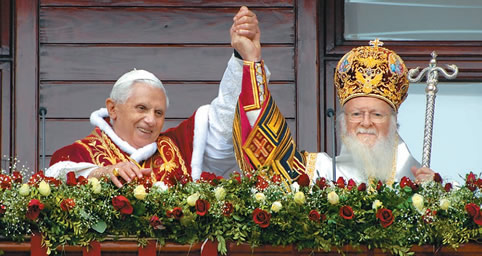
However, this section ends with what I believe may wind up being one of the most significant parts of the entire document; namely, the pope’s comments on his own ministry.  In paragraph #32, he writes, “Since I am called to put into practice what I ask of others, I too must think about a conversion of the papacy.”  To understand what is going on here in proper context, it is useful to remember two other documents.  First, Pope John Paul II’s encyclical, Ut Unum Sint (“That All May Be One”), promulgated in 1995; you can read it all here.  In that document, John Paul asked theologians, bishops and others for help in finding “a way of exercising the primacy which, while in no way renouncing what is essential to its mission, is nonetheless open to a new situation.”  Unfortunately, Pope Francis acknowledges, “we have made little progress in this regard.”  Retired San Francisco Archbishop John Quinn has written and spoken extensively in response to this call, on how more ancient patterns of church governance might be adapted to contemporary needs, but in practical terms, little has been done to implement such changes.  You can find Archbishop Quinn’s books here and here.

The pope, however, suggests that movement may lie ahead.  He cites Vatican II’s recognition of the various regional episcopal conferences, but acknowledges that things have not gone far enough in that regard. “[A] juridical status of episcopal conferences which would see them as subjects of specific attributions, including genuine doctrinal authority, has not yet been sufficiently elaborated. Excessive centralization, rather than proving helpful, complicates he Church’s life and her missionary outreach.”  Here’s where the second text may be helpful.  In 1988, Pope John Paul II promulgated a document entitled Apostolos Suos “On the Theological and Juridical Nature of Episcopal Conferences.”  Read it here.  In this document, the pope directs that an episcopal conference can only issue genuine doctrinal statements of magisterial authority if all the bishops are unanimous in their support of such teaching; if at least 2/3 of the bishops are in support, the the matter is to be referred to the Holy See for promulgation.  This is the very document that would have to be addressed as the pope and his advisors initiate renewal of the structures of the Holy See, and as he proceeds with the “sound decentralization” he spoke of in the Introduction to this text.Image
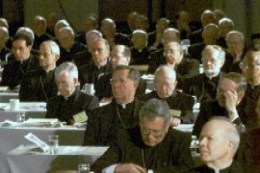
Imagine, for example, if matters related to episcopal appointments were handled — as they were until the 19th Century — by the local churches?  How might liturgical matters be handled in the future?

This is a classic reflection on the nature of collegiality and subsidiarity within the Church.  What are those matters which are best handled at a national, regional, diocesan or even parish level, and which are those matters best dealt with by the Holy See?  It is quite clear that Pope Francis is committed, and is committing all church structures, to a reform that will prune away those aspects which impede the church’s mission of evangelization.

It will be interesting and exciting to see how matters develop!

ADVENT REFLECTION

Personally, I find it very helpful to be reminded that it all boils down to mission, to evangelization.  Starting at a personal level, I must always be ready to spread the Good News; being a part of the Church is about being part of a People who are dedicated to the service of others in THEIR need, not my own.  As an “evangelizing community”, our parishes are also subject to conversion and renewal with one view in mind: the care of others in the name of Christ.  We don’t exist for ourselves but for others.  During this Advent, how can I and how can we better streamline ourselves for mission?  What do we need to reform in our personal and church lives to be evangelizers who take the initiative, are involved and supportive of people in their need, are patient and fruitful, and full of joy?  FOCUS ON THE MISSION!

advent candle 1

The Pope Exhorts: The Church’s Missionary Transformation

Papafrancescolampedusa_1373394935That’s the title of the first chapter of Pope Francis’ Apostolic Exhortation Evangelii Gaudium (EG): “The Church’s Missionary Transformation”.  The title alone is pregnant with possibility.  The chapter covers paragraphs 19-49.

The overarching theme is MISSION — being sent out.  While the Pope begins with the Great Commission of the apostles to “go and make disciples of all nations, baptizing them in the name of the Father and of the Son and of the Holy Spirit,” he also cites the calls of Abraham, Moses and Jeremiah.  He quickly links this missionary spirit with the JOY that goes along with it.  He recalls the joy of the returning 72 disciples, the joy of the first converts on Pentecost, and the joy of Jesus that God has revealed God’s very self to the poor and little ones.  This missionary attitude never ends: “Once the seed has been sown in one place, Jesus does not stay behind to explain things or to perform more signs; the Spirit moves him to go forth to other towns” (#21).

I hear again an echo of Pope John XXIII when Pope Francis speaks next of the unpredictable power of God’s word, “a seed which, once sown, grows by itself, even as the farmer sleeps” (Mk 4:26-29).  Francis writes, “The Church has to accept this unruly freedom of the word, which accomplishes what it wills in ways that surpass our calculations and ways of thinking.”  Now read the words of Pope John XXIII from his opening address to the bishops of the Second Vatican Council: 0073a1d09f8dd5b8995cbcb2d125dfe1

We feel we must disagree with those prophets of gloom, who are always forecasting disaster, as though the end of the world were at hand.  In the present order of things, Divine Providence is leading us to a new order of human relations which, by men’s own efforts and even beyond their very expectations, are directed toward the fulfillment of God’s superior and inscrutable designs.  And everything, even human differences, leads to the greater good of the Church.

No one is to be excluded from the missionary activity and concern of the Church: “In fidelity to the example of the Master, it is vitally important for the Church today to go forth and preach the Gospel to all: to all places, on all occasions, without hesitation, reluctance or fear.  The joy of the Gospel is for all people: no one can be excluded” (#23).  He recalls this non-exclusionary stance by recalling the angel’s proclamation to the shepherds in Bethlehem (“a great joy which will come to all the people”) all the way to the book of Revelation: “an eternal Gospel to proclaim to those who dwell on earth, to every nation and tongue and tribe and people” (Rev 14:6).

The pope then lays out four characteristics of this universal missionary task, and they are all, not surprisingly, eminently practical in approach.

1. Taking the first step

Evangelizers know that God has taken the initiative already, so we are simply following that lead by going out to others.  As he has already said repeatedly, the pope does not want people waiting in church for people to come in; just as God already ran out to meet us, so too we are to run out to meet others where they are.

2. Getting involved and being supportive

Once we’ve reached people, the next step is to get involved with them and their lives.  He writes, “Let us try a little harder to take the first step and to become involved. . . . An evangelizing community gets involved by word and deed in people’s daily lives; it bridges distances, it is willing to abase itself if necessary, and it embraces human life, touching the suffering flesh of Christ in others.”  This is where we begin, to use his famous phrase, repeated here, to take on “the smell of the sheep.”  An evangelizing community is one that gets involved and is supportive of people, whatever their struggles and circumstances, “standing by people at every step of the way, no matter how difficult or lengthy this may prove to be.”

3. Being fruitful

We seek to bear fruit because Christ wants us all to be fruitful.  It is here that the pope offers some very interesting words of encouragement:

It cares for the grain and does not grow impatient at the weeds.  The sower, when he sees weeds sprouting among the grain does not grumble or overreact.  He or she finds a way to let the word take flesh in a particular situation and bear fruits of new life, however, imperfect or incomplete these may appear.  The disciple is ready to put his or her whole life on the line, even to accepting martyrdom, in bearing witness to Jesus Christ, yet the goal is not to make enemies but to see God’s word accepted and its capacity for liberation and renewal revealed.

4. Being joyful

An evangelizing community is filled with joy, knowing “how to rejoice always.”  Here the pope become Eucharistic in tone, reminding his readers that this rejoicing finds expression in the liturgy as “evangelization with joy becomes beauty in the liturgy. . . . The Church evangelizes and is herself evangelized though the beauty of the liturgy, which is both a celebration of the task of evangelization and the source of her renewed self-giving.”

Advent Reflection

I’m going to stop here now before getting into the specific structural ideas the pope presents next.  I think it would be a mistake not to pause and reflect here, especially as we begin the season of Advent.  Can we can find ourselves on this road map of joyful evangelization the pope is describing?  I ask myself: Am I truly missionary?  Do I leave behind my own “comfort zones”?   Do I focus on inclusion, or exclusion?  Am I a risk-taker, especially with regard to what the Pope calls “the unruly freedom of the world”?  What about those four additional characteristics?  All of these are characteristics of every evangelizing community.  Are they evident in ourselves and in our own local parishes and communities?  What would it take to make them even more readily present, active and apparent?

advent candle 1