Deacon Dom Cerrato, editor of The Deacon, is spreading the word about his suggestion of a letter His Eminence Cardinal Mario Grech, the General Secretary of the Synod of Bishops concerning the lack of deacons in the General Assemblies of the Synod on Synodality. You can read more about his project at his blog here: https://www.diaconalministries.org/synod. In part, he writes
In our endeavor to humbly highlight the absence of the diaconate in our Church’s dialogue, we are preparing to send a heartfelt letter to His Eminence Cardinal Mario Grech, General Secretary of the Synod of Bishops. After you’ve had a chance to read the letter below, should you feel moved to join us in this respectful gesture, we warmly invite you to express your support by clicking the button below.
Understand, this gesture is not a petition but rather a symbol of our collective respect, support, and our shared commitment to prayerfully accompany the Church through the Synodal Process. If you choose to stand with us in this effort, we will be honored to include your name alongside this letter when it is presented to Cardinal Grech on May 1, 2024. Your participation would deeply signify our unity and heartfelt support for the invaluable role of the diaconate within our Church.
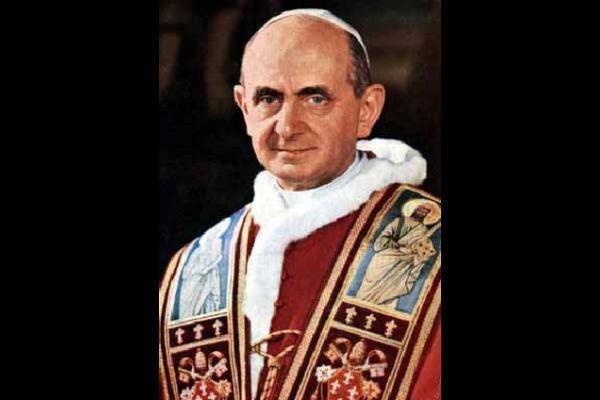
In convening the latest Synod of Bishops, Pope Francis is drawing insight and inspiration from his predecessors. Today, on the verge of the solemn opening of the General Assembly of the Synod of Bishops, I want to highlight two of them: the popes of the Second Vatican Council, St. John XXIII and St. Paul VI. The current Synod of Bishops is not, of course, a general Council of the Church. However, it is my judgment that to understand the Synod and its work, one must be thoroughly grounded in the work of the global episcopate at Vatican II. While that is a project far beyond the scope of this essay, we can find inspiration in the papal bookends of St. John XXIII’s address opening to the Council and then, following the intense work of the bishops over four years, St. Paul VI’s address at the final general session of the Council.
Saint John had faced considerable skepticism, and far worse, for his decision to call the Council. The world seemed to have gone mad throughout the 20th Century, with its global conflicts, economic collapse, and war on an unimaginable scale. The Holocaust and then the beginning of the atomic age changed the world forever. It is important to remember that the Second World War had only been over for fourteen years when he announced the Council. Vatican II, in many ways, was the Church’s response to the horrors and devastation of the Second World War and the world that emerged following it.
The Council Opens
It was against this backdrop that the majority of the world’s bishops assembled in Saint Peter’s Basilica after three years of intense preparation. Following the lengthy procession and then Mass, Saint John addressed the bishops — and the world. “Holy Mother Church rejoices,” he began. He presented a hopeful outlook for the Council, and that it would be a blessing to the Church so that the Church could “look to the future without fear.”
He then acknowledged the existence of those who persisted in a different, negative, and pessimistic view of the Church and the world. This is a well-known passage, but on the eve of the Assembly of the Synod of Bishops, it bears a prayerful, reflective examination.
The Prophets of Gloom: Then and Now
In the daily exercise of our pastoral office, we sometimes have to listen, much to our regret, to the voices of persons who, though burning with zeal, are not endowed with too much sense of discretion or measure. In these modern times, they can see nothing but prevarication and ruin. They say that our era, in comparison with past eras, is getting worse, and they behave as though they have learned nothing from history, which is, nonetheless, the teacher of life. They behave as though at the time of former Councils everything was a full triumph for the Christian idea and life and for proper religious liberty.
What a remarkable passage. Pope John is blunt in his description of the skeptics. They want to live in the past, and yet “they have learned nothing” from that history “which is nonetheless the teacher of life.” They have so “canonized” the past that they distort it beyond recognition. We hear similar voices today, especially some of the rather notorious “dads with webcams” who populate the internet and spend their time mocking, insulting, and even threatening Pope Francis and the Synod. Pope John did more than just call out his critics:
We feel we must disagree with those prophets of gloom, who are always forecasting disaster, as though the end of the world were at hand.
We can echo Pope John in our own day, disagreeing with today’s “prophets of gloom”. Like their predecessors, they too persist in forecasting disaster. Several of these contemporary “prophets of gloom” are Cardinals who have raised dubia (questions, doubts) to Pope Francis. In the earlier submission, Pope Francis wisely declined to respond. In the recent second submission, the pope chose to respond so there would be clarity prior to the impending Synod Assembly. Now, these same cardinals don’t like the pope’s responses and are now asking him to respond “yes” or “no.” To be accurate, dubia are generally responded to as either “yes” (affirmative) or “no” (negative). However, the issues raised by the Cardinals (and consequently by their junior prophets of gloom on the internet) defy such simplistic responses, and the pope was wise and prudent not to fall into such a trap. Like Pope John before him, Pope Francis is leading us to the novus habitus mentis called for by every pope since Pope John, a new way of thinking that offers a vision of hope based on the constant presence and providence of God:
In the present order of things, Divine Providence is leading us to a new order of human relations which, by men’s own efforts and even beyond their very expectations, are directed toward the fulfillment of God’s superior and inscrutable designs. And everything, even human differences, leads to the greater good of the Church.
Council and Synod: Doing the Will of God Yesterday, Today, Tomorrow
First, this is God’s gracious initiative, not ours. Yes, there are people around the world who have specific dreams for the Church in the future. We, the Church, must listen intently, discern prayerfully, and cooperate creatively with God’s will. Second, look again at that remarkable sentence that “everything, even human differences, leads to the greater good of the Church.” The unity of the Church is expressed in its diversity since all of it comes from the One God. Some people today would struggle with Pope John’s statement which is, nonetheless, true. He continues to detail his vision for the goals of the Council, and again, these words could apply to the Synod.
Our duty is not only to guard this precious treasure, as if we were concerned only with antiquity but to dedicate ourselves with an earnest will and without fear to that work which our era demands of us, pursuing thus the path which the Church has followed for twenty centuries. The salient point of this Council is not, therefore, a discussion of one article or another of the fundamental doctrine of the Church which has repeatedly been taught by the Fathers and by ancient and modern theologians, and which is presumed to be well-known and familiar to all. For this, a Council was not necessary.
[T]he Christian, Catholic, and apostolic spirit of the whole world expects a step forward toward a doctrinal penetration and a formation of consciousness in faithful and perfect conformity to the authentic doctrine, which, however, should be studied and expounded through the methods of research and through the literary forms of modern thought. The substance of the ancient doctrine of the deposit of faith is one thing, and the way in which it is presented is another.
Several points suggest themselves for the Synod based on this passage:
We must go beyond a simple “maintenance” of antiquity.
Our times demand walking a path “which the Church has followed for twenty centuries.”
There is no need for a Synod to discuss and debate fundamental doctrine.
The whole world (“the Christian, Catholic, and apostolic spirit”) expects a step forward.
“The substance of the ancient doctrine of the deposit of faith is one thing, and the way in which it is presented is another.”
Implementing the Servant Identity of the Church
After four years of listening, debate, discussion, and discernment, the Council came to an end. On 7 December 1965, Pope Paul VI gathered with the world’s bishops for the final general meeting of the Council and to promulgate the documents approved during the fourth and final session of the Council. Standing before his brother bishops, Pope Paul summarized the work of the Council. A key passage sets the Church — and her deacons — onto a new path.
Another point we must stress is this: all this rich teaching is channeled in one direction, the service of mankind, of every condition, in every weakness and need. The Church has, so to say, declared herself the servant of humanity, at the very time when her teaching role and her pastoral government have, by reason of the council’s solemnity, assumed greater splendor and vigor: the idea of service has been central.
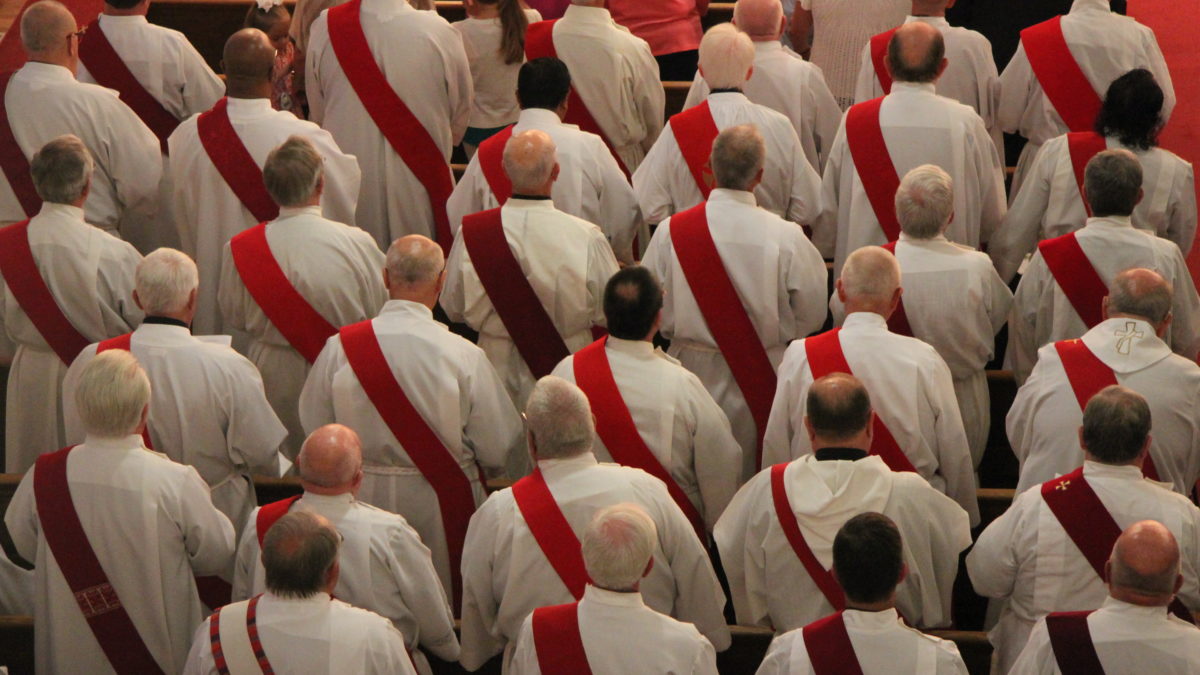
Gone was the perfectas societas approach to ecclesiology. Now the very nature of the Church is that of a servant, a servant of all of humanity. The mission of the Church is to evangelize; that mission is a diakonia, a sacrificial service rendered to all of God’s creation. Into this new direction announced by Pope Paul and the Council Fathers, the renewed diaconate emerges from the shadows of history. And, once again, it is Pope Paul who makes the critical connection between the diakonia of the Church and and the renewed diaconate. He described deacons as “the animators of the Church’s diakonia.” Not many years later, St. John Paul II quoted Paul VI, and added that deacons “are the Church’s service sacramentalized.” Through their ordination, deacons take on a servant-leadership role in the Church. But we are ordained, not to exercise diakonia so that others do not have to. Rather, we exist to assist, empower, and inspire others to fulfill their baptismal obligation to serve God and one another.
Conclusion
The Synod is not a Council. It is, however, a powerful exercise of the Church’s synodal character. The lessons we can learn from the modus operandi and the vision of the Council can still serve as valuable markers on the synodal process. It must be remembered that this Synod is continuing a journey demanded by the bishops of the Council and implemented by Pope Paul. It is not emerging from a vacuum.
As with most things in life, attitude can be everything. If one approaches the Synod with a negative attitude, the acts of the Synod will almost certainly be perceived as negative. Prophets of gloom will find the gloom they seek. However, if approached with the attitude of Pope John, as a new day in the life of the Church (“and now is just the dawn!”), the possibilities are almost endless.
No one could have predicted the crises we face today, and they are slamming us all at once. Even before the devastation caused by the COVID-19 pandemic, we were challenged by the erosion of credibility of all institutions, including churches. Our national politics were continuing their toxic descent into entrenched partisan screeching, and no one has been left unaffected. Add the pandemic to the mix and we have entered a whole new reality, affecting each and every one of us. Just when we need to come together to help each other through all of this, safety demands we be kept apart.
All of this has had profound effects on how we are called to be “Church” today: how we gather (or not), how we pray (no singing), and how we continue our mission of spreading the Good News.
Threatening to pull us even further apart, critics of Pope Francis have been doubling down on their accusations against him and his leadership of the church. These critics are adding even more confusion, anger and uncertainty to an already chaotic time. I recently contributed three reflections to Where Peter Is. Here are the links:
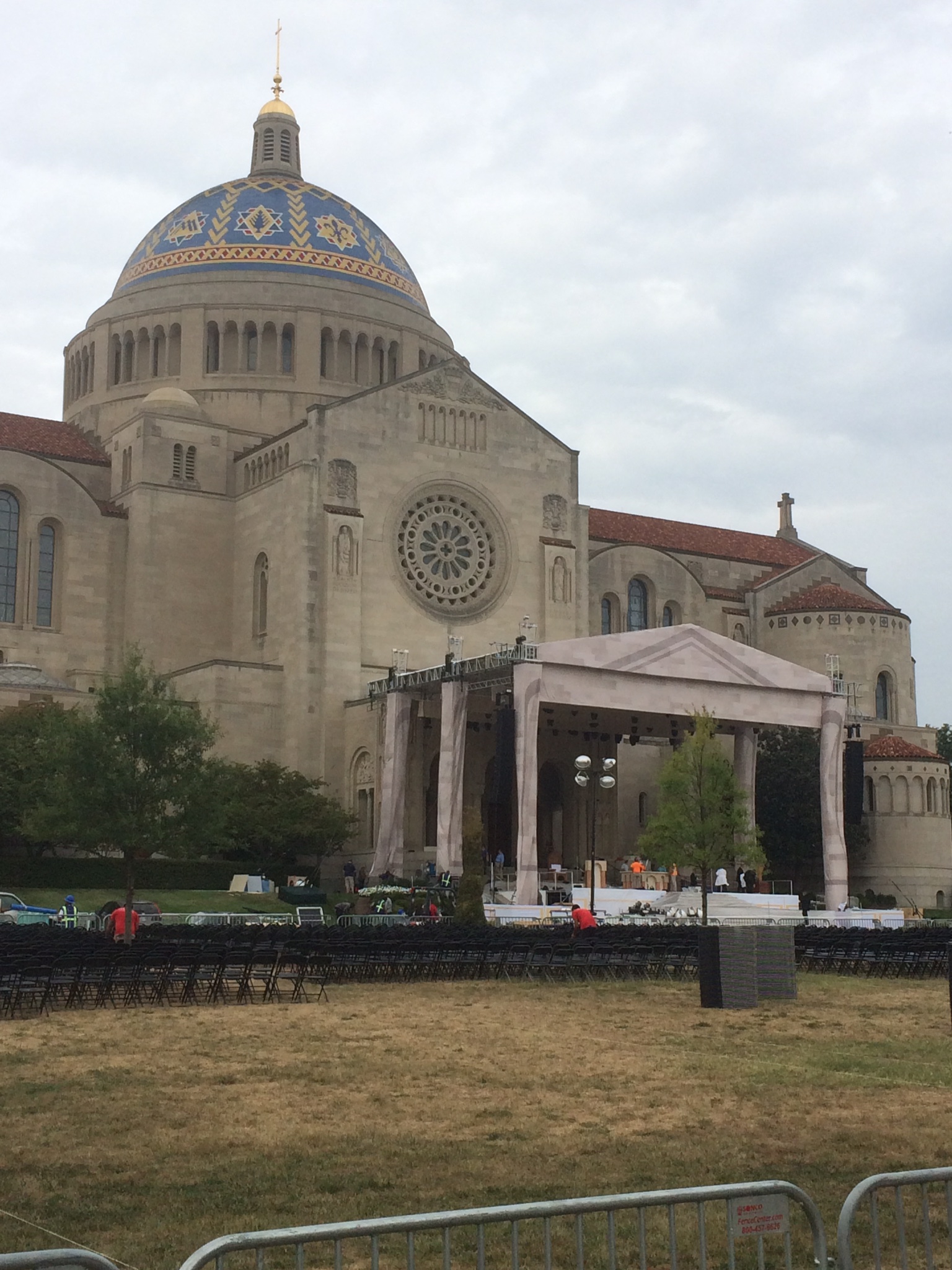
Ever since the Pope announced his first-ever visit to the United States, preparations began. Then, as his plans expanded from Philadelphia to New York to Washington, DC, matters became even more hectic. Then, the surprise announcement of his intention to canonize Franciscan Junipero Serra during his time in Washington, and the jump was made into hyperspace. Today, in Washington, all of those preparations could be seen coming together.
It was a cloudy, cool day by Washington standards, and later in the afternoon, the clouds opened and, as one hotel worker remarked, it felt like Winter had arrived, not the Fall! I am here for several reasons. I am a deacon ordained and incardinated into the Archdiocese of Washington, DC, so this is my home archdiocese in ecclesial terms, and it is good to be back here on that level alone. In fact, as a DC Deacon, I have served here on the Archdiocesan staff as well as on the senior staff of the United States Conference of Catholic Bishops (USCCB). So, when we took the Red Line to the Brookland/CUA Metro stop this morning, the closest stop for the Catholic University, and right across the street from the USCCB, I felt immediately back at home.
But the other reason I’m here is to accompany and assist the Bishop of Monterey in California, Richard J. Garcia, on whose staff I serve currently. Soon-to-be Saint Junipero Serra founded many missions in California, and seven of them are located within the Diocese of Monterey, with Serra himself buried in the sanctuary of his favorite mission at Carmel. The bishop was asked to come to Washington a bit early to meet with numerous press outlets to speak of the canonization and its meaning for Catholics today. He asked me and a couple of our priests to assist with the interviews so much of the day was spent responding to those press requests.
It was wonderful to watch the preparations on the campus of the Catholic University. I did my doctoral work here, and watching the students going about their normal business while others were setting up chairs, workers putting the final touches on the altar and sanctuary on the East side of the Basilica, and technicians conducting never-ending sound checks: it was all very exciting. Eventually we headed back to our hotels to get ready for tomorrow. Our pilgrimage group has made it safely, and we’ll meet with them for breakfast tomorrow before they head out on their DC adventures. Other clergy and laity are also heading in, many of whom will be helping with the Papal Mass on Wednesday.
As I’ve written before, it will be important to keep in mind all of the “moving parts” of the Pope’s visit, which has already begun — in Cuba. That part of the trip is closely linked, intentionally I am sure, to the pastoral visit to the United States. The Pope will pray with the bishops of the United States on Wednesday morning at St. Matthew’s Cathedral in Washington, have lunch with them at the St. John Paul II Cultural Center near the Catholic University, and then the Mass later in the afternoon. Then the next day, Thursday, the Pope will address a joint session of Congress, the first time a pope has ever done that. While Californians are focused on the canonization of Father Serra, I think most Washingtonians, and perhaps most Americans, are more interested in the Congressional address, which promises to be an exciting challenge to every part of the American political spectrum.
And then, of course, the Pope leaves for New York and Philadelphia. I hope simply to reflect and report on my impressions of the DC portion of the apostolic journey.
For now, please keep Pope Francis in your prayers, that he travels in safety and good health, and that his mission of spreading the Good News is met with joy and enthusiasm!
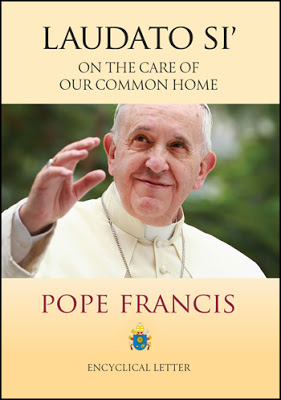
Pope Francis has issued his first encyclical letter to the world, Laudate Si’: On the Care of our Common Home. For several weeks, even before its release, commentators within and outside the Church have been opining about its possible content, the magisterial weight of its teaching, and even on the role of the Holy Father (and indeed, any person of faith) on questions related to ecology and the environment. In the hours since its release, commentary has exploded from every quarter. I don’t intend to enter that fray until I’ve been able to read the entire document, but it might be helpful to consider how we, as deacons, might approach the study and implementation of the encyclical. I offer a few suggestions.
Try to set aside the political rhetoric of current US debates on global warming.
The encyclical is a part of the Church’s magisterium, not an expression of partisan politics. This is not to say that the encyclical should not have an impact on our political landscape, but reading the Pope’s words through an American political lens will prevent us reaping the full benefit of the teaching. Certainly, we should not be trying to “proof text” the encyclical to prove or disprove a particular political agenda. In particular, as deacons, we should help the Holy Father’s words not be coopted by those who might “cherry pick” sections of the encyclical, while ignoring others, simply to meet a political end.
Read the encyclical as part of the larger magisterium of the Church.
As the Pope has said repeatedly, this encyclical must be read and interpreted within the existing matrix of Catholic Social Teaching. While there seems to be much within the text that has the Holy Father’s unique “voice,” the teaching it contains is in continuity with previous statements of the contemporary Church, including the Second Vatican Council (in particular, the Pastoral Constitution on the Church in the Modern World), the papal magisterium (including Sts. John XXIII’s Pacem in Terris and several teachings of St. John Paul II and Pope Emeritus Benedict XVI), and various statements of national bishops’ conferences around the world. We can best serve our communities, in my opinion, by helping people see the connectedness of the moral principles being addressed, a connectedness that shows the constant, recurring concern of the Church for God’s creation and our human responsibility for that creation.
As deacons, how might our own ministries reflect this teaching?
What concrete steps might our own communities be encouraged to take in response to the encyclical? Consider:
Study groups among our adults and young people, actually reading the encyclical and not simply reports about it.
Are there building projects in your parish right now? How ecologically responsible are those projects? Are there ways that the building materials, energy sources, and so on might better reflect our concern for creation?
How might our parishes and institutions throughout the Diocese form partnerships within the wider communities to improve our response to environmental concerns?
As deacons charged with being Heralds of the Good News of Christ, we have a particular responsibility and a unique opportunity to serve in communicating, teaching, and acting on the provisions of the encyclical.
“Call me Ishmael. . . . Whenever it is a damp, drizzly November in my soul. . . I account it high time to get to sea as soon as I can; I quietly take to the ship." -- Herman Melville





 Deacons Today: Servants in a Servant Church