The Pope’s Exhortation: Digging Deeper

francis3At the end of the Introduction to Evangelii Gaudium (EG), shortly after he writes that he will NOT be addressing every possible issue (since much of that will be the responsibility of diocesan bishops in their own territories), Pope Francis outlines “some guidelines which can encourage and guide the whole Church in a new phase of evangelization, one marked by enthusiasm and vitality.  In this context, and on the basis of the teaching of the Dogmatic Constitution Lumen Gentium [one of the foundational texts of the Second Vatican Council], I have decided, among other themes, to discuss at length the following questions” (#17).

Let’s consider this a bit more closely.  First, the issues selected by the pope are ones that he sees as universal and applicable throughout the entire Church (since in the previous paragraph he had already ruled  out regional or diocesan matters).  Second, he is launching a new movement in the mission of evangelization.  Many people were somewhat concerned when Pope Benedict declared  a year focused on the New Evangelization, not because it wasn’t needed, but because it could lead some people to conclude (erroneously, of course!) that the work of evangelization would “end” with the end of the Year!  Pope Francis is not only correcting that misperception, but going a huge step further.  He is taking us even further and opening a whole new portal of evangelization, and this new phase is to be characterized by enthusiasm and vitality.  Third, he is grounding everything in the teaching of the Second Vatican Council, especially the Dogmatic Constitution on the Church, Lumen Gentium CoverLumen gentium.  This in an interesting and significant choice.  One could reasonably assume that he would have chosen the Pastoral Constitution on the Church in the Modern World, Gaudium et spes, since its focus is on the relationship of the Church to contemporary society.  Instead, he is focusing on the fundamental conciliar document which deals directly and substantively with the inner nature of the Church herself.  With this in mind, let’s look at the seven questions the pope is going to emphasize with the rest of the document.

1.  The reform of the Church in her missionary outreach;

2.  The temptations faced by pastoral workers;

3.  The Church, understood as the entire People of God which evangelizes;

4.  The homily and its preparation;

5.  The inclusion of the poor in society;

6.  Peace and dialogue within society;

7.  The spiritual motivations  for mission.

Pope Francis writes that he is going to detail his thoughts on these issues not as a kind of theological treatise but to underscore their importance to the Church and the Church’s mission of evangelization today.  Furthermore, he sees them as a way to give a definite shape to this new chapter of the evangelical mission “which I ask you to adopt in every activity which you undertake [emphasis in the original]” (#18).

What a great and challenging message for all Christians, and in a particular way, for those of us who serve in any kind of ministry in and for the Church in the world!  These seven points can serve as a disciple-evangelist “checklist” of sorts, and as we continue this reflection, we’ll see what the pope has in mind for each of us.
The Exhortation: Getting Started

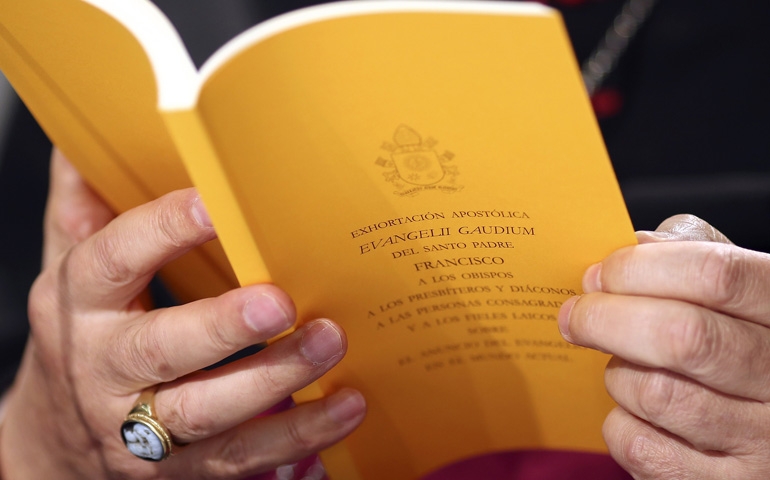
ExhortationSo far, much of the coverage of Evangelii gaudium (EG), Pope Francis’ Post-Synodal Apostolic Exhortation, has focused on snippets of random phrases on the one hand, commentary on the pope’s remarks on economic life, or even assessments of the magisterial “weight” to be attached to the text (If someone likes what the pope has to say, they want it to be as “weighty” as possible; if someone else doesn’t like what is being written, they want it to be as insignificant as possible).  What I want to try to do is to find middle, common ground.  I also don’t want to engage in “proof-texting” the document, or in getting so engaged in analyzing the trees that we miss the forest of the pope’s message.

EG consists of 288 sections (“paragraphs”), arranged in an Introduction and five chapters.  Let’s start with the Introduction (paragraphs 1-18).  It may be helpful to begin with the end of the Introduction, actually!  Paragraphs 16-18 are self-described as providing the “scope and limits of this Exhortation” so this should be helpful in offering the proper framework for the rest of the document.

Pope Francis grounds the Exhortation, not surprisingly, with the XIII Ordinary General Assembly of the Synod of Bishops held between 7-28 October 2012, which focused on the “New Evangelization”:  “I was happy to take up the request of the Fathers of the Synod to write this Exhortation.  In so doing, I am reaping the rich fruits of the Synod’s labors” (#16)  However, he immediately expands on that scope:   “In addition, I have sought advice from a number of people and I intend to express my own concerns about this particular chapter of the Church’s work of evangelization.”  So far, so good.  But then the pope does something significant and challenging.  He tells us what he is NOT going to do, and issues a strong “exhortation” to the bishops of the world.

Countless issues involving evangelization today might be discussed here, but I have chosen not to explore these many questions which call for further reflection and study.  Nor do I believe that the papal magisterium should be expected to offer a definitive or complete word on every question which affects the Church and the world.  It is not advisable for the Pope to take the place of local Bishops in the discernment of every issue which arises in their territory.  In this sense, I am conscious of the need to promote a sound decentralization.

Synod on Evangelization 2012

Synod on Evangelization October 2012

Paragraph 16, therefore, seems particularly important for our understanding of what will follow, both in the Exhortation and in the pope’s approach to the mission of the Church (evangelization) and his own exercise of the See of Peter.  We are seeing continuity and change walking hand in hand.  In this document, Francis remains grounded in the work of the Synod, but, while he intends to add his own voice to that of the Synod, he clearly and directly challenges the bishops of the Church saying to all, in effect, that no one should look to the pope for answers on everything.  His expectation is for bishops to BE bishops, pastors, leaders in their own right for their diocesan churches.  This is not necessarily a new idea, of course.  Vatican II clearly teaches the same thing repeatedly!  However, I find it helpful that Francis emphasizes a repeated mention of “sound decentralization” as we shall see later.

Turning briefly to the opening of the document itself, we should comment on the pope’s choice to focus on “joy” as the theme of the Exhortation.  Joy, of course, has a profound and venerable theological significance for Christians, leading Teilhard de Chardin to observe that “Joy is the infallible sign of God’s presence.”  There are numerous “Francis” touches related to this theme.  While fully acknowledging the sufferings of so many persons today, he observes that “there are Christians whose lives seem like Lent without Easter” (#6), and that “sometimes we are tempted to find excuses and complain, acting as if we could only be happy if a thousand conditions were met” (#7).  And yet, with a masterful use of scripture and calling upon other sources such as Paul VI (especially Evangelii nuntiandi) and even the Aparecida document of the bishops of Latin America, Francis calls all of us to recall the fundamental joy that should permeate the hearts and lives of all.

Paragraph #15 cites Pope John Paul II’s Redemptoris missio of 1990, in which the late pope wrote, “today missionary activity still represents the greats challenge for the Church” and “the missionary task must remain foremost.”  Pope Francis asks, “What would happen if we were to take these words seriously?”  He immediately answers his own question: “We would realize that missionary outreach is paradigmatic for all the Church’s activity” [emphasis in the original].  It is here that he turns to the 2007 Aparacida Document — as he has frequently in his homilies since becoming pope — writing that “we cannot passively and calmly wait in our church buildings,” moving rather into a “decidedly missionary pastoral ministry.”  As every pope has said since at least Pope John XXIII, spreading the Gospel is THE mission of all members of the Church, and every activity in which we are involved should be understood as an evangelistic.  It is clear from the Introduction to EG that Pope Francis intends to focus his person and his papacy on this renewed, incarnated vision of a Servant Church who lovingly and joyfully proclaims God’s presence to all.

The Pope Exhorts: Some First Impressions

Pope FrancisThe Year of Faith for the New Evangelization, called by Pope Benedict, ended officially last Sunday, the Solemnity of Our Lord Jesus Christ, King of the Universe.  At that time, Pope Francis officially “presented” his Apostolic Exhortation to the Church, and it was published on Tuesday.  Entitled Evangelii gaudium (EG), it has already turned heads with much of its content as well as its style, which has captured much of the homiletic approach has become so well-known.  Already, bloggers and others have offered the occasional quote which jumped off the page for them, but I’d like to do something a bit different.

First, I’d like to set the context of the document itself before getting too far into the text.  People has asked, “What is an Apostolic Exhortation, and how does it differ from, say, an Encyclical Letter often written by popes?”  This document is offered to the Church as a capstone to the Synod on the New Evangelization which was called by Pope Benedict at the beginning of the Year of Faith.  While not required to do so, most popes have taken the opportunity to synthesize the work of the Synod, and to indicate its implications for the future.  For example, following the 1990 Synod on  Priestly Formation, Pope John Paul II promulgated the post-Synodal Apostolic Exhortation Pastores Dabo Vobis in 1992, which has served as blueprint for much of priestly formation ever since.  So, the first thing to realize about Evangelii gaudium is that it is a product intimately related to the last Synod.  However, not only does it also point a way forward (as other post-Synodal documents have) in a general sense, it is also the first document published by Pope Francis as completely his own.  It therefore can serve as a road map of papal priorities.  As he writes in the opening paragraph, “In this Exhortation I wish to encourage the Faithful to embark on a new chapter of evangelization marked by this joy, while pointing out new paths for the Church’s journey in years to come.”  So, unlike a papal encyclical, which can be on any topic the pope chooses, a post-Synodal Apostolic Exhortation is linked to a specific topic.  Pope Francis has chosen, however, to take advantage of this opportunity to offer a trajectory for his papacy.

FrancisThe second thing that seems quite significant to me in a general sense is the scope of the references used by Pope Francis.  I recently reviewed a book being published by Crossroads which contains forty-eight reflections written or delivered by then-Cardinal Bergoglio during his serve as Archbishop of Buenos Aires.  I was particularly struck by his profound use of scripture.  I know this should not seem so surprising, perhaps, but he is a master of profound and sophisticated scriptural analysis while expressing his reflections in powerful pastoral language.  What is rare is finding people who can do both well!  This use of scripture is readily apparent in EG as well.  After scripture, and in addition to the expected references to the Second Vatican Council and to the work of previous popes on evangelization (in particular, Popes Paul VI and John Paul II), there are exceptional references to the work of the episcopate worldwide: the Aparecida document, for example, the various regional synods on Asia and Oceania, and the bishops of the Philippines.  There is a particular richness, depth and universality to EG which can be traced especially to such sources.

Those are a couple of initial points which I believe to be significant from the outset.

What do you think?

God bless,

Deacon Bill

Welcome!

I have moved this blog to WordPress because it seemed a bit easier to manage than Blogger.  We shall see!

Once again I apologize for not blogging as frequently as I would like.  On the other hand, the reasons are wonderful ones: my ministries on behalf of the diocese, the teaching I am doing, especially graduate students in pastoral ministry, and the ministries of our parish are all life-giving and time-consuming.  All of which is wonderful!

I have also been considering prayerfully whether to keep this blog running in any case.  As a deacon of the Catholic church who is also a professor of Theology, I am sensitive to the varying responsibilities of each venue!  After all, prayerfully crafting a homily is considerably different from academic research and writing, or from writing a staff memorandum!  Some people who may visit this blog may want a more homiletic approach taken; still others may expect a scholarly treatise (I am confident that NO ONE will want a staff memorandum!).  I make no guarantees: there may be some issues that I will essay in a more academic vein; other things may be more personally reflective.  For anyone seeking to ascertain my theological orthodoxy, I would refer them to my academic work, and urge them not make judgements solely on the basis of blog postings, since there is no way, in my opinion, to provide the academic rigor on a blog as there is in more traditional contexts.  Even if there were such a possibility, I choose to use the blog for more informal writing, discussions, and reflections.  So, with that disclaimer, I’ve decided to keep the blog going!

I will be making the occasional design change to the blog as I gain more experience with WordPress.  I will, hopefully, add a bookshelf with some of my own writing as well as other related material which may be of interest.

Again, welcome!

God bless,

Deacon Bill