Deacon William T. Ditewig, Ph.D.
[Posted here with permission. It will be published in the next issue of OSV’s The Deacon.]

This essay is, in many ways, a kind of lament. Many of us have written extensively on the disappointing and even disheartening lack of deacons in attendance at the first General Assembly of the Synod either as participants or as theological or canonical consultants. As hurtful as it is, we must certainly continue in our wonderful and grace-filled ministry to those most in need around us. To grieve over missed opportunities does not relieve us of those obligations.

My mentor at the Catholic University of America, Father Joseph A. Komonchak, has written and spoken often of the gap between the glorious words we sometimes use to describe the Church, and the reality of the Church as many people experience it. He wrote, “If there is a single question that has haunted me for the forty years that I have now been teaching ecclesiology, it concerns the relationship between the glorious things that are said in the Bible and in the tradition about the Church – ‘Gloriosa dicta sunt de te, civitas Dei!’ (Ps 86:3) – and the concrete community of limited and sinful men and women who gather as the Church at any time or place all around the world.” He described how people’s eyes “seemed to glaze over when someone spoke of the ‘Mystical Body of Christ’ or ‘Mother Church’ or ‘Bride.’ Theologians might have found it interesting to explore such notions, but what could they have to do with the people in the pew?” In this essay, then, we will “mind the gap” between those “gloriosa dicta” about the diaconate along with the frequent “de profundis” (Ps 130:1) sometimes experienced by the Church’s deacons.
Ah, the gloriosa dicta!

Throughout the patristic literature we find repeated references to the deacon serving “in the very ministry of Christ,” that the relationship of the deacon and bishop should be like the relationship between God the Father and God the Son, and that the deacon should be the eyes and ears, heart of soul of the bishop, that deacon and bishop should be like “one soul in two bodies.”
In our own time, we have the language of Vatican II, which includes the statement that diaconal duties are “ad vitam Ecclesiae summopere necessaria” – supremely necessary to the life of the Church. The Council continues by describing the diaconate itself as “a proper and permanent grade of the hierarchy.”
Moving beyond the Council, popes and theologians continued to say glorious things about the diaconate. Pope Paul VI referred to the diaconate as the “driving force” for the Church’s service, and Pope St. John Paul II repeated that description before adding that the diaconate is “the Church’s service sacramentalized.” Church documents and the work of contemporary theologians built on that language, using terms like “the deacon is an icon of Christ the Servant”, while James Barnett’s classic work on the diaconate refers to us as a “full and equal order.” Another early text even makes the claim that, “A parish, which is a local incarnation of Church and of Jesus, is not sacramentally whole if it is without either priest or deacon.”
Such marvelous and glorious and humbling words! A lexicon of service to inspire and drive the diakonia of the Church!
But then, de profundis….

But is this how deacons experience things in their daily exercise of ministry? Is this how the lived reality reflects these glorious words? Is this how our parishioners and fellow ministers, lay and ordained, see us? If it is, praise God! If it isn’t, what can we do, as the English say, to “mind the gap” between theory and practice? Deacons are happy and fulfilled in their various ministries, while at the same time, there are stories of presbyters, religious, and laity who do not seem to “get” the diaconate and even, in some cases, are antagonistic toward it. Deacons report instances where pastors “don’t want” the bishop to assign a deacon to the parish, and still other cases where deacons are accused of perpetuating clericalism in the Church. Still others have been told that “the diaconate isn’t a true vocation.” In short, the gap between the gloriosa dicta of theory and the de profundis of praxis is, in many cases, wide and deep. And so we come to the question: how might we close the gap?
Enter the Synod on Synodality.
What an opportunity for representatives of all God’s People to gather and discern together the future of the Church! But when the time came to assemble for the 16th Ordinary Assembly of the Synod of Bishops, where were the deacons?
Certainly, the Synod Secretariat faced a massive challenge: ensuring participants and consultants representing the universal Church in all its richness of laity, religious, and clergy. Delegates were chosen by episcopal conferences, from the Eastern Catholic Churches, selected leaders from the Roman Curia, and 120 delegates personally selected by Pope Francis. In total, 363 people were voting members, including 54 women. In addition to the voting members, 75 additional participants acted as facilitators, experts, or spiritual assistants. Wonderful!
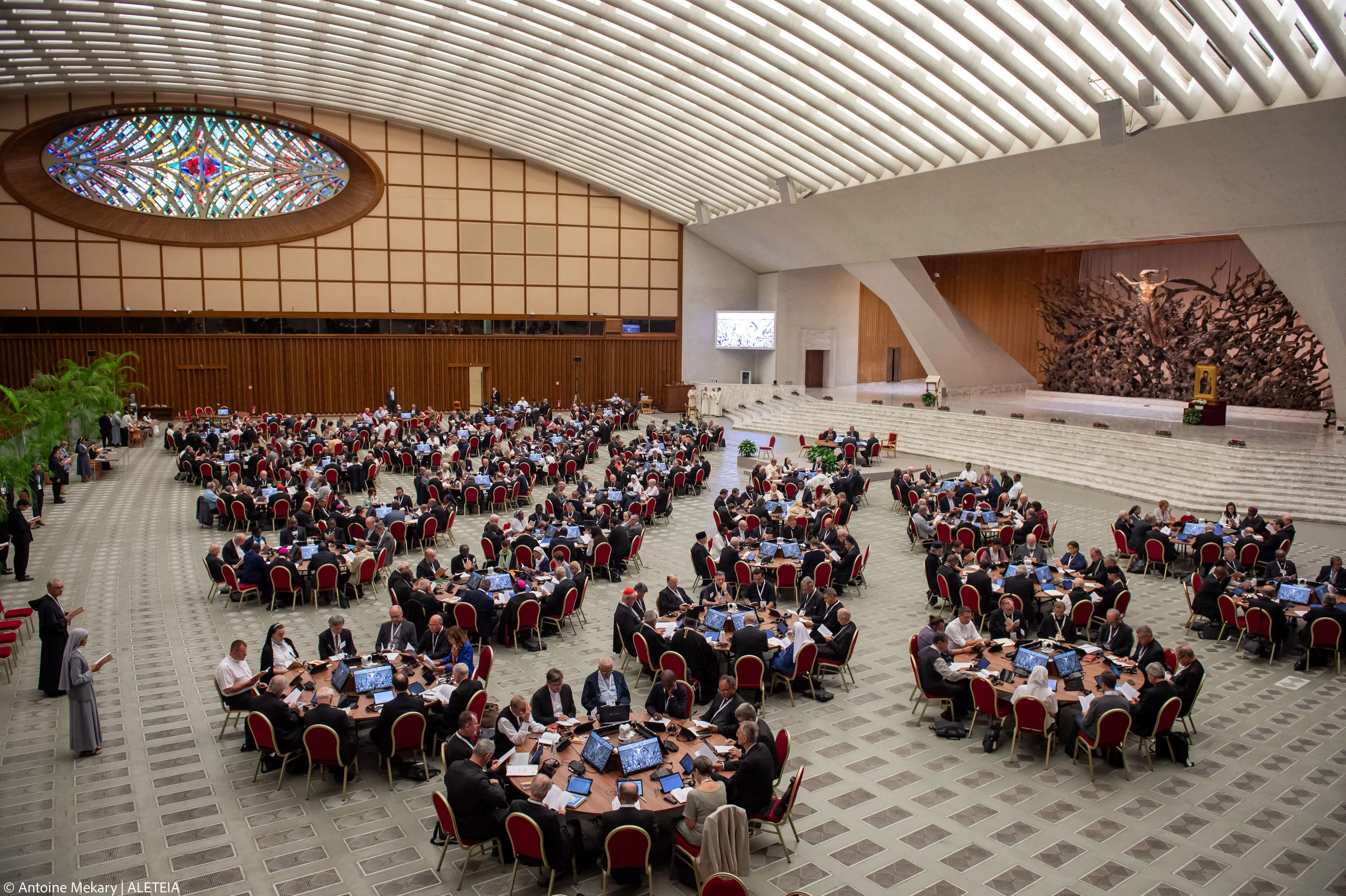
And one deacon. (Actually, two: one was from Syria about to be ordained to the presbyterate.)
There were other lacunae. Many observers noted the lack of parish priests, the poor, and even the lack of substantive influence of the assembled theological consultants when contrasted with the influence of the periti at the Second Vatican Council. But nowhere was the inequity more glaring than that of the diaconate. Imagine a group of men calling a meeting to talk about women, but with no women present. Imagine a meeting about the priesthood, with no priests participating. And imagine a meeting about the diaconate with no deacons. In a choir, each singer has their own voice, and yet each one must listen to the others to form beautiful harmony. If the Church were a choir, the same applies: everyone would have a voice, while listening to all the other voices. Deacons have been told, in glorious terms, that they are part of the choir. But, in terms of the Synod, they have no voice. In a choir, is it better to talk about a tenor or to hear one? In the church, is it better to talk about deacons, or to hear them?
Someone seems to be listening, at least about the lack of parish priests at the Synod. The Synod Secretariat has announced recently an extraordinary 5-day gathering of some 300 priests convening in late April. According to the Secretariat, this is to respond to the desire of the Synod participants to “develop ways for a more active involvement of deacons, priests, and bishops in the synodal process during the coming year. A synodal Church cannot do without their voices, their experiences, and their contribution.” The announced gathering is therefore good news. But once again the question recurs: Where is the gathering of the deacons?
Once again, there is the gap between glorious words and actual practice. When you tell someone that they are valued and that “their voices, their experiences, and their contribution” are vital, and then do nothing to open the door to those voices, why should the nice words be believed? To be excluded again, after the gap is pointed out, feels hurtful and dismissive, conveying clearly that deacons have no voice worth hearing, no experience worth sharing, and no insights to give or to receive. It sends the clear message that deacons are unnecessary, with nothing to contribute. The gap between “gloriosa dicta” and “de profundis” remains.
In conclusion, what may be done? Some will rightly say that none of this impedes our responsibility to care humbly for others and that we do not need a seat at the Synodal tables. I fully affirm the first part of that claim. But serving does not mean we should not also have a share in the Synodal process. As I have suggested elsewhere, perhaps one course of action might be to have conversations within our own parishes and dioceses and pass those insights along to our bishops. Perhaps theologians and canonists might direct the results of their research on the diaconate to the Synod Secretariat for their use. No matter what we do, however, we must do everything we can to bridge the gap between words and actions. As heralds of the Gospel, we can do no less.


 Many people might be unaware of the history behind these three items, so let me cover each briefly. Before doing that, however, we should keep one traditional factor in mind. Throughout the Catholic tradition, East and West, it has been a well-established principle that “married men may be ordained but ordained men may not marry.” Following ordination, then, the longstanding norm (until the 1984 Code of Canon Law) was that, once ordained, a man could not marry — or marry again, in the case of a married cleric whose wife has died. In other words, the very reception of Holy Orders constitutes an impediment to entering a marriage. The 1984 Code (c. 1078), however, permits a request for a dispensation from the “impediment of order” which would then permit the widowed deacon to re-marry. More about this below.
 The three issues mentioned today are all questions that up until now have required a petition from the cleric involved to the Holy See for resolution. None of them were things that could be decided by the local diocesan bishop or the regional episcopal conference (such as the United States Conference of Catholic Bishops). So let’s take a closer look at these three situations.
 “The passage to new marriage for a widowed permanent deacon”: This is a situation which has been faced by many of our deacons over the past decades. Obviously a married man cannot and does not make the promise of celibacy prior to ordination as a Deacon: we do not promise a hypothetical: “I promise to embrace the celibate life IF my wife predeceases me” is not part of our liturgical and sacramental lexicon. However, once ordained of course, that married deacon is impeded from entering another marriage. First, of course, because he is already married! But if his wife dies, he is still not free to marry again because he has assumed that “impediment of order” I mentioned above. St. John Paul II developed three conditions under which a widowed permanent deacon might petition for a dispensation from the impediment of order (notice, by the way, that this is not a “dispensation from celibacy” since the married deacon has never made such a promise from which to be dispensed in the first place). These three reasons, which need not concern us at the moment, have taken various forms over the years, including some revisions by Cardinal Arinze which made the likelihood of obtaining such a dispensation most highly unlikely. The petition for this dispensation right now begins with a petition from the widowed deacon to the Holy See, via his diocesan bishop (or religious superior). What the C9 is suggesting is that in the future, this petition would go from the Deacon to the Episcopal Conference (or, if the Conference develops such procedures) to the diocesan Bishop.
 Deacons Today: Servants in a Servant Church