Following my reflection on the Annunciation, I received a large number of e-mails about my comments on Gabriel and the heraldic role of the Deacon. I mentioned that I had been researching such themes for a while and given several presentations on the subject. Given the apparent interest, I’ll offer a shortened form of that presentation here. This all flows from the charge given specifically and uniquely to the deacon during the ordination: “Receive the Gospel of Christ, whose herald you now are: Believe what you read, teach what you believe, and practice what you teach.”
First, some background. “Angels”, of course have a venerable history in the Judaeo-Christian tradition as most people know. But what sometimes is forgotten is that the notion of “God’s messengers” transcends ancient culture. For example, the great philosopher Plato, writing some 300 years before Christ, referred to Hermes and Iris as “the divine angeloi” of the gods. (Hermes, by the way, gives his name to the term hermeneutics, the study of the interpretation of scripture; as we shall see, these messengers not only proclaim a message and fly away, they are also messengers who help to explain the message.) The “wings” of the angel are clearly visible in artistic renderings of these messengers, to signify the speed with which they carry out the gods’ commands; wings will continue to be associated with divine messengers in the Jewish and Christian traditions as well.
Raphael Healing
In the Hebrew tradition, angels are mentioned frequently throughout scripture (usually referred to as malakhim), and they take on a variety of roles in addition to simply being a messenger. In addition to conveying God’s messages, they are also described as shielding, rescuing, and caring for the people. In the apocalyptic book of Daniel, for example, we encounter named angels, angels who might easily be seen as “guardian” angels, and even an early “rank structure” for various angels. What’s interesting here is that not all Jews believed in angels. As we read in Acts 23:8: “For the Sadducees say there is no resurrection, or angel, or spirit, but the Pharisees acknowledge them all.” The Sadducees were focused principally on the Torah itself, and didn’t go along with later developments in Judaism: they much preferred the purity of Torah itself. So, no angels for them!
In the Christian tradition, we have inherited the more Pharisaic position about angels, and in Christian scripture angels continue in the same vein: they deliver messages, they protect, they explain, they serve the will of God for the good of the people.
And here’s where the connection comes with the deacons of the Christian Church. Although many people mistakenly characterize Christianity as a Western church, in our roots we are Eastern. And the Eastern traditions of Christianity have, almost from the beginning, associated deacons with the role of the angel in the community. In particular, deacons are often associated with the angels who would later be described as archangels: Michael, the great defender of the people (Dan 12:1-13; Dan 10:31,21; Jude 9; Rev 12:7); Gabriel, who announces and explains great messages (Daniel 8:16-26; 9:21-27;Lk 1:28); Raphael, who is a healer who guides and protects his charges (Tobit 5; 6:6-11; 8:1-3; 12:15).
All of this is found explicitly throughout the Eastern liturgical traditions of Catholicism and Orthodoxy. Father Simon Smyth has written:
The deacon as an icon of an angel finds repeated expression throughout the Liturgy. As the angels both worship God in heaven and come down to earth as messengers and helpers, ascending and descending, so the deacon comes out from the sanctuary (the symbol of heaven) and from standing before the altar (the throne of God) to the people to teach, to proclaim the Gospel, to lead them in prayer – angelic ministries all.
Throughout the Commemoration of the Living and of the Departed, the deacon leads the singing of the people and offers up “the smoke of the incense, which came with the prayers of the saints, ascended up before God out of the angel’s hand.”
Deacon using the liturgical fan
The use of the liturgical fan at the Second Epiclesis emphasizes the deacon as an angel – the fanning (being reminiscent of the sound of wings) indicating the presence of angels around the throne of God, surrounding the altar.
The association of the deacon with this angelic symbol, the liturgical fan, is a powerful one. . . . It is a sign of his office, a sign of what he is. When there are sufficient deacons, liturgical fans are carried in the Great Entrance, which again links visually deacons and angels.
As the deacons surround the priest and the altar so angels surround the whole sanctuary and the space around the altar are filled with the heavenly powers to honor Him Who is present on the altar. By means of the deacons. . . we can follow in our understanding the invisible powers in their service of officiating at this ineffable liturgy.
Look at the similarity with this image from the dome of a church
As I mentioned in my earlier posting, the so-called “deacon doors” or “angel doors” in the Eastern iconostasis have images of deacon saints or angels on them. The saintly deacons (such as Stephen, for example) will be depicted in deacon vesture but also with the wings of the angel; angels will be vested as deacons as well. I would also stress something else. In almost all of the images I have found from the Eastern tradition, you will notice that the deacon stole is being worn as the deacon wears it for the distribution of communion; in the Eastern tradition the deacon rearranges his stole across his chest before communion, and restores it to its original configuration afterward. There is a strong Eucharistic symbolism involved in the depiction of the angelic role of the deacon.
The angelic ministry of the deacon is no stranger in the Latin tradition either. As I mentioned in my earlier posting, Western medieval art often depicted angels wearing the dalmatic of the deacon, even when the Latin Church had largely lost sight of the deacon in regular ministry. Bishop Roberto Octavio Gonzales Nieves, OFM of San Juan has written:
“The Diaconate is re-instituted at this time in history. . . to act today as a herald: the angel of Evangelismos. . . . In ancient times deacons were sent by bishops with important communications to other churches; also in Eastern liturgies, the stole is seen as the deacon’s angelic wings, and in Western art many angels appear wearing dalmatics.
“Today we can see the deacon as “the new Gabriel who proclaims” – for us – the good news of salvation. Today the restored diaconate says, ‘The Holy Spirit will come upon you, and the power of the Most High will overshadow you’ [Lk 1:35].”
There is so much more we could share here. My point in doing this research, however, was this. We deacons often look for good models in our diaconal ministry. We turn to Stephen, Lawrence, and Francis of Assisi as our deacon “heroes” and models. I’m suggesting that we should add to our pantheon the angels who have served throughout our Tradition: angels such as Raphael, who heals, guides and protects; Michael, who defends and advocates for the people; Gabriel, who proclaims, teaches, and guards.
We are called to be “angelic ministers”:
To go anywhere and to do anything God demands
Swiftly
Not only to proclaim the Word of God as God’s Herald, but to act in God’s name as well.
“Deacons are the angels standing at the throne of God: serving, pleading, cajoling, correcting, feeding, preaching, teaching by word and example. Deacons are the very diakonia and kenosis of the church.” (Fr. Paul Henry)
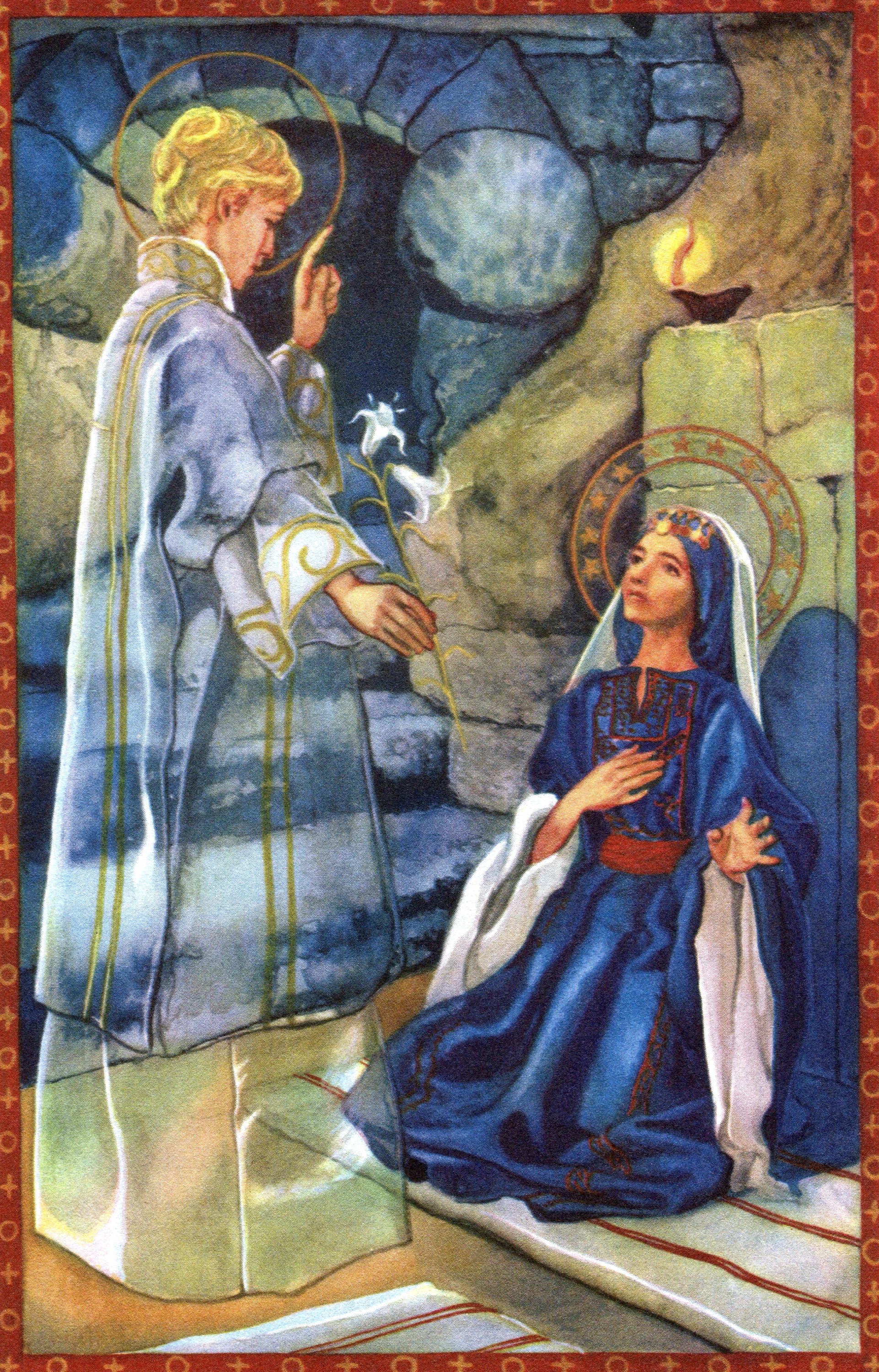
Today we celebrate the great feast of the Annunciation, when the angel Gabriel appeared to the young woman Miryam to discuss God’s plan that she become the mother of the Christ of God. The focus of many great homilies, such as my buddy Deacon Greg Kandra’s wonderful homily “How Can This Be”? , is justifiably on that young Jewish woman Miryam, Mary. We watch as Mary, full of fear, courageously gives her “yes” to God, taking on whatever God has in store for her and her family in the future.
I was blessed to be ordained a deacon on the Feast of the Annunciation twenty-four years ago today, and over the years, I’ve come to appreciate the fact that we need to spend time with BOTH Mary and Gabriel. Gabriel is so much more than God’s mouthpiece, a divine voice mail announcing a fait accompli to Mary! Let me sort this out, a reflection on diaconal ordination in light of the Annunciation.
During the ordination of a deacon, the bishop places the Book of the Gospels into the new deacons hands: it’s the first task of the new deacon, and the first charge given to the deacon by his bishop: “Receive the Gospel of Christ, whose herald you now are: Believe what you read, teach what you believe, and practice what you teach!” I heard those words directed to me on 25 March 1990 by my archbishop, Cardinal James Hickey of the Archdiocese of Washington, DC. We had heard the Gospel of the Annunciation just moments before, and now the Cardinal was telling me that I was supposed to be a Herald of Christ! Immediately, I sensed a kind of kinship with the herald in the Gospel: Gabriel.
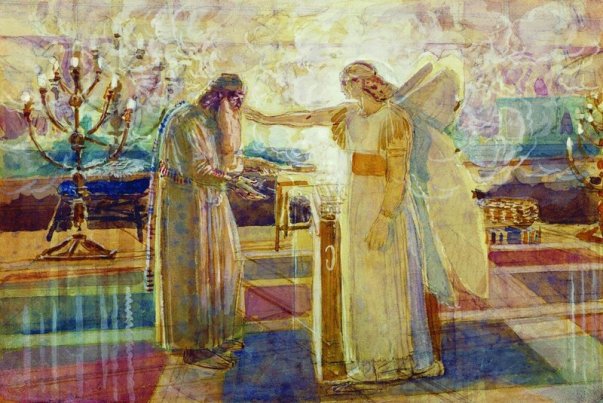
Consider Gabriel’s role. In the Hebrew scriptures, for example, he interprets the dreams of Daniel. He is the messenger who goes to Zecharias, the father of John the Baptist. Again, he not only “announces” things; he explains them and acts on them as well. And then we have the appearance of Gabriel to Mary. Once more, he does not simply announce God’s plan and fly away; he helps Mary, who is justifiably uncertain and questioning: “How can this be?” And he explains to her. The heralds of God are not merely proclaimers of the Word only; they are supposed to be ministers of the Word, helping others to understand and respond in faith.
For those of us who serve as Deacons, that’s the foundation of the charge we’re given at ordination: not simply to proclaim the Word and leave, but to proclaim the Word, believing completely the message of God, and then teaching and practicing that Word in our own lives of service. Mary’s fiat came from her own graced relationship with God, but it was also aided through the ministry of the herald, from who she received not only the Word, but encouragement and support, an angelic model of the very relationship she was being called to herself. To make Christ present in the world demands more than mere words; it demands real world faith, courage, and commitment. Mary’s fiat and Gabriel’s fiat go together.
Perhaps this is why there is such a longstanding tradition, especially in the Eastern traditions of the Church, to associate the ministry of the Deacon with the ministry of angels: saintly angelic heroes like Gabriel are frequently depicted as angels, and angels — those heralds of God — are frequently depicted in the vestments of the deacon.
So, as we reflect on the fiat of Mary, may we also ponder the role of Gabriel, the Herald.
“Believe what you read, teach what you believe, and practice what you teach.”
It’s hard to believe, but Lent is just around the corner. Every year, popes write messages to the world offering a vision for ongoing conversion and how we might better follow Christ as his disciples. This year, Pope Francis once again demonstrates his profound diaconal vision for the Church. His 2014 Lenten Message focuses our attention on the nature of poverty itself and our response to it
In the year that has passed since the pope’s election, I have been struck by the profound sense of diaconate which radiates from the Holy Father, especially, during Lent and Holy Week. Let me start by something which some might think only an arcane bit of trivia, but for me, it is something quite profound. Some of the first images we had of the new pope came from his days as Archbishop of Buenos Aires as we washed the feet of people — all kinds of people — on Holy Thursday. Invariably the images showed the Cardinal Archbishop wearing his stole as a deacon does while washing feet. This was clearly a deliberate choice he made: to remove his priest’s chasuble and to rearrange his stole diagonally as a deacon wears it. For people who might not be very familiar with the way these things normally work, this may not seem like such a big deal, so let me explain. Normally, during the Mass of the Lord’s Supper on Holy Thursday, in the Latin Church, the priest (or bishop) presiding, the deacons assisting at that Mass, and any concelebrants, will remove their outer vestments: the chasuble for the bishops/presbyters, the dalmatic for the deacons. In many cases, these same clerics might also take off their stoles as well, although some will keep the stoles on. Priests and bishops wear their stoles over their shoulder with the ends of the stole hanging straight down in front of them. Deacons wear the stole over the left shoulder, and secured at the right hip, so that the stole appears diagonally across the deacon’s chest. So, imagine a priest celebrating this rite: he removes his chasuble and the stole — worn in the priestly manner — is visible. If he leaves the stole on during the washing of the feet, then that’s what people will see. If the deacon removes his dalmatic, people will see the stole worn diagonally. What Pope Francis does is something I don’t think any of us has ever seen before: he removes his chasuble, and then takes his priest’s stole and rearranges it, intentionally, into the diagonal stole of the deacon. And only then does he begin to wash feet.
The message, therefore, is crystal clear and sacramentally significant: In this act of washing feet, we are imitating Christ the Servant, Christ the Deacon, who was pouring out his life for others just as he was pouring out the water over the feet of his disciples. It’s all about diakonia.
Want more? Guess when Pope Francis actually signed his Lenten Message? Oh, it was only released over the last couple of days, but if you look at the end of the document, you will find that he actually signed it on 26 December, the Feast of St. Stephen, Deacon and First Martyr.
With this as background, let’s look at some of the things the Holy Father has to say. The pope cites St. Paul: “He became poor, so that by his poverty you might become rich”(2 Cor 8-9), and asks, “What do these words of Saint Paul mean for us Christians today? What does this invitation to poverty, a life of evangelical poverty, mean for us today?” He immediately responds that first this “shows us how God works.” He speaks of how God chose to reveal himself in poverty out of a desire to be close to us, “a love which does not hesitate to offer itself in sacrifice for the beloved.” I was reminded of the words of St. John Paul II, who wrote in his great encyclical Fides et Ratio, when he referred to kenosis as “a grand and mysterious truth for the human mind, which finds it inconceivable that suffering and death can express a love which gives itself and seeks nothing in return” (#93).
Pope Francis reminds us that this was a “logic of love,” and that God did not desire salvation to “drop down from heaven”; rather, Christ was among us “to comfort us, to save us, to free us.” He continues, “In imitation of our Master, we Christians are called to confront the poverty of our brothers and sisters, to touch it, to make it our own and to take practical steps to alleviate it. Destitution is not the same as poverty: destitution is poverty without faith, without support, without hope.” The pope lists three types of destitution: material, moral and spiritual; as we go through them, how can each of us — especially those of us who are clergy of the Church — address each of these?
Material destitution refers to those living without the essentials of human dignity, “those living without who lack basic rights and needs such as food, water, hygiene, work and the opportunity to develop and grow culturally.” The pope observes that “the Church offers her help, her diakonia, in meeting these needs and binding these wounds. . . .” He powerfully reminds us that in the poor and the outcast “we see Christ’s face; by loving and helping the poor, we love and serve Christ.” He goes even further, striking a now familiar theme: “When power, luxury and money become idols, they take priority over the need for a fair distribution of wealth. Our consciences thus need to be converted to justice, equality, simplicity and sharing.”
Moral destitution is “slavery to vice and sin.” The pope speaks of those who have lost all hope of finding meaning in life, suffer from addictions of all types (he cites alcohol, drugs, gambling and pornography), or suffer from lack of “equal access to education and health care.” Moral destitution is all about a loss of hope and meaning, often due to unjust social conditions, by unemployment and a loss of dignity.
Spiritual destitution is experienced when people turn away from God and reject his love. “If we think we don’t need God who reaches out to us through CHrist, because we believe we can make do on our own, we are headed for a fall.” The pope reminds us that it is the Gospel which is the “real antidote to spiritual destitution:
Wherever we go, we are called as Christians to proclaim the liberating news that forgiveness for sins committed is possible, that God is greater than our sinfulness, that he freely loves us at all times and that we were made for communion and eternal life. The Lord asks us to be joyous heralds of this message of mercy and hope!
We many not yet be thinking about Lent, but the Pope is. And would it really hurt any of us to start our spiritual preparations now? He prays that all of us be “ready to bear witness to all those who live in material, moral and spiritual destitution the Gospel message. . . . Lent is a fitting time for self-denial; we would do well to ask ourselves what we can give up in order to help and enrich others by our own poverty. Let us not forget that real poverty hurts: no self-denial is real without this dimension of penance. I distrust a charity that costs nothing and does not hurt.”
So, my friends, are we living and serving in the image of Christ? Are we are truly imitating Christ, “who became poor and enriched us by his poverty”? Have we emptied ourselves so that others may live?
St. Stephen, Deacon and First Martyr, Pray for Us!
This is a simple personal reflection. No big agenda, no big point to make.
I love being a deacon for many reasons. But one of the things that is always a blessing is something I’ve been doing most of my adult life, even before being ordained a deacon: distributing Communion at Mass. It is one of the most profound and moving experiences of ministry.
At my current parish we have been encountering growing numbers of parishioners over the last couple of years, so much so that we’ve had to adapt our normal arrangements for communion to meet this need. At our most highly attended Masses, after I distribute the Precious Blood to other communion ministers, I take a ciborium and head to our “cry room”. Then I walk to the back of the Church and up the stairs to the choir loft, which is actually used for overflow seating (the choir is down near the altar), and then I go back downstairs and take a position at the back of the Church and begin distributing communion back there.
What I have come to love about doing this is that it feels very “diaconal” to be taking Christ to people who are “in the back” for a variety of reasons. Some are there because the want a head start getting to the parking lot after Mass; but they are there. Others are back there because they have little children and they want to be able to do what might be needed if the kids get fussy during Mass; but they are there. Still others are there because they were running late or because they don’t like to move toward the front for some reason; but they are there.
Normally we take a position somewhere near the sanctuary and remain statically in place while people come to us for Communion. What I find wonderful is the idea of a minister going out to where the people are. It communicates so well that, not only during Mass but at all times, we are to carry Christ to wherever he is most needed, and not simply wait for people to come forward.
This famous quote, generally attributed to Thomas Paine, but used (and abused!) by many has inspired leaders for a long time. “Leadership” and its exercise, especially in the Church, is something that concerns us all in one way or another. Some years ago, I reflected on ecclesial leadership while working on my doctoral dissertation, which dealt with the theological and canonical issues related to governance and deacons. Although my degree is in Theology, not Canon Law, there was no way to address this issue without consulting extensively with canonists, and, in particular, the late and great American canonist, Fr. James H. Provost. Jim became a good friend before his death, and his loss is still being felt by all who knew him.
I recently came across some notes I made from an article Jim wrote entitled,“Canonical Reflection on Selected Issues in Diocesan Governance” (in The Ministry of Governance, James K. Mallett, ed.). I offer the following list, taken and adapted from Jim’s article, as a reflection on traits essential to servant-leadership in the Church today. Jim wrote them specifically for his fellow canon lawyers, but I believe they have relevance for all pastoral ministers. The categories are Jim’s; the brief commentary is mine.
1) Be always vigilant for the spiritual purpose.
As we serve the People of God, this vigilance should be at the forefront. Regardless of the issue we are helping people with, what is the ultimate spiritual purpose behind it? Without this focus, ministry might become little more than social work. Obviously, this is not to suggest that social work is a bad thing! For the minister, however, we go beyond that task. As canon law itself reminds us, “The salvation of souls is the highest law” (salus animarum suprema lex). Keeping this principle in mind will help us keep our priorities straight.
2) Think with the Church.
As Pope Francis has recently reminded us, to “think with the Church” does not simply mean knowing the teachings of the Church, as important as that is, but to have a sense of what all members of the Church are thinking, and what their needs are. In other words, the Church — as People of God, Mystical Body of Christ and Temple of the Holy Spirit — is not simply the hierarchy, nor is the “mind of the Church” (mens ecclesiae) reducible to a collection of dogmas and doctrines: it involves active and caring listening to all, attempting to discern the will of God, and then acting accordingly. In short, when we consider this maxim, Pope Francis would remind us, “Think with the WHOLE Church.”
3) Serve if you would lead.
Anyone who has ever led others quickly realizes the profound truth that “a good leader is first a good follower.” However, it is equally true that the best leadership style is a servant-leadership, one that cares for the people serving with the leader. This is true, no matter what the venue. After leaving the seminary after eight years, I joined the Navy and wound up serving on active duty for twenty-two years, first as an enlisted linguist, and then — for the bulk of my career — as an officer. I served for many leaders, and had the privilege of serving in leadership as well: and the BEST leaders were always servant leaders. Such a leader was always concerned first with the needs of those he or she is leading so that they are then free to carry out the mission, whatever that happens to be. If this is true even in ways of life outside the Church, how much more profoundly is it true of those who serve in leadership in the Church. Servant leaders put others first, dream dreams, have visions, and inspire others to greatness in the eyes of God.
4) Use the power you have.
Power is not a bad word, despite the negative connotations often associated with it. Power is the first of the divine attributes, and power is imparted to us through the sacraments. Power is the ability to act, to serve, to provide care: all of this is good. Often people, even those who serve in ministry, will bemoan the apparent fact that they “don’t have the power to change” something. Still, all of us, through the grace of sacramental initiation and, for some, ordination, have a measure of “power” which must be used in service of others. Instead of worrying about what we cannot do, we need to focus on what we can do!
5) Empower the Church.
Speaking of power, it is meant to be shared. When Christ heals Peter’s mother-in-law, she immediately gets up to serve. That’s a good lesson for us in ministry: We are called not only to help others, we are called to help them UP. We are to give them the power they need to serve others and continue that mission. Power is meant to be used and shared.
6) Promote and protect rights.
The theology of the Church, as expressed through the law of the Church, focuses not only the responsibilities we have under the law, but on the rights we have: rights that come from God, and rights that are extended through the ministry and authority of the Church. Jim’s advice here, to focus on rights, puts the correct emphasis on ministries. The responsibilities we have flow from those rights: the responsibility for parents to be the prime educators of their children in faith, for example, flows first from their RIGHT to do so! In other words, we are encouraged not only to react to our responsibilities but to act first out of our rights; to be ACTIVE, not merely REACTIVE.
7) Consult when making decisions.
Fr. Provost was reminding canonists that the law often requires prior consultation in decision-making, but his advice is helpful to all of us. The Church, from its earliest days, has valued collegiality, collaboration and consultation. Consider, as just one example, the so-called “Council of Jerusalem” when Paul went up to Jerusalem to meet (confront?) the other leaders of the Church over the issue of Gentile converts. After talking together, those early leaders wrote a letter to the converts which acknowledged their dependence on the Holy Spirit who then informed their decision. Although we often hear from some folks that “the Church is not a democracy,” this is simply too simplistic and ignores the evidence of history, which suggests widespread models of collegiality and consultation, and we ignore that to our peril.
8) Interpret the law as it is meant to be interpreted.
This is a tricky one, but critical! For those of us who are not lawyers, it might be tempting to “read the black” and assume we know precisely what it means! Language, however, is symbol, and symbols always “contain” more than appears at first sight. When serving in ministry, do we make the proper attempts to find out how specific laws are to be interpreted? Consider point #1 again: How am I to interpret this law in light of the overall spiritual purpose of the situation? I am not suggesting that we find ways around our laws; merely that they will need to be interpreted as the law itself expects. For that, consultation may be required (see #7)!
9) Be generous.
One principle of the interpretation of Church law involves the very “generosity” of the law. The law exists for the spiritual good of people, and that involves being as generous as possible with the benefits of the Church. For example, do we seek out ways to provide the sacraments to people? We saw this recently when Pope Francis baptized the infants in the Sistine Chapel, including a child of a couple not yet married in the eyes of the Church. The situation of the parents, while of concern to us of course, need not cause us to be stingy with the benefits of baptism for the child as well as her parents. All of us in ministry can think of countless other examples: we need to think with our arms open.
10) Be consistent.
Every pastoral situation is unique, as we all know full well. And yet, justice obliges us to be consistent in our interpretation and application of law, while still appreciating the unique demands of each situation. I think the caution here also involves the dangers of parochialism or favoritism for some people, and a narrow interpretation for those we may not know — or like! — as well! This gives us a needed balance of pastoral approach. It also conveys a sense of positive predictability: we are trying to be even-handed with all because all are equal in the sight of God.
11) Be timely.
Is this one ever important! Remember, again, that Jim was writing this to fellow canon lawyers, reminding them that “justice delayed is justice denied.” That applies across the whole spectrum of pastoral ministry. Are we as responsive as we should be to the questions, requests, concerns that come our way, or do we procrastinate or even ignore certain things? The people we serve have a right to a timely response, whatever their need is. How do we feel when it seems someone is ignoring or discounting us and our concerns?
12) Be forthright.
Many of us struggle with this one. As ministers, we don’t want to hurt others. Sometimes, however, we are the bearers of bad news or difficult decisions. Jim’s reminder is that, despite the difficulties which we may encounter in doing so, we need to be honest and direct with those we serve. This does not mean that we are insensitive or nasty about things; it simply means that we all have to be honest with each other.
I, for one, continue to struggle with these principles. Still, they are a good “checklist” for servant-leadership, and can serve as a fine reflective tool when we’re on retreat, for example! Perhaps it is better to say that they can form part of a ministerial examination of conscience as we grow in service to others. There are times when each and every one of us is asked to “lead.” At other times we are all called to “follow”, and still other times when we just need to “get out of the way”!
Deacon Reginald Pole, who was Cardinal President for the First Session of the Council of Trent
Most people recognize that the diaconate enjoyed a “golden age” which ended in the 4th Century. The transformation of the diaconate, including the decline of a diaconate permanently exercised began shortly after, although there are the famous exceptions usually given: the English Cardinal Reginald Pole, for example, or Francis of Assisi. However, the last known “permanent” deacon prior to the Second Vatican Council was probably Italian jurist Teodolfo Mertel (1806-1899).
Deacon Teodolfo Mertel, jurist and Cardinal-Prefect of the Roman Rota
Teodolfo studied in the seminary with the Capuchins, and in 1828, at the age of 22, the brilliant young lawyer received a joint doctorate in both civil and canon law from La Sapienza University in Rome. By the time he was 25 he was serving as a lawyer for the Roman Curia. He served in positions of increasing responsibility between 1831 till 1853, when he was assigned as Minister of the Interior and of Grace and Justice.
Although he received first tonsure in 1843 and the minor orders shortly thereafter, he did not proceed further at that time. At the consistory of 15 March 1858, Mertel was made a Cardinal by Pope Pius IX. On the same day he was appointed President of the Supreme Council for Internal Affairs of the State, and on the next day, 16 March 1858, the pope ordained him a deacon at Castelgandolfo. Cardinal Mertel served in several other major assignments and participated in the First Vatican Council (1869-1870). He continued in various positions, eventually serving as Prefect of the Tribunal of the Signature of Justice from 1877 until his death in 1899. He participated in the conclave of 1878 which elected Pope Leo XIII; he served as Protodeacon of the Mass of Coronation and placed the triple tiara on the new pope’s head.
A well-known story from his time observed that, when the Prefect wished to go to Mass, he had to take one of his priest-staff members along to say the Mass.
In his later years, due to illness, he returned to his hometown, where he died 11 July 1899, at the age of 93.
We deacons do not need to be made Cardinals. However, we should always strive to find new and creative ways to serve God and God’s people!
From the inbox comes a note from a very concerned brother deacon. A priest recently told him that there was no real sacramental significance to being a deacon, unlike the ordinations of presbyters or bishops, which change a person at the very core of their being. As another deacon once remarked to me after a Conference, a priest once told him that “being a deacon is not a REAL vocation, like being a priest or a religious.” I have heard both of these observations before, and want to reassure my brother deacons that, contrary to the mistaken opinions of some of the priests involved (and others, of course): being a deacon IS a real vocation, and our ordination is just as “sacramentally effective and significant” as any other ordination to the other orders that make up the Sacrament of Holy Orders!
What’s going on here? Why is there such confusion about this? Let me suggest a few answers. Perhaps this could be part of a conversation and ongoing formation offered to our seminarians and priests (and it wouldn’t hurt for deacons and lay folks to remember it, too!).
1) A “theology of the diaconate” is only just now being developed. This may seem surprising, but when you think about it, it makes sense. For about a millennium or so, “being ordained” was usually summed up in (reduced to?) reflections on “being a priest.” That was the order that mattered the most, since this was the order (of presbyters) who “confected the Eucharist”, and all other orders were preliminary to, and led to, the presbyterate. For quite a while, even being a bishop was understood primarily through the lens of the priesthood, with the responsibilities of being a bishop understood primarily as a matter of jurisdiction, not sacramental significance. This point of view was overturned at the Second Vatican Council, which restored a more ancient understanding of Orders, first by reclaiming the more ancient theological understandings of the episcopate (see Lumen gentium, ##18-27), returning the diaconate to an order to be exercised permanently, and by authorizing the restructuring of the entire Sacrament of Holy Orders; Pope Paul VI implemented those decisions between 1967 (when he adjusted canon law to permit the ordination of “permanent” deacons) and 1972 (when he suppressed, in the Latin Church, first tonsure, the minor orders of porter, lector, exorcist and acolyte, and the subdiaconate; he concurrently authorized LAY ministries of lector and acolyte, no longer to be ordinations, but lay institutions). This means, vis-a-vis the diaconate, that for the first time in more than a millennium, a person could be ordained to a major and permanent order of the ministry (the diaconate) without eventually seeking ordination to the presbyterate. Therefore, given the large scale absence of “permanent” deacons for so long, there was no proper theology of the diaconate-qua-diaconate.
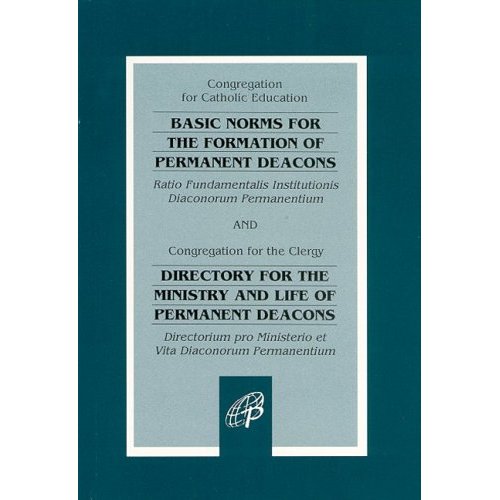
The Holy See recognized this in a 1998 document from the Congregation for Catholic Education (#3):
The almost total disappearance of the permanent diaconate from the Church of the West for more than a millennium has certainly made it more difficult to understand the profound reality of this ministry. However, it cannot be said for that reason that the theology of the diaconate has no authoritative points of reference, completely at the mercy of different theological opinions. There are points of reference, and they are very clear, even if they need to be developed and deepened.
So, what are these “points of reference” offered by the Holy See?
A. First of all we must consider the diaconate, like every other Christian identity, from within the Church which is understood as a mystery of Trinitarian communion in missionary tension. This is a necessary, even if not the first, reference in the definition of the identity of every ordained minister insofar as its full truth consists in being a specific participation in and representation of the ministry of Christ. This is why the deacon receives the laying on of hands and is sustained by a specific sacramental grace which inserts him into the sacrament of Orders.
B. The diaconate is conferred through a special outpouring of the Spirit (ordination), which brings about in the one who receives it a specific conformation to Christ, Lord and servant of all. Quoting a text of the Constitutiones Ecclesiae Aegypticae, Lumen gentium (n. 29) defines the laying on of hands on the deacon as being not “ad sacerdotium sed ad ministerium”,(6) that is, not for the celebration of the eucharist, but for service. This indication, together with the admonition of Saint Polycarp, also taken up again by Lumen gentium, n. 29,(7) outlines the specific theological identity of the deacon: as a participation in the one ecclesiastical ministry, he is a specific sacramental sign, in the Church, of Christ the servant. His role is to “express the needs and desires of the Christian communities” and to be “a driving force for service, or diakonia”, which is an essential part of the mission of the Church.
C. The matter of diaconal ordination is the laying on of the hands of the Bishop; the form is constituted by the words of the prayer of ordination, which is expressed in the three moments of anamnesis, epiclesis and intercession. . . . [NOTE: The matter and form of the diaconate, presbyterate and episcopate were clarified and promulgated by Pope Pius XII in his 1947 SacramentumOrdinis. One would hope that by now this document would have found its way into seminary curricula!]
D. Insofar as it is a grade of holy orders, the diaconate imprints a character and communicates a specific sacramental grace. The diaconal character is the configurative and distinguishing sign indelibly impressed in the soul, which configures the one ordained to Christ, who made himself the deacon or servant of all. It brings with it a specific sacramental grace, which is strength, vigor specialis, a gift for living the new reality wrought by the sacrament. “With regard to deacons, ‘strengthened by sacramental grace they are dedicated to the People of God, in conjunction with the bishop and his body of priests, in the service (diakonia) of the liturgy, of the Gospel and of works of charity’”. Just as in all sacraments which imprint character, grace has a permanent virtuality [The Latin original has: Sicut in omnibus sacramentis characterem imprimentibus, gratia permanentem virtualem vim continet]. It flowers again and again in the same measure in which it is received and accepted again and again in faith.
E. In the exercise of their power, deacons, since they share in a lower grade of ecclesiastical ministry, necessarily depend on the Bishops, who have the fullness of the sacrament of orders. In addition, they are placed in a special relationship with the priests, in communion with whom they are called to serve the People of God.
F. From the point of view of discipline, with diaconal ordination, the deacon is incardinated into a particular Church or personal prelature to whose service he has been admitted, or else, as a cleric, into a religious institute of consecrated life or a clerical society of apostolic life.(13) Incardination does not represent something which is more or less accidental, but is characteristically a constant bond of service to a concrete portion of the People of God. This entails ecclesial membership at the juridical, affective and spiritual level and the obligation of ministerial service.
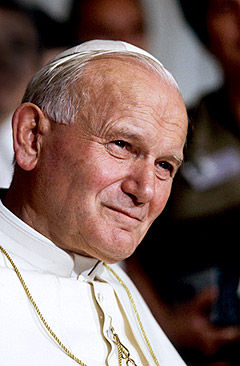
2. If this were not enough to demonstrate the proper character of a vocation to the diaconate, consider the words of soon-to-be Saint John Paul II, who offered a series of catecheses on the diaconate in 1993. He observed with great clarity a theme he would make several times during his papacy:
The exercise of the diaconal ministry—like that of other ministries in the Church—requires per se of all deacons, celibate or married, a spiritual attitude of total dedication. Although in certain cases it is necessary to make the ministry of the diaconate compatible with other obligations, to think of oneself and to act in practice as a ‘part-time deacon’ would make no sense. The deacon is not a part-time employee or ecclesiastical official, but a minister of the Church. His is not a profession, but a mission!
So, why does any confusion persist on this matter? Let me offer a couple of suggestions.
3. The sacramental question of HOW the deacon participates in the one Sacrament of Holy Orders has developed since the release of the documents on the diaconate in 1998. Following some initial changes to the Latin editio typica of the Catechism of the Catholic Church back in 1994, Pope Benedict in 2009 issued motu proprioOmnium et Mentem. In this document, canon law (specifically cc. 1008 and 1009) was changed to reflect that only presbyters and bishops act in persona Christi Capitis (“in the person of Christ, the Head of the Church”), while deacons serve in a ministry of word, sacrament and charity. This distinction, however, does not — and should not — be taken to suggest that deacons are no less ORDAINED into sacred ministry (which is the point of the canons on this point!) or that our ordination is no less sacramentally significant. The canons simply reflect a theological position that there are two modalities of participation in the ONE Sacrament of Holy Orders. [Here’s an interesting side note: the change to canon law only affected the Code of Canon Law for the Latin Church; the Code of Canons for the Eastern Catholic Churches does not use the language of in persona Christi Capitis, so the distinction did not need to be made there.]
4. I think that, since the Council, there has been legitimate concern on the part of many presbyters that the specific nature of the presbyterate has been under assault. One bishop who participated in all four sessions of the Council as a young bishop, once remarked to me that he considered it a great shortcoming of the Council that they did not spend more time on the nature of the priesthood itself. “After all,” this bishop said, “We spent considerable time talking about the sacramental nature of the episcopate, and we developed wonderful texts on the nature and role of the laity. We even renewed the diaconate! But we did not take into proper account the profound impact all of that would have on the presbyterate itself.” As a result, many of the functions which had become part of the presbyterate prior to the Council now began to be disbursed to other ministers, both lay and, now, deacons. This means that there is a certain concern that the presbyterate itself is being somehow “eroded” as others assume their own rightful and legitimate places in ministry, both within the Church and in the world.
But the bottom line remains:
Deacons are ordained, and are permanently changed in the core of our being by that ordination (what we used to call in days gone by as “ontologically changed”). We are always and everywhere full-time ministers, as St. John Paul II so passionately proclaimed, even when that ministry occurs outside the normal institutional structures of the Church. During those same catecheses in 1993, John Paul II also reminded people that “a deeply felt need in the decision to re-establish the permanent diaconate was and is that of greater and more direct presence of Church ministers in the various spheres of the family, work, school, etc., in addition to existing pastoral structures.” The diaconate is a sacrament and a proper vocation. It is perhaps also a useful reminder to many of our sisters and brothers that we are all gifted with many “proper vocations” — calls from God! — in our lifetimes. Our baptisms themselves constitute our primal vocation, before all others, for example! Some of us are called to religious life, some are called to matrimony, some are called to Orders, and some of us are called to several of these at the same time! Our God is a most generous God, and attempts to characterize one vocation over against another is to deny that divine generosity and to misunderstand the nature of vocation in the first place.
Sorry I haven’t posted in a couple of days, but we have been preparing for our annual retreat for our current deacon candidate class, coming up next weekend, during which they will be installed in the ministry of Lector by the bishop. I’ve also headed to the neighboring Diocese of Fresno to facilitate their annual Clergy Convocation. Today I met with Bishop Armando Ochoa and the presbyterate of the Diocese. Since the diaconate is still relatively new in the Diocese, we spent the day talking about the diaconate in general and responding to questions and concerns that the priests had. But this is all preliminary to the matters we’ll work on tomorrow: pastoral planning in the Diocese. Tomorrow the deacons join us and we’re going to talk about the annual pastoral planning process we’re developing in the Diocese of Monterey and see how a similar process might help in Fresno.
So, as the clergy of the Diocese prayerfully discern their next steps in strategic pastoral planning, please keep all of us in your prayers! Please pray for our deacon candidates and their families in Monterey, and for our neighbors in Fresno!
It’s always good to keep things in perspective. One way to do that is to consider often overlooked history. For example:
The Catholic bishops of the world assembled at the Second Vatican Council voted overwhelmingly in 1964 to renew the Order of Deacons as a ministry permanently exercised. Bishops who expressed particular interest in this renewed Order came largely from Western and Eastern Europe (the majority) followed by bishops of Latin America and Africa. Following the Council, in 1967, Pope Paul VI implemented this decision when he promulgated Sacrum Diaconatus Ordinem.
One of the things the bishops had agreed upon was that the decision whether or not to have (permanent) deacons had to be made by a petition from the appropriate episcopal conference to the Holy See. Following the Pope’s motu proprio, five episcopal conferences immediately requested and received permission to ordain deacons (and the United States wasn’t one of them). The Conferences from Germany, France, Italy, Brazil, and Cameroon. (For those interested, the bishops of the United States studied the issue for a year and then in 1968, requested and received permission; the first deacons in the US were ordained in 1969.)
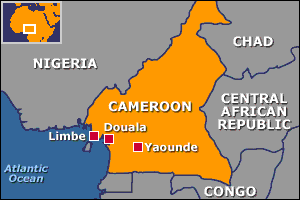
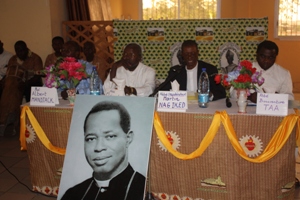
Germany had the first ordinations, on 3 November and 8 December, 1968. But also on 8 December 1968, seven men were ordained deacons for the Diocese (now Archdiocese) of Douala in Cameroon.
Cameroon? Why? Context is critical.
Colonial Cameroon achieved independence between 1955 and 1960. Pope John, of course, had announced on 25 January 1959 his intention to convene the Council, and the early preparations began. In Africa, the face of Catholicism, especially its episcopal leadership, was changing rapidly. The first native African bishop in all of Africa had been ordained in Rome by Pope Pius XII in 1939; he remained the only African bishop on the continent until 1951. Then, between 1951 and 1958 (the end of Pius XII’s papacy), 20 more were ordained, and in 1960, Pope John named one of them, Archbishop Rugambwa of Tanzania, the first native African cardinal of the church. One of those bishops was Thomas Mongo, a 41-year old priest of the Diocese of Douala, who became auxiliary bishop, and then two years later, in 1957, the diocesan bishop of Douala.
It was in this capacity that Bishop Mongo attended all four sessions of the Second Vatican Council. He served as diocesan Bishop until ill-health forced his early retirement in 1973 at the age of 59; he lived a very simple life of service until his death in 1988.
Conference in honor of Bishop Mongo whose portrait is visible in front of the panel
By all accounts, Bishop Mongo was known as a gentle and attentive leader, committed to building up the community among his people and their priests (and then, his deacons). Unlike many other bishops, he had no advanced university education. One biographer highlighted his exceptionally collaborative style by noting that among his closest aides, throughout his entire time as diocesan bishop, he had only one vicar general, chancellor and finance officer. Today he remains revered as the “Father” of the Archdiocese of Douala. Though he suffered from poor health through most of his tenure, he was famous for his focus on the poor of Cameroon, especially the children. He worked personally in building homes for the poor, paid school fees for poor children, and even gave up his own car, preferring to walk or to ride along with someone else. He was also the first bishop in all of Africa to ordain permanent deacons to assist him in all of this community building. The bishop was also well-known for his political activism, an “artisan of peace” who actively engaged in political debates concerning Cameroon’s future. In particular, he preached that the country “should be placed in God’s hands, retain its African identity and not be a replica of France.” He opposed colonial rule and condemned any political action that would deprive people of their rights.
Deacons are still being ordained in Douala, with the latest report I have seen about an ordination in 2013. While they are not great in numbers (approximately 20, from what I can find), they are part of the foundations of the contemporary diaconate, and we can all learn from our “founders”!
“Call me Ishmael. . . . Whenever it is a damp, drizzly November in my soul. . . I account it high time to get to sea as soon as I can; I quietly take to the ship." -- Herman Melville

 First, some background. “Angels”, of course have a venerable history in the Judaeo-Christian tradition as most people know. But what sometimes is forgotten is that the notion of “God’s messengers” transcends ancient culture. For example, the great philosopher Plato, writing some 300 years before Christ, referred to Hermes and Iris as “the divine angeloi” of the gods. (Hermes, by the way, gives his name to the term hermeneutics, the study of the interpretation of scripture; as we shall see, these messengers not only proclaim a message and fly away, they are also messengers who help to explain the message.) The “wings” of the angel are clearly visible in artistic renderings of these messengers, to signify the speed with which they carry out the gods’ commands; wings will continue to be associated with divine messengers in the Jewish and Christian traditions as well.
 Raphael Healing
 And here’s where the connection comes with the deacons of the Christian Church. Although many people mistakenly characterize Christianity as a Western church, in our roots we are Eastern. And the Eastern traditions of Christianity have, almost from the beginning, associated deacons with the role of the angel in the community. In particular, deacons are often associated with the angels who would later be described as archangels: Michael, the great defender of the people (Dan 12:1-13; Dan 10:31,21; Jude 9; Rev 12:7); Gabriel, who announces and explains great messages (Daniel 8:16-26; 9:21-27;Lk 1:28); Raphael, who is a healer who guides and protects his charges (Tobit 5; 6:6-11; 8:1-3; 12:15).
Deacon using the liturgical fan

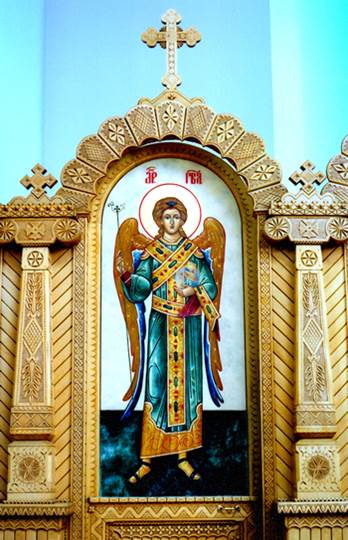
 Look at the similarity with this image from the dome of a church
 The angelic ministry of the deacon is no stranger in the Latin tradition either. As I mentioned in my earlier posting, Western medieval art often depicted angels wearing the dalmatic of the deacon, even when the Latin Church had largely lost sight of the deacon in regular ministry. Bishop Roberto Octavio Gonzales Nieves, OFM of San Juan has written: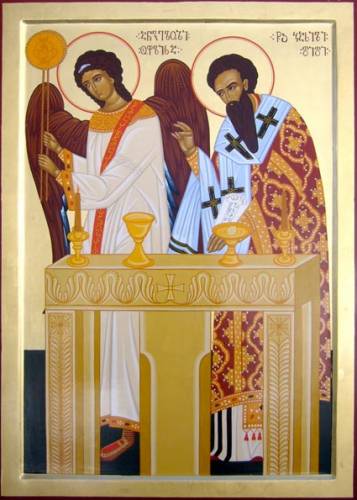












 Deacons Today: Servants in a Servant Church