Father Reese and Tired Old Tropes About Deacons

INTRODUCTION

Jesuit Father Thomas Reese has, once again, wheeled out some tired old myths and misperceptions about the diaconate. He seems to go through this exercise every so often. His argument seems to be that if the Church starts to ordain women as deacons, all will be well. However, if the Church doesn’t ordain women deacons, then no one should be ordained deacons. He seems to say that the diaconate is sacramental and necessary if women are ordained, but not sacramental or necessary if they are not. He reaches this bizarre conclusion applying principles that are ahistorical, theologically untenable, and downright dangerous in their ignorance of the matters involved. Such misinformation must be addressed.

As I say, Father Reese has done all this before. I responded to him before on this blog, and I will copy it again here for the reader’s convenience. Here it is:

==============================

DEACONS: MYTHS AND MISPERCEPTIONS

Jesuit Father Thomas Reese has published an interesting piece over at NCRonline entitled “Women Deacons? Yes.  Deacons?  Maybe.”  I have a lot of respect for Fr. Tom, and I thank him for taking the time to highlight the diaconate at this most interesting time.  As the apostolic Commission prepares to assemble to discuss the question of the history of women in diaconal ministry, it is good for all to remember that none of this is happening in a vacuum.  IF women are eventually ordained as deacons in the contemporary Church, then they will be joining an Order of ministry that has developed much over the last fifty years.  Consider one simple fact: In January 1967 there were zero (0) “permanent” deacons in the Latin Rite of the Catholic Church (the last two lived and died in the 19th Century).  Today there are well over 40,000 deacons serving worldwide.  By any numerical measure, this has to be seen as one of the great success stories of the Second Vatican Council.  Over the last fifty years, then, the Church has learned much about the nature of this renewed order, its exercise, formation, assignment and utilization.  The current question, therefore, rests upon a foundation of considerable depth, while admitting that much more needs to be done.

However, Father Reese’s column rests on some commonly-held misperceptions and errors of fact regarding the renewal of the diaconate.  Since these errors are often repeated without challenge or correction, I think we need to make sure this foundation is solid lest we build a building that is doomed to fall down.  So, I will address some of these fault lines in the order presented:

  1.  The“Disappearance” of Male Deacons
exsultet1

Father states that “[Women deacons] disappeared in the West around the same time as male deacons.”  On the contrary, male deacons remained a distinct order of ministry (and one not automatically destined for the presbyterate) until at least the 9th Century in the West.  This is attested to by a variety of sources.  Certainly, throughout these centuries, many deacons — the prime assistants to bishops — were elected to succeed their bishops.  Later in this period, as the Roman cursus honorum took hold more definitively, deacons were often ordained to the presbyterate, leading to what is incorrectly referred to as the “transitional” diaconate.  However, both in a “permanent” sense and a “transitional” sense, male deacons never disappeared.

  1.  The Renewal of Diaconate as Third World Proposal
1115_p12b500

Father Tom writes that his hesitancy concerning the diaconate itself “is not with women deacons, but with the whole idea of deacons as currently practiced in the United States.” (I would suggest that this narrow focus misses the richness of the diaconate worldwide.)  He then turns to the Council to provide a foundation for what follows.  He writes, “The renewal of the diaconate was proposed at the Second Vatican Council as a solution to the shortage of native priests in missionary territories. In fact, the bishops of Africa said, no thank you. They preferred to use lay catechists rather than deacons.”  This statement simply is not true and does not reflect the history leading up to the Council or the discussions that took place during the Council on the question of the diaconate.
LocalsRebuildDresden

As I and others have written extensively, the origins of the contemporary diaconate lie in the early 19th Century, especially in Germany and France.  In fact there is considerable linkage between the early liturgical movement (such as the Benedictine liturgical reforms at Solesmes) and the early discussions about a renewed diaconate: both stemmed from a desire to increase participation of the faithful in the life of the Church, both at liturgy and in life.  In Germany, frequent allusion was made to the gulf that existed between priests and bishops and their people.  Deacons were discussed as early as 1840 as a possible way to reconnect people with their pastoral leadership.  This discussion continued throughout the 19th Century and into the 20th.  It became a common topic of the Deutschercaritasberband (the German Caritas organization) before and during the early years of the Nazi regime, and it would recur in the conversations held by priest-prisoners in Dachau.  Following the war, these survivors wrote articles and books on the need for a renewed diaconate — NOT because of a priest shortage, but because of a desire to present a more complete image of Christ to the world: not only Christ the High Priest, but the kenotic Christ the Servant as well.  As Father Joseph Komonchak famously quipped, “Vatican II did not restore the diaconate because of a shortage of priests but because of a shortage of deacons.”
Vatican II

Certainly, there was some modest interest in this question by missionary bishops before the Council.  But it remained largely a European proposal.  Consider some statistics.  During the antepreparatory stage leading up to the Council (1960-1961), during which time close to 9,000 proposals were presented from the world’s bishops, deans of schools of theology, and heads of men’s religious congregations, 101 proposals concerned the possible renewal of the diaconate.  Eleven of these proposals were against the idea of having the diaconate (either as a transitional or as a permanent order), while 90 were in favor of a renewed, stable (“permanent”) diaconate.  Nearly 500 bishops from around the world supported some form of these 90 proposals, with only about 100 of them from Latin America and Africa.  Nearly 400 bishops, almost entirely from both Western and Eastern Europe, were the principal proponents of a renewed diaconate (by the way, the bishops of the United States, who had not had the benefit of the century-long conversation about the diaconate, were largely silent on the matter, and the handful who spoke were generally against the idea).  Notice how these statistics relate to Father Tom’s observation.  First, the renewed diaconate was largely a European proposal, not surprising given the history I’ve outlined above.  Second, notice that despite this fact, it is also wrong to say that “the African bishops said no thank you” to the idea.  Large numbers of them wanted a renewed diaconate, and even today, the diaconate has been renewed in a growing number of African dioceses.

One other observation on this point needs to be made.  No bishop whose diocese is suffering from a shortage of priests would suggest that deacons would be a suitable strategy.  After all, as we all know, deacons do not celebrate Mass, hear confessions or anoint the sick.  If a diocese needed more priests, they would not have turned to the diaconate.  Yes, there was some discussion at the Council that deacons could be of assistance to priests, but the presumption was that there were already priests to hand.

In short, the myth that “the diaconate was a third world initiative due to a shortage of priests” simply has never held up, despite its longstanding popularity.

  1.  Deacons as Part-Time Ministers

Father cites national statistics that point out that deacons are largely unpaid, “most of whom make a living doing secular work.”  “Why,” he asks, “are we ordaining part-time ministers and not full-time ministers?”
shutterstock_137696915-660x350

Let’s break this down.  First, there never has been, nor will there ever be, a “part-time deacon.”  We’re all full-time ministers.  Here’s the problem: Because the Catholic Church did not have the advantage of the extensive conversation on diaconate that was held in other parts of the world, we have not fully accepted the notion that ministry extends BEYOND the boundaries of the institutional church itself.  Some of the rationale behind the renewal of the diaconate in the 19th Century and forward has been to place the Church’s sacred ministers in places where the clergy had previously not been able to go!  Consider the “worker-priest” movement in France.  This was based on a similar desire to extend the reach of the Church’s official ministry outside of the parish and outside of the sanctuary.  However, if we can only envision “ministry” as something that takes place within the sanctuary or within the parish, then we miss a huge point of the reforms of the Second Vatican Council and, I would suggest, the papal magisterium of Pope Francis.  The point of the diaconate is to extend the reach of the bishop into places the bishop can’t normally be present.  That means that no matter what the deacon is doing, no matter where the deacon is working or serving, the deacon is ministering to those around him.

We seem to understand this when we speak about priests, but not about deacons.  When a priest is serving in some specialized work such as president of a university, or teaching history or social studies or science at a high school, we would never suggest that he is a “part-time” minister.  Rather, we would correctly say that it is ALL ministry.  Deacons take that even further, ministering in our various workplaces and professions.  It was exactly this kind of societal and cultural leavening that the Council desired with regard to the laity and to the ordained ministry of the deacon.  The bottom line is that we have to expand our view of what we mean by the term “ministry”!

  1.  “Laypersons can do everything a deacon can do

Father writes, “But the truth is that a layperson can do everything that a deacon can do.”  He then offers some examples.  Not so fast.
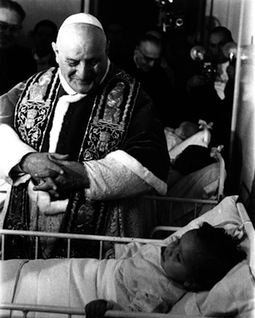
ANSA-John23Hospital-255x318

Not unlike the previous point, this is a common misperception.  However, it is only made if one reduces “being a deacon” to the functions one performs.  Let’s ponder that a moment.  We live in a sacramental Church.  This means that there’s more to things than outward appearances.  Consider the sacrament of matrimony.  Those of us who are married know that there is much, much more to “being married” than simply the sum of the functions associated with marriage.  Those who are priests or bishops know that there is more to who they are as priests and bishops than simply the sum of what they do.  So, why can’t they see that about deacons?  There is more to “being deacon” than simply the sum of what we do.  And, frankly, do we want priests to stop visiting the sick in hospitals or the incarcerated in prisons simply because a lay person can (and should!) be doing that?  Shall we have Father stop being a college professor because now we have lay people who can do that?  Shall we simply reduce Father to the sacraments over which he presides?  What a sacramentally arid Church we would become!

The fact is, there IS a difference when a person does something as an ordained person.  Thomas Aquinas observed that an ordained person acts in persona Christi et in nomine Ecclesiae — in the person of Christ and in the name of the Church.  There is a public and permanent dimension to all ordained ministry that provides the sacramental foundation for all that we try to do in the name of the Church.  We are more than the sum of our parts, we are more than the sum of our functions.

  1.  “We have deacons. . . because they get more respect”
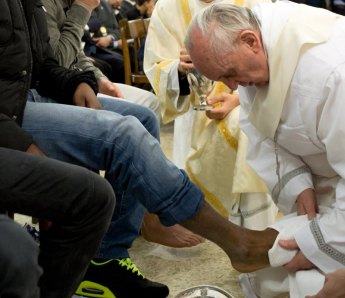
francis-washing-feet

With all respect to a man I deeply admire, I expect that most deacons who read this part of the column are still chuckling.  Yes, I have been treated with great respect by most of the people with whom I’ve served, including laity, religious, priests and bishops.  On the other hand, the experience of most deacons does not sustain Father’s observation.  The fact is, most people, especially if they’re not used to the ministry of deacons, don’t associate deacons with ordination.  I can’t tell the number of times that I’ve been asked by someone, “When will you be ordained?” — meaning ordination to the priesthood.  They know I am a deacon, but, as some people will say, “but that one really doesn’t count, does it?”  I had another priest once tell me, “Being a deacon isn’t a real vocation like the priesthood.”  If it’s respect a person is after “beyond their competence” (to quote Father Reese), then it’s best to avoid the diaconate.

No, the truth is that we have deacons because the Church herself is called to be deacon to the world (cf. Paul VI).  Just as we are a priestly people who nonetheless have ministerial priests to help us actualize our priestly identity, so too we have ministerial deacons to help us actualize our ecclesial identity as servants to and in the world.  To suggest that we have deacons simply because of issues of “respect” simply misses the point of 150 years of theological and pastoral reflection on the nature of the Church and on the diaconate.

In all sincerity, I thank Father Reese for his column on the diaconate, and I look forward to the ongoing conversation about this exciting renewed order of ministry of our Church.

=================================

CONCLUSION

I ended that earlier article with the hope of an ongoing conversation with Father Reese about the diaconate. Unfortunately, it seems that will not be happening. Father seems stuck in the mire of myths and misperceptions that have long been debunked by historical fact, theological development, and, in the final analysis, the lived pastoral experience of the Church and the Church’s deacons over the nearly six decades of the renewal of the diaconate. In the name of the Church, deacons are ordained to “animate the Church’s service” (St. Pope Paul VI) and to be “the Church’s service sacramentalized” (Pope St. John Paul II).

The Diaconate and the Synod: Minding the Gap

Deacon William T. Ditewig, Ph.D.

[Posted here with permission. It will be published in the next issue of OSV’s The Deacon.]

This essay is, in many ways, a kind of lament. Many of us have written extensively on the disappointing and even disheartening lack of deacons in attendance at the first General Assembly of the Synod either as participants or as theological or canonical consultants. As hurtful as it is, we must certainly continue in our wonderful and grace-filled ministry to those most in need around us. To grieve over missed opportunities does not relieve us of those obligations.

My mentor at the Catholic University of America, Father Joseph A. Komonchak, has written and spoken often of the gap between the glorious words we sometimes use to describe the Church, and the reality of the Church as many people experience it. He wrote, “If there is a single question that has haunted me for the forty years that I have now been teaching ecclesiology, it concerns the relationship between the glorious things that are said in the Bible and in the tradition about the Church – ‘Gloriosa dicta sunt de te, civitas Dei!’ (Ps 86:3) – and the concrete community of limited and sinful men and women who gather as the Church at any time or place all around the world.”  He described how people’s eyes “seemed to glaze over when someone spoke of the ‘Mystical Body of Christ’ or ‘Mother Church’ or ‘Bride.’ Theologians might have found it interesting to explore such notions, but what could they have to do with the people in the pew?”  In this essay, then, we will “mind the gap” between those “gloriosa dicta” about the diaconate along with the frequent “de profundis” (Ps 130:1) sometimes experienced by the Church’s deacons.

Ah, the gloriosa dicta!

Throughout the patristic literature we find repeated references to the deacon serving “in the very ministry of Christ,” that the relationship of the deacon and bishop should be like the relationship between God the Father and God the Son, and that the deacon should be the eyes and ears, heart of soul of the bishop, that deacon and bishop should be like “one soul in two bodies.”

In our own time, we have the language of Vatican II, which includes the statement that diaconal duties are “ad vitam Ecclesiae summopere necessaria” – supremely necessary to the life of the Church. The Council continues by describing the diaconate itself as “a proper and permanent grade of the hierarchy.”

Moving beyond the Council, popes and theologians continued to say glorious things about the diaconate. Pope Paul VI referred to the diaconate as the “driving force” for the Church’s service, and Pope St. John Paul II repeated that description before adding that the diaconate is “the Church’s service sacramentalized.” Church documents and the work of contemporary theologians built on that language, using terms like “the deacon is an icon of Christ the Servant”, while James Barnett’s classic work on the diaconate refers to us as a “full and equal order.” Another early text even makes the claim that, “A parish, which is a local incarnation of Church and of Jesus, is not sacramentally whole if it is without either priest or deacon.”

Such marvelous and glorious and humbling words! A lexicon of service to inspire and drive the diakonia of the Church!

But then, de profundis.

But is this how deacons experience things in their daily exercise of ministry? Is this how the lived reality reflects these glorious words? Is this how our parishioners and fellow ministers, lay and ordained, see us?  If it is, praise God! If it isn’t, what can we do, as the English say, to “mind the gap” between theory and practice? Deacons are happy and fulfilled in their various ministries, while at the same time, there are stories of presbyters, religious, and laity who do not seem to “get” the diaconate and even, in some cases, are antagonistic toward it. Deacons report instances where pastors “don’t want” the bishop to assign a deacon to the parish, and still other cases where deacons are accused of perpetuating clericalism in the Church. Still others have been told that “the diaconate isn’t a true vocation.” In short, the gap between the gloriosa dicta of theory and the de profundis of praxis is, in many cases, wide and deep. And so we come to the question: how might we close the gap?

Enter the Synod on Synodality.

What an opportunity for representatives of all God’s People to gather and discern together the future of the Church! But when the time came to assemble for the 16th Ordinary Assembly of the Synod of Bishops, where were the deacons?

Certainly, the Synod Secretariat faced a massive challenge: ensuring participants and consultants representing the universal Church in all its richness of laity, religious, and clergy. Delegates were chosen by episcopal conferences, from the Eastern Catholic Churches, selected leaders from the Roman Curia, and 120 delegates personally selected by Pope Francis. In total, 363 people were voting members, including 54 women. In addition to the voting members, 75 additional participants acted as facilitators, experts, or spiritual assistants. Wonderful!

And one deacon. (Actually, two: one was from Syria about to be ordained to the presbyterate.)

          There were other lacunae. Many observers noted the lack of parish priests, the poor, and even the lack of substantive influence of the assembled theological consultants when contrasted with the influence of the periti at the Second Vatican Council. But nowhere was the inequity more glaring than that of the diaconate. Imagine a group of men calling a meeting to talk about women, but with no women present. Imagine a meeting about the priesthood, with no priests participating. And imagine a meeting about the diaconate with no deacons. In a choir, each singer has their own voice, and yet each one must listen to the others to form beautiful harmony. If the Church were a choir, the same applies: everyone would have a voice, while listening to all the other voices. Deacons have been told, in glorious terms, that they are part of the choir. But, in terms of the Synod, they have no voice. In a choir, is it better to talk about a tenor or to hear one? In the church, is it better to talk about deacons, or to hear them?

Someone seems to be listening, at least about the lack of parish priests at the Synod. The Synod Secretariat has announced recently an extraordinary 5-day gathering of some 300 priests convening in late April. According to the Secretariat, this is to respond to the desire of the Synod participants to “develop ways for a more active involvement of deacons, priests, and bishops in the synodal process during the coming year. A synodal Church cannot do without their voices, their experiences, and their contribution.” The announced gathering is therefore good news. But once again the question recurs: Where is the gathering of the deacons?

Once again, there is the gap between glorious words and actual practice. When you tell someone that they are valued and that “their voices, their experiences, and their contribution” are vital, and then do nothing to open the door to those voices, why should the nice words be believed? To be excluded again, after the gap is pointed out, feels hurtful and dismissive, conveying clearly that deacons have no voice worth hearing, no experience worth sharing, and no insights to give or to receive. It sends the clear message that deacons are unnecessary, with nothing to contribute. The gap between “gloriosa dicta” and “de profundis” remains.

In conclusion, what may be done? Some will rightly say that none of this impedes our responsibility to care humbly for others and that we do not need a seat at the Synodal tables. I fully affirm the first part of that claim. But serving does not mean we should not also have a share in the Synodal process. As I have suggested elsewhere, perhaps one course of action might be to have conversations within our own parishes and dioceses and pass those insights along to our bishops. Perhaps theologians and canonists might direct the results of their research on the diaconate to the Synod Secretariat for their use. No matter what we do, however, we must do everything we can to bridge the gap between words and actions. As heralds of the Gospel, we can do no less.


Building Up the Body of Christ

Initial Reflections on Deacons and Priests in the Summary Report of the

First Session of the XVI Ordinary General Assembly of the Synod of Bishops

For the nurturing and constant growth of the People of God, Christ the Lord instituted in His Church a variety of ministries, which work for the good of the whole body (Lumen Gentium, 18).

Introduction: Memories

            The old man was tired. We had been conducting a series of interviews over several weeks, and today’s interview had drained him as he recalled people and events from decades earlier. But the last two questions had re-energized him as he shifted in his chair and leaned forward to respond. “Bishop,” I had asked, “two more questions. First, for many years, you used to talk about the Second Vatican Council all the time. In recent years, however, you rarely talk about it. Why not? Second, are there issues that you think the Council Fathers overlooked or did not emphasize as much as they should have?”

            The bishop was the bishop emeritus of a Midwestern diocese. He had attended all four sessions of Vatican II as a young newly ordained auxiliary bishop. He had agreed to these interviews as an essential contribution to the oral history of the Council. His responses to these questions were particularly poignant.

            “Well, Bill, I’ll tell you. Your two questions go together. The answer is one word: the priesthood.” He explained that, after the Council, he had enthusiastically embraced the implementation of the Council. He created a Diocesan Pastoral Council, restructured and expanded his diocesan staff, and personally spread the news of the Council throughout the diocese. However, not many years after the Council, the dwindling number of priests became a torrent, and the number of seminarians plummeted. As the years passed, the bishop began to wonder if something they had done at the Council – or not done – was responsible. It dawned on him that while the Council had done some wonderful things, perhaps they had missed something.

On the one hand, they had called all people to perfection in holiness, obliged the laity to greater participation and co-responsibility for the Church, advanced their own understanding of the nature of episcopal ministry, addressed reforms in religious life, and even revitalized a diaconate permanently exercised. But the world’s bishops had not addressed the priesthood in any substantive way. The bishop said that the very group who would be responsible for the ongoing pastoral implementation of so many of the Council’s decisions were not consulted in advance, were not represented in the conciliar debates, and were not properly formed and informed to actualize the vision and realize the potential of the Council. The bishops had assumed the overall stability of the nature and ministry of the priesthood. Until his death, the bishop agonized over this lacuna and its effects.

The 16th Ordinary General Assembly of the Synod of Bishops

            This memory came to mind while reading the Synthesis Report of the 16th Ordinary General Assembly of the Synod of Bishops. This essay will focus on Section 11 of the Report, titled “Deacons and Priests in a Synodal Church.” Before beginning, however, I want to be clear: I could not be more excited about Pope Francis and his call to recognize, affirm, and expand the synodal character of the Church. For the pilgrim church described by Vatican II to continue on its way to the Kingdom, a “synodal path” is essential. However, if the Synod were a choir, I believe some voices would be missing.

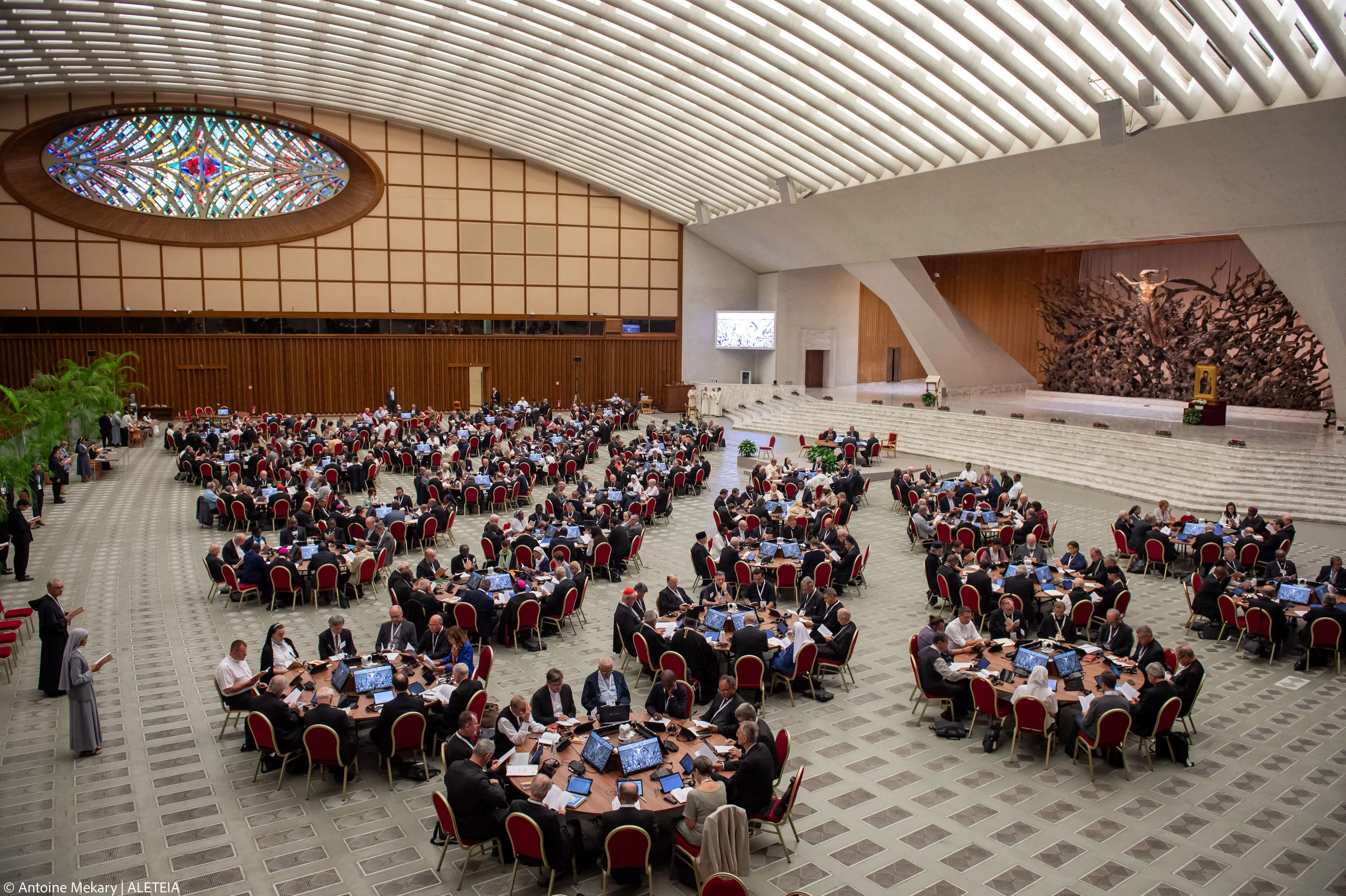
By all accounts from those who were there, the 2023 General Assembly was a positive and exhausting experience. The Synod Secretariat at the Holy See faced a Herculean challenge: identifying participants and supporting players representing the universal Church in all its rich tapestry of laity, religious, and clergy. Delegates were chosen by episcopal conferences, from the Eastern Catholic Churches, selected leaders from the Roman Curia, and 120 delegates personally selected by Pope Francis. In total, 363 people were voting members, including 54 women. In addition to the voting members, 75 additional participants acted as facilitators, experts, or spiritual assistants. From a planning perspective alone, the Synod office did a yeoman job of pulling together an impressively diverse team of participants.

            At the same time, many observers have noted significant lacunae in the participant list. There were, for example, only two deacons in the assembly, one a deacon from Belgium and another from Syria who is about to be ordained a presbyter. Others point to a serious lack of parish priests in the Assembly. Still others highlighted the absence of the poor, and other commentators have noted the lack of substantial influence of the theological experts attending the Assembly when contrasted with the significant impact of theological and canonical periti at Vatican II. All of these areas, and more, are worthy of additional analysis and study. This essay’s focus on Section 11 should not be understood as suggesting these are the only or even the most notable areas for investigation. The purpose of synodality is to journey together, listen, share, and discern together. It seems that if one finds oneself talking about someone else rather than with someone else, then a structural weakness in the process has been found. Consider a well-known example.

Priest anointing

Some years ago, the USCCB worked on a draft document on the role of women in the Church. It went through many drafts, listening sessions, and more drafts. Finally, after years of effort, the bishops scrapped the project. The bishops realized that the document was talking about women and the Church as if they were two distinct things: women on the one hand and the Church on the other. If a group of men called a meeting to talk about women, and no women were part of those conversations, we would immediately see the weakness of the approach.

Similarly, we might point to discussions about deacons and the diaconate, in which deacons had no voice, or discussions about priests and priesthood, in which parish priests had no voice. As mentioned above, two deacons were present at the General Assembly. Yes, there were priests present, but how many were serving as parish priests? The concern is not only that deacons and priests should have the opportunity to be heard, but even more importantly, they are obliged to listen first-hand to the voices around them. Like a choir, the singers must listen to each other. The hope is that as we continue down a synodal path, ways may be found to continue to add voices to the choir. Which is better: to talk about a tenor or to hear one?

            The old bishop comes to mind. He came to believe that he had erred by not realizing how the reforms and initiatives of Vatican II would affect the priesthood. The priesthood would remain, he thought, relatively unchanged while everything else around the priest was changing. Only after the Council did he and other bishops realize that their priests were largely unprepared to be the kind of pastoral leaders responsible for implementing the Council’s visions. We might share that concern in the ongoing synodal process. The ministers who will assist in creating and serving in a synodal Church must participate in the formal process so that their voices and experiences can be heard and that they can learn directly from the experiences of others. They have both a right to be heard and an obligation to listen, a responsibility to respond in humility, regarding others as better than themselves, looking not at their own interests, but to the interests of others (Philippians 2:3-4).

Section 11 of the Synthesis Report

            Section 11 is composed of three sections: Convergences (4), Issues to Address (2), and Proposals (6).


Convergences

            The four “convergences” address the nature and exercise of ordained ministry, an overall positive statement of the diversity and quality of service currently offered by the clergy, a critical concern over clericalism, and finally, how formation leads to an awareness of one’s limitations as well as one’s strengths can help overcome clericalism.

The first point of convergence describes deacons and priests as follows: “The priests are the main cooperators of the Bishop and form a single presbyterate with him; deacons, ordained for the ministry, serve the People of God in the diakonia of the Word, of the liturgy, but above all of charity.”

            In general, this sentence is unsurprising. Still, I would observe that the history of the diaconate (especially the patristic record) consistently highlights the unique bond between deacons and their bishop. It is so unique that when a deacon is ordained, only the bishop lays hands on the ordinand, unlike the ordination of presbyters and bishops in which all attending priests lay hands on the new priests and all attending bishops lay hands on the new bishops. The contrast is striking and significant: the deacon has a unique and special relationship with his bishop. Of course, presbyters have their unique priestly fraternity with the bishop, but the omission of the deacon’s relationship with the bishop is unfortunate.

Deacon and Jail Ministry

            Second, the description of the deacon’s ministry speaks of the three-fold munus of the Word, of the Liturgy, “but above all of charity.” While it is true that charity is characteristic of the deacon and diaconal ministry, it is the “above all” that raises a concern. Pastoral experience and theological analysis since the renewal of the diaconate nearly sixty years ago have developed an understanding that the three munera are to be balanced and integrated. It has been the position of the United States Conference of Catholic Bishops that the three functions are inherently interrelated and that no one who is not competent across all three areas is to be ordained. Some theologians have described the relationship of the functions as perichoretic and not simply discrete functions unto themselves. It is commonplace for deacons and their formators to speak of the “three-legged stool” metaphor: if the three legs are unbalanced, the deacon will fall.

The Report also highlights a concern that deacons value and exercise their liturgical and sacramental role at the expense or neglect of charitable service. That, of course, is a reasonable concern. On the other hand, it seems that the very sacramental identity of the deacon is to be found in a balanced exercise of the three-fold munus. One might say it differently: Just as it would be wrong for a deacon to exercise his liturgical function exclusively with no charitable ministry, it would be equally wrong for a deacon to work only in charitable efforts and not take that work into the pulpit or the sanctuary. Over the years of the renewed diaconate, many writers have correctly stressed the balanced exercise of the Word, the Liturgy, and Charity.

            The second point of convergence speaks of the diverse forms of pastoral ministry currently exercised by priests and deacons. It is a fine summary, and its description of a synodal approach to ordained ministry is particularly apt. It opens the discussion to the next point of convergence: the dangers of clericalism.

In this third area, clericalism is described as “an obstacle to ministry and mission” and “a deformation of the priesthood.” While the paragraph speaks in general terms of clericalism, I would suggest that all comments focused on priestly formation and attitude toward power over service should be targeted explicitly at all who serve: bishops, presbyters, deacons, religious, and laity.

            The fourth and final point of convergence emphasizes “a path of realistic self-knowledge” at all formation levels for ordained ministry. Again, the term associated with Vatican II, co-responsibility, describes the desired approach to ministry, marked by a “style of co-responsibility.” Human formation should help candidates for ordination (deacons and priests) be aware of their human limits as well as their abilities. Notably, the use of language is inclusive of all the ordained and is not restricted to priestly formation. Also significant is the appreciation of the candidate’s family of origin and the community of faith’s role in this process, which has fostered the vocation to ordained ministry.

Issues to Address

            Following these four points of convergence, two specific issues are raised. The first is related to the specific formation of deacons and priests for a synodal Church, and the second concerns priestly celibacy for the priests of the Latin Church.

            In the United States, the USCCB has issued and revised a series of formation standards for both deacons and priests over several decades. While there are significant similarities in the content of formation (especially in the intellectual dimension), the context of formation for deacons is quite distinct from that of priests. The program for deacon formation is a diocesan responsibility, augmented as possible or necessary by partnerships with Catholic institutes of higher learning. Rather than going away “to the seminary,” deacon formation is conducted in diocesan venues, usually on evenings and weekends, since most deacon candidates are raising families and working in secular careers and professions.

            In that regard, then, deacon formation is already “linked to the daily life of the communities.” This is not to suggest that an ongoing review of the overall deacon formation process is unnecessary so as “to avoid the risks of formalism and ideology which lead to authoritarian attitudes.” Both seminary and diocesan formation processes will benefit from the Synod’s call for extensive and creative re-evaluation.

            The second issue, concerning priestly celibacy, is straightforward and is a topic that has been long discussed. Does the overall value of celibacy “necessarily translate into a disciplinary obligation in the Latin Church”? While further reflection may be appropriate, it would seem to be an opportune time to move into implementing a program ad experimentum in various locations in which married candidates for presbyteral ordination are admitted to formation and possible ordination to the presbyterate.

Proposals

            Six proposals conclude the section. Three of them focus on the diaconate. I will summarize them before commenting on them in globo.

            The first proposal recommends an evaluation “of the implementation of the diaconal ministry after the Second Vatican Council,” citing the uneven implementation of the diaconate. Several concerns are mentioned. First, some regions have not introduced it at all. Others fear the diaconate might be misunderstood as an attempted “remedy” for the shortage of priests. Still others were concerned that “sometimes their ministeriality is expressed in the liturgy rather than in service to the poor and needy.” The essential point is sound: implementing a renewed diaconate has been uneven.

Second, the Synod  identifies a need “to understand the diaconate first and foremost in itself, and not only as a stage of access to the priesthood.” It points out the linguistic distinction sometimes made between so-called “permanent” and “transitional” deacons as a sign of the failure to describe the diaconate on its own terms. Third, the “uncertainties surrounding the theology of the diaconal ministry” reveal a need for “a more in-depth reflection,” which “will also shed light on the question of women’s access to the diaconate.”

            All three proposals have merit and should be pursued enthusiastically, systematically, and comprehensively. However, the language of the proposals suggests that such an evaluation has not been undertaken already in various places. Documents from the Holy See (published in 1998) and from the various episcopal conferences have long cited these areas of concern. The Holy See issued Basic Norms for the Formation of Permanent Deacons jointly with the Directory for the Ministry and Life of Permanent Deacons, which offered significant theological and canonical guidance on the renewal of the diaconate.Almost from the beginning of the 1968 renewal of the diaconate in the United States, the Conference of Bishops has conducted regular assessments on these and related issues.

For example, a significant series of studies by the USCCB in 1995 resulted in the Conference renaming the bishops’ committee responsible for the renewed diaconate to remove the word “Permanent,” changing the Secretariat (and Committee) of the Permanent Diaconate to the Secretariat (and Committee) of the Diaconate in recognition of the theological point that there is one diaconate. Sacramentally, no ordination is “transitional”: once ordained a deacon, one remains a deacon. As I have written elsewhere, we do not refer to a presbyter who later becomes a bishop as a “transitional” priest; he remains a priest. A deacon remains a deacon even if one is later is ordained presbyter or bishop. One practice related to this matter that needs serious review is the continued use of the “apprentice model of the diaconate” of ordaining seminarians to the diaconate before ordination to the presbyterate. This practice continues distorting the possibilities of the diaconate being exercised in a synodal church.

 Finally, the USCCB and other episcopal conferences have issued national Directories on deacons’ formation, ministry, and life. In addition to these magisterial efforts, theologians worldwide have studied, taught, and written extensively on these issues.

            I enumerate these sources to counter the possible implication of the Synod’s words that the evaluation it is calling for would be something new. Significant pastoral and theological work has been undertaken for decades, and this foundational work could serve well the contemporary synodal call for a “more in-depth evaluation.” Any such new evaluation will have a strong foundation on which to build.

            The fourth and fifth proposals implement the previous discussion about the nature and content of clergy formation, including the development of  “processes and structures that allow regular verification of the ways in which priests and deacons who carry out roles of responsibility exercise the ministry.” The key would be to have ways for the local community’s involvement in these structures. While these are welcome proposals, one might suggest the feedback and assessment process be expanded to include the episcopate, presbyterate, and diaconate. The final proposal is also straightforward and should be readily implemented, providing an “opportunity to include priests who have left the ministry in a pastoral service that enhances their training and experience.”

Conclusion

            Would the presence of additional deacons and priests at the General Assembly have had an impact on any of these and related questions? We cannot know, but one would certainly hope it would have contributed something of value to the process. As synodal strategies are developed and enhanced throughout the Church, deacons and priests will be expected to assist and support the process in concert with everyone else. It is essential that the hearts, hands, and voices of deacons and parish priests be part of the chorus of the faithful now engaged in the discernment of a future synodal Church. If we find ourselves talking about other people rather than talking together with them, we have reached a perilous point. All of us are called to pray, listen, discern, and lend our hearts and hands to build a synodal Church.

Deacons and the Synod, Postscript: Prayer, Reflection, Discernment

In my previous essays on this topic (Part One here, Part Two here, Part Three here), I have referenced the various Worksheets included with the Instrumentum Laboris for the October Synod Assembly. I now offer this brief postscript.

Section B 2 is concerned with “Co-responsibility in Mission.” In this section is the question (B 2.4), “How can we properly value ordained Ministry in its relationship with baptismal Ministries in a missionary perspective?” Included in this section is a “question for discernment”: “How can we promote in the Church both a culture and concrete forms of co-responsibility such that the relationship between baptismal Ministries and ordained Ministry is fruitful? If the Church is wholly ministerial, how can we understand the specific gifts of ordained Ministers within the one People of God from a missionary perspective?”

Among the several suggestions for prayer and reflection is this one: “How is the ministry of the permanent diaconate to be understood within a missionary synodal Church?”

Would it not be prudent, appropriate, and wise to have deacons in the room for that prayer, reflection and discernment?

Deacons and the Synod, Part Three: Concrete Consequences for the People of God

 This will be the third and final essay in a series on “Deacons and the Synod.” The first essay focused on the apparent lack of deacon participants in the upcoming October General Assembly of the Synod on Synodality and related issues. In the second essay, I suggested that there might be productive ways for deacons to participate in this October’s synodal process going on in Rome without being there in person. In my opinion, it is vital for deacons to be a voice in the synodal process given the nature and sacramental significance of the diaconate itself. From the earliest days of Christianity, deacons were to be the “eyes and ears, heart and soul” of the bishop” (see, for just one example, the mid-3rd Century Syrian Didascalia Apostolorum, “Let let the deacon be the hearing of the bishop, and his mouth and his heart and his soul; for when you are both of one mind, through your agreement there will be peace in the Church”). We are ordained by the bishop to participate in his own pastoral ministry. This occurs not only by serving the specific needs of others but also by making those needs known to the bishop. None of us, bishops, deacons, presbyters, religious, and lay people, serve in a vacuum. In this case, our bishops cannot serve needs they do not know about. How can we bishops and deacons be “both of one mind” if we do not share what burdens our hearts in the care of others?

And so we arrive at this third and final essay. Deacons exist, deacons are ordained, for others. They need to be part of the synodal process not for themselves but for the entire People of God. St. Paul VI referred to deacons as “the animators of the Church’s diakonia,” and St. John Paul II further explained that deacons “are the Church’s service sacramentalized.” Through their ordination, deacons take on a servant-leadership role in the Church. In this essay, therefore, we consider ways in which deacons might lead the entire community of faith in developing a synodal Church. To paraphrase Pope Paul and Pope John Paul: deacons can be understood as “the animators of the Church’s synodality,” and that deacons “are the Church’s synodality sacramentalized.”

I suggest deacons find ways to identify areas of need and concern as their pastoral experience and prayerful reflection indicate and to communicate these experiences and reflections, through appropriate channels, to their bishops. However, they should not stop there. It is not sufficient for deacons to be in a kind of “closed loop” with their bishops. How can deacons help lead others in a synodal path, especially all of those people who will not be present in Rome in October? I offer again the five suggestions I offered previously, slightly expanded. These and similar suggestions can serve as a foundation not only for the Church’s deacons but for the wider community of faith as well. As I wrote before, this list is not exhaustive. Feel free to add to it!

  1. Follow the progress of the Assembly through the media. Don’t trust unofficial sources. Follow the releases from the Holy See. As someone who studies and teaches Ecclesiology, I have spent considerable time checking out a variety of sources, generally online, to see what our parishioners and others may be encountering. I have found it disturbing, aggravating, and infuriating to see what nonsense is spewed by so many “commentators.” Sometimes, there is simply a presentation of factual errors and myths. Still, those errors and myths are now “out there” for anyone to see and hear. People in good faith are therefore misled without even realizing it, and they then make judgments about what they’re hearing from our pulpits and classrooms. “Father must be wrong in his homily because Dr. So-in-So on YouTube said the opposite.” And these are the more benign consequences!

Far more disturbing are those “experts” who are bad-mouthing Pope Francis, his pontificate, and most of the world’s bishops. Can a pope be criticized? Of course. But there is a difference between legitimate concerns over certain aspects of a papacy and crossing the line into schism. Some commentators, for example, refuse to refer to Pope Francis by his papal title and use only his birth name. Again, on one level, that is not the end of the world; but more often than not, it is a way to minimize or even question the ecclesial legitimacy of Pope Francis.

We deacons need to view such “experts” with great caution. Not only our parishioners are vulnerable to such poisonous commentary, thinking it to be accurate, but so too can clergy. In this essay, I don’t want to deviate from the subject at hand and name some names of these “commentators.” Perhaps that can be the subject of a later essay. For now, I simply advise great caution in finding accurate resources on the papacy and on the synodal process itself. Do not trust any sources that might lead others into serious error and even schism. Just as a reminder, c. 751 defines schism as “the refusal of submission to the Supreme Pontiff or of communion with the members of the Church subject to him.” Lack of submission and communion is the foundation of schism.

Therefore, I recommend using only the best resources moving forward, starting with the official documents related to the Synod itself. These may be resources offered by the Holy See, the various episcopal Conferences (such as our own USCCB), or official statements of our own diocesan bishops.

  1. Study the Instrumentum Laboris. Here’s a link to it. How do you respond to these issues and questions yourself? I will develop this item shortly. Imagine that you were there “in the room where it happened” at the Synod Assembly. The Instrumentum Laboris outlines the various topics to be discussed during the Assembly. There is no reason why each and every one of us can’t have these discussions ourselves, and lots of reasons why we should! More later.
  2. Deacon Directors or other leaders in the diaconal community: Consider having weekly sessions (perhaps via ZOOM) for the deacon community to discuss the highlights of the past week. Not much to add to this suggestion. Every diocese has different options available to it that might facilitate such discussions. The diaconate community might decide to hold these discussions, not simply among themselves, but also with other members of the parish or deanery. Just as the bishops have invited other participants into their Synod (It is called the “Synod of Bishops,” after all), having people other than deacons joining in our local meetings can be productive and necessary.
  3. Perhaps pastors and deacons might do something similar for the entire parish and deanery. Bishops may initiate a diocesan process as well for their dioceses.
  4. in opening the Synod, Pope Francis spoke of the three-fold focus of communion, participation, and mission. He pointed out that “the words ‘communion’ and ‘mission’ can risk remaining somewhat abstract, unless we cultivate an ecclesial praxis that expresses the concreteness of synodality at every step of our journey and activity, encouraging real involvement on the part of each and all. Here is where deacons can be particularly helpful. As the Assembly progresses, deacons and others can discuss the practical realities of implementing the issues being discussed. I have subtitled this third essay “Concrete Consequences.” I take that verbiage from the late German theologian Herbert Vorgrimler who once wrote that deacons are to develop and demonstrate the “concrete consequences” of the Eucharist on the lives of our communities. This is where we can make our most unique contributions, where we take theory and aspiration and make it tangible.         

WORKSHEETS FOR THE SYNODAL ASSEMBLY

The Instrumentum Laboris contains fifteen worksheets that will guide the Assembly’s discussions. The same worksheets could guide local and regional processes. While this is not the place to review each worksheet in detail, I offer some comments on their general organization.

Notice there are three groups of five worksheets. Group B1 concerns communion, Group B2 addresses co-responsibility, and Group B3 involves participation, governance, and authority. All of these themes flow directly and intentionally from the work of the Second Vatican Council. As Pope Francis and the Synod coordinators have stressed, the upcoming Assembly is not a general council of the Church; it is not Vatican III! Pope Francis recently observed that the work of Vatican II remains incomplete, and the themes for the Synod Assembly reflect a two-fold concern. First, that the work of the Council itself remains a work in progress, and second, that the Synod should be understood against the background of the Council, and building on a Conciliar foundation.

 Finally, once these discussions are held, the results should be offered to our diocesan bishops for his own reflection, use, and decision-making. This is one way for us deacons in particular to offer our service as his “eyes, ears, voice, heart, and soul,” the traditional roles of the deacon.

Conclusion

Each and every one of us is called to be part of a synodal Church. Several hundred people have been invited to participate in a remarkable gathering in October. The vast majority of us will not be there in person. That does not mean we do not have a responsibility to participate in our own ways. Instead of feeling “left out” we should embrace our baptismal inclusion in the People of God, and for deacons, our vocational call to animate the Church’s diakonia — and synodality.

Deacons and the Synod, Part One: “Father, Where Are You Going Without Your Deacon?”

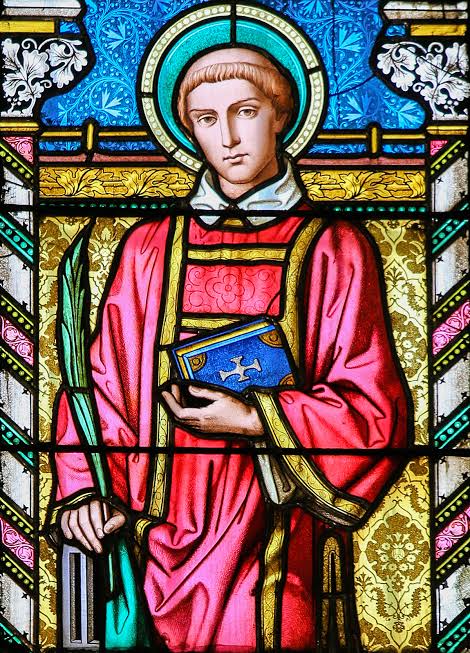
In 258 AD, the Roman emperor Valerian ordered the execution of all Christian clergy in Rome. Pope Sixtus II had been arrested and was being led to his death when his Archdeacon Lawrence approached him with these words. Several days later, Lawrence too would be martyred, following in his bishop’s footsteps. The legend of Lawrence of Rome has inspired Christians, especially deacons, ever since. And his words echo through the ages.

            “Father, where are you going without your deacon?” These words came to mind recently when the list of participants was published for this October’s Synod on Synodality. As a student and teacher of Ecclesiology, I was excited to see the expanded “guest list”. Every conceivable category of persons is going to participate in the Synod.  Lay women and men, religious women and men, young students, bishops, presbyters, theologians, canonists — almost everyone gets a seat at the table. It is a glorious tapestry of the Church! Except that one strand of color will be missing from that tapestry.

            “Father, where are you going without your deacon?” Among all the participants in this part of the synodal process, there seemed to be not a single solitary deacon. I was later able to verify that one or possibly two deacons would be there, although not from North America. To many people, this dearth of deacons may not seem an important issue. However, the diaconate is an ordained ministry that is uniquely synodal in its nature and focus. Ordained “in the person of Christ the Servant” to model the kenotic nature of the Church, deacons are (in the words of St. John Paul II) “apostles of the New Evangelization.” Deacons proclaim, invite, mediate, and pour themselves out to meet the needs of others, with a unique relationship to the bishop and his ministry. In 1967, when St. Paul VI implemented the Second Vatican Council’s decision to renew a diaconate permanently exercised, there were no so-called “permanent” deacons in the Church. Today, there are more than 50,000 such deacons, with about 40% of those deacons here in the United States.

            This is more than a question of numbers, however. It is the fact that, given what the Church believes and teaches about the very nature of the diaconate, one of the three orders of ordained ministry in the Church, deacons could and should contribute to the synodal process, including the October Assembly. So, on at least two levels, the current absence of deacons in the process is crushing. First, our absence suggests that deacons have nothing to contribute, or conversely, nothing to learn from the process of the Synod. Second, who is there to share our story, our insights, and our vision?

            “Father, where are you going without your deacon?”

Palm Sunday 2020: Servants in a Servant Church for a Suffering World

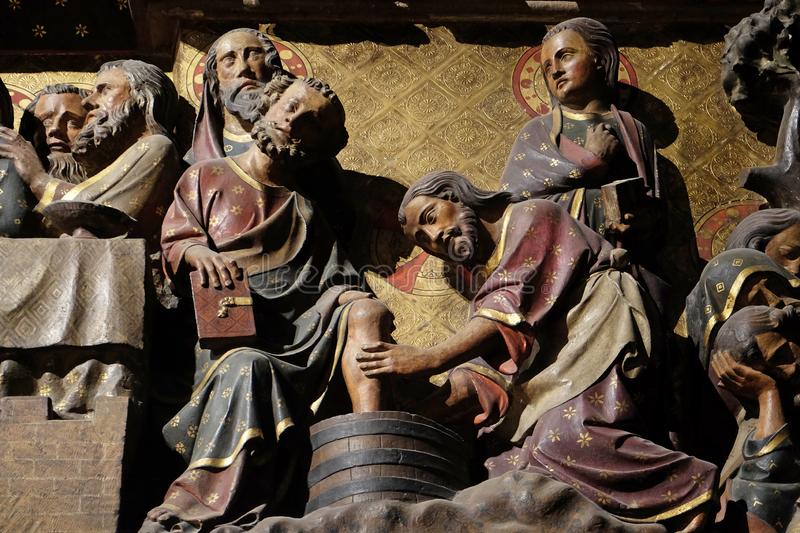
Today we celebrate Palm Sunday in ways no one could have ever imagined, although there have been times in the life of the church when our ancestors had similar experiences. Pope Francis has given a wonderful Palm Sunday homily [here] to a world weary of illness, isolation and violence. His words remind us all of some very important truths, and for those of us who serve in the particular order of deacons: our service can only truly be understood against the more fundamental reality that the church herself is a servant. Indeed, peeling the layers back even more, we remember this Holy Week that we are a servant church precisely because our God — who is love — is Servant. As Pope France put it succinctly, “God saved us by serving us.”

Jesus — Second Person of the Trinity — “who came to serve, not to be served.”

All of us who are baptized disciples of Christ, are immersed into the life of God and are called to “the imitation of Christ,” who came to serve and not to be served. The Holy Father recounts how often, especially during the liturgical celebrations of Holy Week, Christ — the Second Person of the Trinity — is referred to as a Servant. Created in the image and likeness of God, we are to live as Christ did: pouring out his life for the health and salvation of others. In a moving passage, Pope Francis reminds us:

Dear brothers and sisters, what can we do in comparison with God, who served us even to the point of being betrayed and abandoned? We can refuse to betray him for whom we were created, and not abandon what really matters in our lives. We were put in this world to love him and our neighbors. Everything else passes away, only this remains. The tragedy we are experiencing at this time summons us to take seriously the things that are serious, and not to be caught up in those that matter less; to rediscover that life is of no use if not used to serve others. For life is measured by love. So, in these holy days, in our homes, let us stand before the Crucified One – look upon the Crucified One! – the fullest measure of God’s love for us, and before the God who serves us to the point of giving his life, and, – fixing our gaze on the Crucified One – let us ask for the grace to live in order to serve. May we reach out to those who are suffering and those most in need. May we not be concerned about what we lack, but what good we can do for others.

All of this applies to each and every one of us. What, then, can it mean to those of us who are deacons? It is a potent reminder to us that we are ordained, not simply to do what all of us are supposed to do as a result of our sacramental initiation (discipleship), but as a result of our ordination at the hands our bishop, to renew our commitment to be true leaders in service (apostleship). We are not ordained to serve so that others do not have to! We serve first as a result of new life in Baptism; we serve further as animators (to use St. Paul VI’s word) of that service by others. We share in the bishop’s own diakonia, a diakonia first lived through Paschal Mystery of Christ which we celebrate this week.

I encourage everyone, but especially deacons, to pray over Pope Francis’ wonderful homily today. May this Holy Week during a time of global pandemic be for all a time of renewal, of overcoming death, of new life in the Christ.

Deacons at Mass During the Time of COVID-19

Over the last several weeks, deacons and others have been wrestling with the notion of deacons assisting at the various live-streamed Masses going on around the country. Two major questions have emerged:

  1. Should deacons be assisting at all at these Masses?
  2. If deacons are present at Mass, should they abstain from receiving Holy Communion?

First, should deacons (or, really, ANY other ministers besides the priest) be assisting at a live-streamed Mass?

I would begin with a caveat. It depends! There may be logistical or other factors which would make the assistance by a deacon problematic. For example, if a sanctuary is so small (such as a private chapel in the rectory) that the deacon cannot remain some feet away from the priest, then perhaps he should forego assisting.

However, in general, it seems to me that whenever possible, the deacon should be present and assist at Mass. The liturgical witness of the deacon’s ministry at the Eucharist is important and a vital sign of the diaconal identity of the Church. As one of the bishops said at the Second Vatican Council, “The Church has a right to all of the graces given to her by God, and the diaconate is one of those graces.”

On a practical level, of course, the priest and deacon should be sure to discuss in advance the specifics of their liturgical “choreography.” As most of us realize, our normal positions vis-a-vis the presider can easily be adapted keeping “social distancing” in mind. Sure, we will temporarily be a bit closer when we hand the gifts to Father, but we can immediately return to a safer distance. On a personal level, I assisted and preached at last Sunday’s live streamed Mass from our parish, and Father and I were able to maintain a safe distance from each other while still carrying out our respective ministries. Given the layout of our sanctuary, it took very little adaptation to make it work.

Second, if deacons are present, what about Holy Communion? Should deacons abstain from receiving Holy Communion; in fact, CAN the deacon abstain?

Looking at these questions from a technical perspective, it is possible for the deacon to abstain from receiving Holy Communion. The only minister who MUST receive Communion is the priest-presider, since it is he who is offering the sacrifice in persona Christi — and the sacrifice must be consumed. This, however, is a minimalist approach to the Eucharist. For many years, many people did not receive Communion at every Mass for a variety of reasons. It was Pope Pius X who encouraged a greater reception of Communion by the people; this effort continued and was emphasized at the Second Vatican Council, so that now nearly everyone receives Communion at every Mass they attend.

But what about the Deacon, especially in today’s situation? I think we would all agree that it is best if the assisting deacon were to receive Holy Communion. This is true on many levels, including the sign value of seeing the deacon receive. Now, how might that be done safely today? It seems to me that one legitimate option would be for both priest and deacon to receive by means of intinction, with the deacon then consuming the remaining Precious Blood and purifying the sacred vessels. I realize that other deacons and priests are using the more traditional (at least in the Latin Church) approach, but intinction seems to offer the safest method, in my opinion.

I used the expression “sign value” above, and I think that’s an important consideration. Our sacraments are public; they are, as the Baltimore Catechism used to have it: “outward signs instituted by Christ to give grace.” Part of the outward sign of the Eucharist is the ministry of the ordained, which should be exercised in as complete and fulsome way as possible.

So, if at all possible, “it is good for us to be here” at the side of our priest-brother for the Eucharist, even while we remember to stay at a safe distance. And, if we’re there, we should receive Holy Communion, using the safest means available.

Just one deacon’s opinion.

Thirty Years a Deacon: “How Can This Be?”

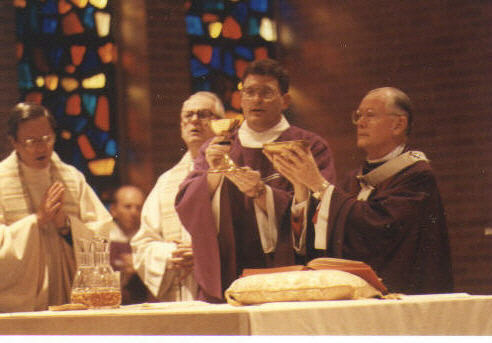
Fr. Tom Henseler, Deacon Harry Clyde, Fr. Jack Smith, myself, Cardinal Hickey

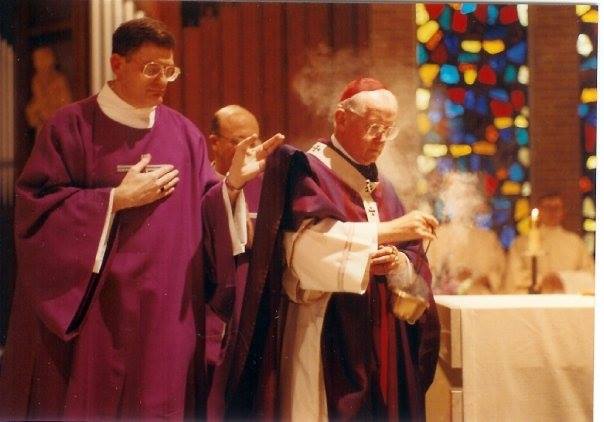
A couple of days ago, on 25 March, I celebrated 30 years as a Deacon of the Catholic Church, ordained on 25 March 1990 by the late Cardinal James Hickey, the Archbishop of Washington, DC. It was the Fourth Sunday of Lent as well as the traditional date for the Annunciation. Mary’s words, “How can this be?” resonate for anyone called to ordained ministry: each of us knows only to well our weaknesses, our sinfulness, our unworthiness.

The past 30 years have been filled with grace and blessing. In ways I never could have imagined thirty years ago, God has brought me into contact with God’s People in so many different places and situations. We have laughed and cried together (fortunately, I think the laughter has far outweighed the tears!), as together we try to walk the various paths we have been given, but paths that ultimately lead back to God.

With deep gratitude for these first thirty years, I thank God, my family, and the People of God, and I renew those promises made at ordination so many years ago, pledging to serve to the best of my abilities as long as God gives me strength to do so.

Holy Mary, Mother of Deacons, pray for us!

.

On the Eve of Holy Week: A Personal Thanksgiving

ORDINA_1001This Sunday, 25 March 2018, is Palm Sunday.  But 28 years ago, it was the Fourth Sunday of Lent (Laetare Sunday) — and on that date I was ordained a deacon of the Catholic Church in the Archdiocese of Washington, DC by our Cardinal-Archbishop, James A. Hickey.
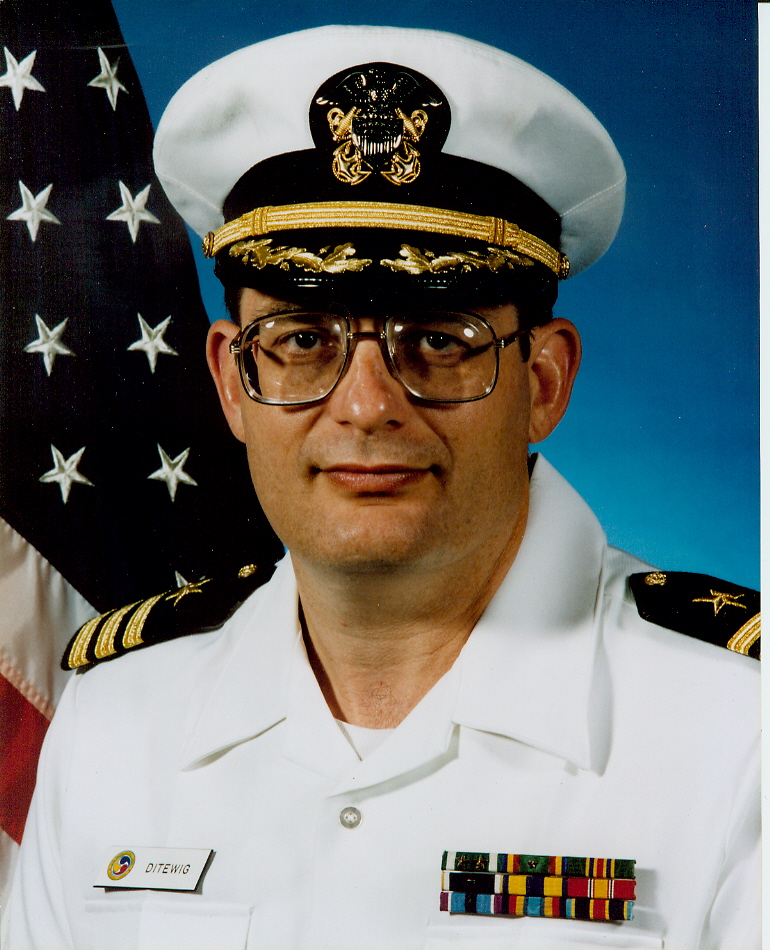


XO HanzaAt that time I was a Commander in the United States Navy, under orders to report to the US Naval Security Group Activity, Hanza, Okinawa, Japan as Executive Officer.  For the previous three years, while assigned to the National Security Agency, I had participated in the deacon formation program of the Archdiocese of Washington, DC.  When my orders to Okinawa arrived, I contacted Deacon Tom Knestout, our deacon director, and then-Father Bill Lori, priest-secretary to Cardinal James Hickey (and now the Archbishop of Baltimore).  Father Lori, God bless him, jumped to the meat of the issue, “Shall we ask the Cardinal to ordain you early, before you leave?”  Within 10 minutes, the Cardinal had approved the request and the date was set.
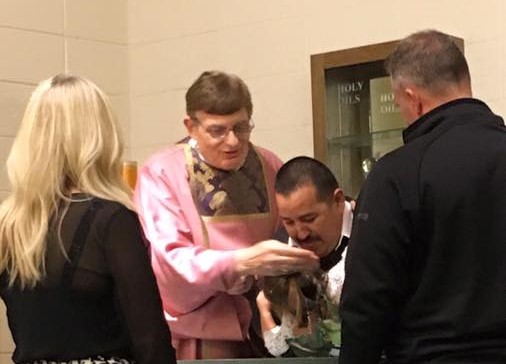
It seems unbelievable that this time in ordained ministry has passed so quickly, and with countless blessings.  To have been so privileged to serve in so many ways, in so many places, and to walk with people in their joys and sorrows — and the baptisms!  (I have to mention the baptisms.  Gaudete Sunday Baptism 2 editTo see families, large and small, approaching the font, is an inexpressible joy.)  Twenty-eight years ago, I could not have imagined the journey to come; I suppose we can all say that about our lives!
As we enter into this holiest of seasons I simply want to thank God for the great grace of serving as a deacon of the church.  And of course, no family man can serve in this way without the deepest love and gratitude for his family and for the many challenges (along with the blessings) they have faced on this journey.

If past is prologue, the next 28 years should be very interesting! Deo gratias!

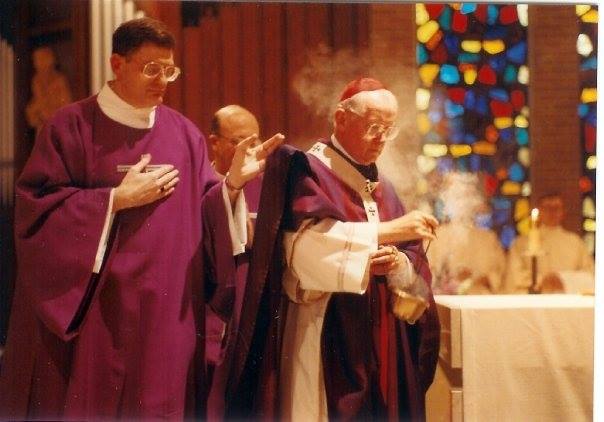
Incensation at Ordination