Father Reese and Tired Old Tropes About Deacons

INTRODUCTION

Jesuit Father Thomas Reese has, once again, wheeled out some tired old myths and misperceptions about the diaconate. He seems to go through this exercise every so often. His argument seems to be that if the Church starts to ordain women as deacons, all will be well. However, if the Church doesn’t ordain women deacons, then no one should be ordained deacons. He seems to say that the diaconate is sacramental and necessary if women are ordained, but not sacramental or necessary if they are not. He reaches this bizarre conclusion applying principles that are ahistorical, theologically untenable, and downright dangerous in their ignorance of the matters involved. Such misinformation must be addressed.

As I say, Father Reese has done all this before. I responded to him before on this blog, and I will copy it again here for the reader’s convenience. Here it is:

==============================

DEACONS: MYTHS AND MISPERCEPTIONS

Jesuit Father Thomas Reese has published an interesting piece over at NCRonline entitled “Women Deacons? Yes.  Deacons?  Maybe.”  I have a lot of respect for Fr. Tom, and I thank him for taking the time to highlight the diaconate at this most interesting time.  As the apostolic Commission prepares to assemble to discuss the question of the history of women in diaconal ministry, it is good for all to remember that none of this is happening in a vacuum.  IF women are eventually ordained as deacons in the contemporary Church, then they will be joining an Order of ministry that has developed much over the last fifty years.  Consider one simple fact: In January 1967 there were zero (0) “permanent” deacons in the Latin Rite of the Catholic Church (the last two lived and died in the 19th Century).  Today there are well over 40,000 deacons serving worldwide.  By any numerical measure, this has to be seen as one of the great success stories of the Second Vatican Council.  Over the last fifty years, then, the Church has learned much about the nature of this renewed order, its exercise, formation, assignment and utilization.  The current question, therefore, rests upon a foundation of considerable depth, while admitting that much more needs to be done.

However, Father Reese’s column rests on some commonly-held misperceptions and errors of fact regarding the renewal of the diaconate.  Since these errors are often repeated without challenge or correction, I think we need to make sure this foundation is solid lest we build a building that is doomed to fall down.  So, I will address some of these fault lines in the order presented:

  1.  The“Disappearance” of Male Deacons
exsultet1

Father states that “[Women deacons] disappeared in the West around the same time as male deacons.”  On the contrary, male deacons remained a distinct order of ministry (and one not automatically destined for the presbyterate) until at least the 9th Century in the West.  This is attested to by a variety of sources.  Certainly, throughout these centuries, many deacons — the prime assistants to bishops — were elected to succeed their bishops.  Later in this period, as the Roman cursus honorum took hold more definitively, deacons were often ordained to the presbyterate, leading to what is incorrectly referred to as the “transitional” diaconate.  However, both in a “permanent” sense and a “transitional” sense, male deacons never disappeared.

  1.  The Renewal of Diaconate as Third World Proposal
1115_p12b500

Father Tom writes that his hesitancy concerning the diaconate itself “is not with women deacons, but with the whole idea of deacons as currently practiced in the United States.” (I would suggest that this narrow focus misses the richness of the diaconate worldwide.)  He then turns to the Council to provide a foundation for what follows.  He writes, “The renewal of the diaconate was proposed at the Second Vatican Council as a solution to the shortage of native priests in missionary territories. In fact, the bishops of Africa said, no thank you. They preferred to use lay catechists rather than deacons.”  This statement simply is not true and does not reflect the history leading up to the Council or the discussions that took place during the Council on the question of the diaconate.
LocalsRebuildDresden

As I and others have written extensively, the origins of the contemporary diaconate lie in the early 19th Century, especially in Germany and France.  In fact there is considerable linkage between the early liturgical movement (such as the Benedictine liturgical reforms at Solesmes) and the early discussions about a renewed diaconate: both stemmed from a desire to increase participation of the faithful in the life of the Church, both at liturgy and in life.  In Germany, frequent allusion was made to the gulf that existed between priests and bishops and their people.  Deacons were discussed as early as 1840 as a possible way to reconnect people with their pastoral leadership.  This discussion continued throughout the 19th Century and into the 20th.  It became a common topic of the Deutschercaritasberband (the German Caritas organization) before and during the early years of the Nazi regime, and it would recur in the conversations held by priest-prisoners in Dachau.  Following the war, these survivors wrote articles and books on the need for a renewed diaconate — NOT because of a priest shortage, but because of a desire to present a more complete image of Christ to the world: not only Christ the High Priest, but the kenotic Christ the Servant as well.  As Father Joseph Komonchak famously quipped, “Vatican II did not restore the diaconate because of a shortage of priests but because of a shortage of deacons.”
Vatican II

Certainly, there was some modest interest in this question by missionary bishops before the Council.  But it remained largely a European proposal.  Consider some statistics.  During the antepreparatory stage leading up to the Council (1960-1961), during which time close to 9,000 proposals were presented from the world’s bishops, deans of schools of theology, and heads of men’s religious congregations, 101 proposals concerned the possible renewal of the diaconate.  Eleven of these proposals were against the idea of having the diaconate (either as a transitional or as a permanent order), while 90 were in favor of a renewed, stable (“permanent”) diaconate.  Nearly 500 bishops from around the world supported some form of these 90 proposals, with only about 100 of them from Latin America and Africa.  Nearly 400 bishops, almost entirely from both Western and Eastern Europe, were the principal proponents of a renewed diaconate (by the way, the bishops of the United States, who had not had the benefit of the century-long conversation about the diaconate, were largely silent on the matter, and the handful who spoke were generally against the idea).  Notice how these statistics relate to Father Tom’s observation.  First, the renewed diaconate was largely a European proposal, not surprising given the history I’ve outlined above.  Second, notice that despite this fact, it is also wrong to say that “the African bishops said no thank you” to the idea.  Large numbers of them wanted a renewed diaconate, and even today, the diaconate has been renewed in a growing number of African dioceses.

One other observation on this point needs to be made.  No bishop whose diocese is suffering from a shortage of priests would suggest that deacons would be a suitable strategy.  After all, as we all know, deacons do not celebrate Mass, hear confessions or anoint the sick.  If a diocese needed more priests, they would not have turned to the diaconate.  Yes, there was some discussion at the Council that deacons could be of assistance to priests, but the presumption was that there were already priests to hand.

In short, the myth that “the diaconate was a third world initiative due to a shortage of priests” simply has never held up, despite its longstanding popularity.

  1.  Deacons as Part-Time Ministers

Father cites national statistics that point out that deacons are largely unpaid, “most of whom make a living doing secular work.”  “Why,” he asks, “are we ordaining part-time ministers and not full-time ministers?”
shutterstock_137696915-660x350

Let’s break this down.  First, there never has been, nor will there ever be, a “part-time deacon.”  We’re all full-time ministers.  Here’s the problem: Because the Catholic Church did not have the advantage of the extensive conversation on diaconate that was held in other parts of the world, we have not fully accepted the notion that ministry extends BEYOND the boundaries of the institutional church itself.  Some of the rationale behind the renewal of the diaconate in the 19th Century and forward has been to place the Church’s sacred ministers in places where the clergy had previously not been able to go!  Consider the “worker-priest” movement in France.  This was based on a similar desire to extend the reach of the Church’s official ministry outside of the parish and outside of the sanctuary.  However, if we can only envision “ministry” as something that takes place within the sanctuary or within the parish, then we miss a huge point of the reforms of the Second Vatican Council and, I would suggest, the papal magisterium of Pope Francis.  The point of the diaconate is to extend the reach of the bishop into places the bishop can’t normally be present.  That means that no matter what the deacon is doing, no matter where the deacon is working or serving, the deacon is ministering to those around him.

We seem to understand this when we speak about priests, but not about deacons.  When a priest is serving in some specialized work such as president of a university, or teaching history or social studies or science at a high school, we would never suggest that he is a “part-time” minister.  Rather, we would correctly say that it is ALL ministry.  Deacons take that even further, ministering in our various workplaces and professions.  It was exactly this kind of societal and cultural leavening that the Council desired with regard to the laity and to the ordained ministry of the deacon.  The bottom line is that we have to expand our view of what we mean by the term “ministry”!

  1.  “Laypersons can do everything a deacon can do

Father writes, “But the truth is that a layperson can do everything that a deacon can do.”  He then offers some examples.  Not so fast.
ANSA-John23Hospital-255x318

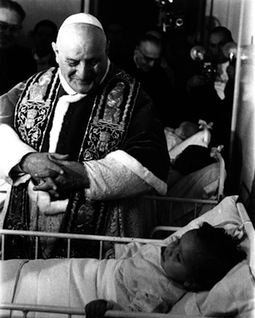
Not unlike the previous point, this is a common misperception.  However, it is only made if one reduces “being a deacon” to the functions one performs.  Let’s ponder that a moment.  We live in a sacramental Church.  This means that there’s more to things than outward appearances.  Consider the sacrament of matrimony.  Those of us who are married know that there is much, much more to “being married” than simply the sum of the functions associated with marriage.  Those who are priests or bishops know that there is more to who they are as priests and bishops than simply the sum of what they do.  So, why can’t they see that about deacons?  There is more to “being deacon” than simply the sum of what we do.  And, frankly, do we want priests to stop visiting the sick in hospitals or the incarcerated in prisons simply because a lay person can (and should!) be doing that?  Shall we have Father stop being a college professor because now we have lay people who can do that?  Shall we simply reduce Father to the sacraments over which he presides?  What a sacramentally arid Church we would become!

The fact is, there IS a difference when a person does something as an ordained person.  Thomas Aquinas observed that an ordained person acts in persona Christi et in nomine Ecclesiae — in the person of Christ and in the name of the Church.  There is a public and permanent dimension to all ordained ministry that provides the sacramental foundation for all that we try to do in the name of the Church.  We are more than the sum of our parts, we are more than the sum of our functions.

  1.  “We have deacons. . . because they get more respect”
francis-washing-feet

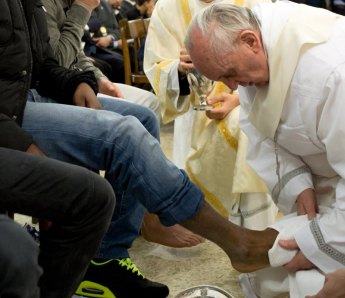
With all respect to a man I deeply admire, I expect that most deacons who read this part of the column are still chuckling.  Yes, I have been treated with great respect by most of the people with whom I’ve served, including laity, religious, priests and bishops.  On the other hand, the experience of most deacons does not sustain Father’s observation.  The fact is, most people, especially if they’re not used to the ministry of deacons, don’t associate deacons with ordination.  I can’t tell the number of times that I’ve been asked by someone, “When will you be ordained?” — meaning ordination to the priesthood.  They know I am a deacon, but, as some people will say, “but that one really doesn’t count, does it?”  I had another priest once tell me, “Being a deacon isn’t a real vocation like the priesthood.”  If it’s respect a person is after “beyond their competence” (to quote Father Reese), then it’s best to avoid the diaconate.

No, the truth is that we have deacons because the Church herself is called to be deacon to the world (cf. Paul VI).  Just as we are a priestly people who nonetheless have ministerial priests to help us actualize our priestly identity, so too we have ministerial deacons to help us actualize our ecclesial identity as servants to and in the world.  To suggest that we have deacons simply because of issues of “respect” simply misses the point of 150 years of theological and pastoral reflection on the nature of the Church and on the diaconate.

In all sincerity, I thank Father Reese for his column on the diaconate, and I look forward to the ongoing conversation about this exciting renewed order of ministry of our Church.

=================================

CONCLUSION

I ended that earlier article with the hope of an ongoing conversation with Father Reese about the diaconate. Unfortunately, it seems that will not be happening. Father seems stuck in the mire of myths and misperceptions that have long been debunked by historical fact, theological development, and, in the final analysis, the lived pastoral experience of the Church and the Church’s deacons over the nearly six decades of the renewal of the diaconate. In the name of the Church, deacons are ordained to “animate the Church’s service” (St. Pope Paul VI) and to be “the Church’s service sacramentalized” (Pope St. John Paul II).
Where Are the Deacons — Again?

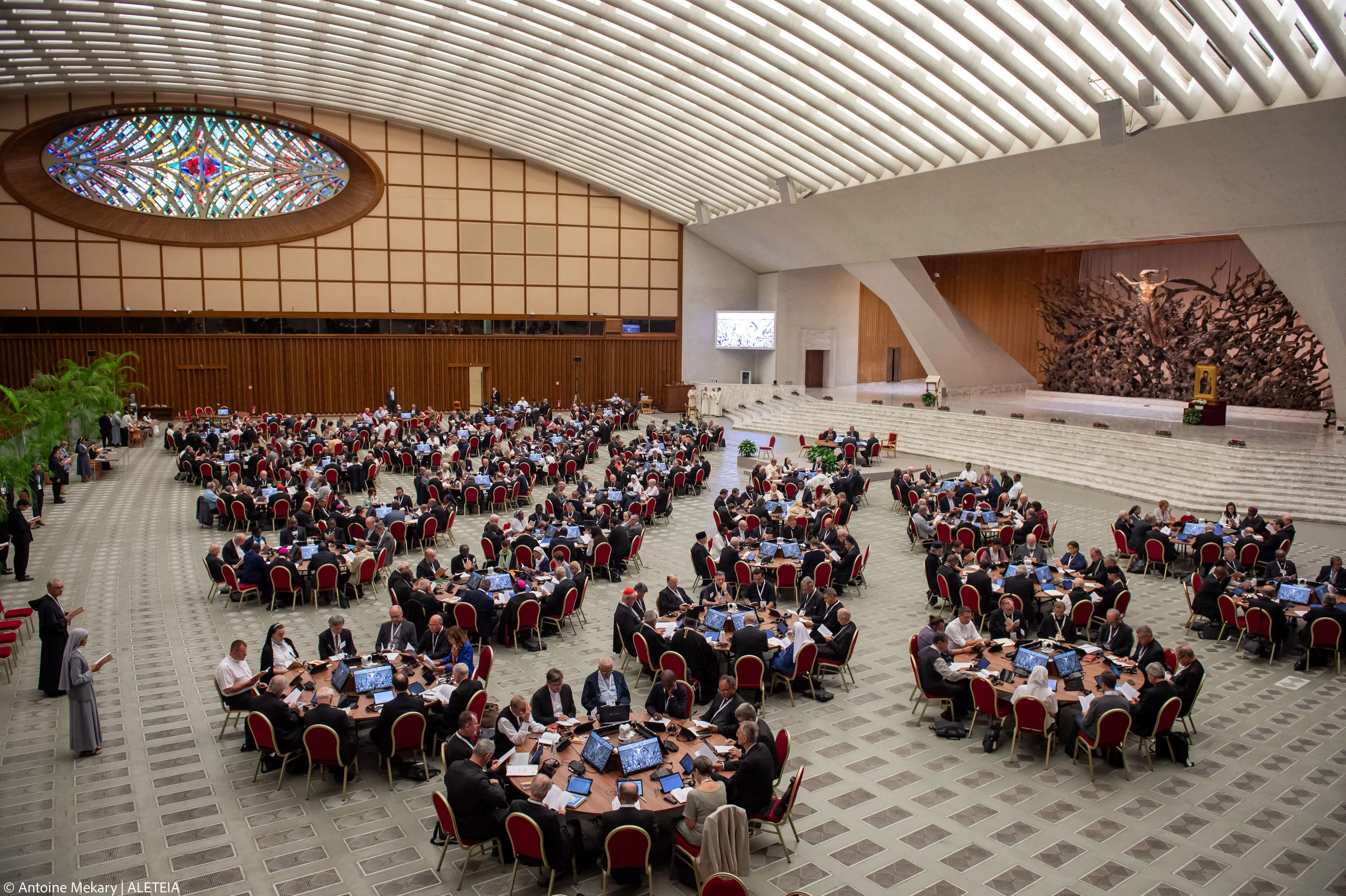
When the 2023 General Assembly of the Synod on Synodality convened, many observers noted the absence of deacons and priests. In the case of deacons, for example, one (“permanent”) deacon was in attendance, along with another deacon soon to be ordained to the presbyterate. Now, the Synod Secretariat has announced an extraordinary 5-day gathering of some 300 priests convening in late April 2024. This assembly is being held, according to the Secretariat, to respond to the desire of the Synod participants to “develop ways for a more active involvement of deacons, priests, and bishops in the synodal process during the coming year. A synodal Church cannot do without their voices, their experiences, and their contribution.” The announced gathering is therefore good news. But once again the same question recurs: Where are the deacons?

            If the participants desired “more active involvement” of deacons, where are they? Perhaps more important, why is the participation of deacons so problematic? The words of the announcement and the Synthesis Report are clear enough but, yet again, the actions – or inaction – belie those words. When you tell someone that they are valued and that “their voices, their experiences, and their contribution” are vital, and then do nothing to open the door to those voices, why should the nice words be believed?

            Having little to no substantive participation by deacons at the 2023 Assembly could be explained as a painful oversight. Once this lacuna is pointed out, however, to be excluded from the process yet again is deliberately hurtful and dismissive, conveying clearly that deacons simply have no voice worth hearing, no experience worth sharing, and no insights to give or to receive. In short, when every other possible group of participants and theological experts are literally at the table of the synod, the absence of deacons sends the clear message that deacons are unnecessary, with nothing to contribute. How glaringly different from our history! Those deacons were the “eyes and ears, heart and soul” of the bishop, with one source (the mid-3rd Century Syrian Didascalia Apostolorum) proclaiming, “Let let the deacon be the hearing of the bishop, and his mouth and his heart and his soul; for when you are both of one mind, through your agreement there will be peace in the Church”.

    Although the Second Vatican Council, in renewing a diaconate to be permanently exercised, said that the ministries of the deacon are “so very necessary to the life of the Church,” it would seem this statement is no longer to be valued.

            Perhaps the more important question is not “Where are the deacons?” but rather, “Why, just why, are deacons not part of the vision of the Synod?”

On the Eve of the Synod: Papal Bookends and Diakonia

St. John XXIII and St. Paul VI

In convening the latest Synod of Bishops, Pope Francis is drawing insight and inspiration from his predecessors. Today, on the verge of the solemn opening of the General Assembly of the Synod of Bishops, I want to highlight two of them: the popes of the Second Vatican Council, St. John XXIII and St. Paul VI. The current Synod of Bishops is not, of course, a general Council of the Church. However, it is my judgment that to understand the Synod and its work, one must be thoroughly grounded in the work of the global episcopate at Vatican II. While that is a project far beyond the scope of this essay, we can find inspiration in the papal bookends of St. John XXIII’s address opening to the Council and then, following the intense work of the bishops over four years, St. Paul VI’s address at the final general session of the Council.

Saint John had faced considerable skepticism, and far worse, for his decision to call the Council. The world seemed to have gone mad throughout the 20th Century, with its global conflicts, economic collapse, and war on an unimaginable scale. The Holocaust and then the beginning of the atomic age changed the world forever. It is important to remember that the Second World War had only been over for fourteen years when he announced the Council. Vatican II, in many ways, was the Church’s response to the horrors and devastation of the Second World War and the world that emerged following it.

The Council Opens

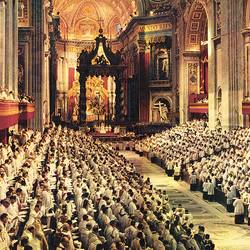
It was against this backdrop that the majority of the world’s bishops assembled in Saint Peter’s Basilica after three years of intense preparation. Following the lengthy procession and then Mass, Saint John addressed the bishops — and the world. “Holy Mother Church rejoices,” he began. He presented a hopeful outlook for the Council, and that it would be a blessing to the Church so that the Church could “look to the future without fear.”

He then acknowledged the existence of those who persisted in a different, negative, and pessimistic view of the Church and the world. This is a well-known passage, but on the eve of the Assembly of the Synod of Bishops, it bears a prayerful, reflective examination.

The Prophets of Gloom: Then and Now

In the daily exercise of our pastoral office, we sometimes have to listen, much to our regret, to the voices of persons who, though burning with zeal, are not endowed with too much sense of discretion or measure. In these modern times, they can see nothing but prevarication and ruin. They say that our era, in comparison with past eras, is getting worse, and they behave as though they have learned nothing from history, which is, nonetheless, the teacher of life. They behave as though at the time of former Councils everything was a full triumph for the Christian idea and life and for proper religious liberty.

What a remarkable passage. Pope John is blunt in his description of the skeptics. They want to live in the past, and yet “they have learned nothing” from that history “which is nonetheless the teacher of life.” They have so “canonized” the past that they distort it beyond recognition. We hear similar voices today, especially some of the rather notorious “dads with webcams” who populate the internet and spend their time mocking, insulting, and even threatening Pope Francis and the Synod. Pope John did more than just call out his critics:

We feel we must disagree with those prophets of gloom, who are always forecasting disaster, as though the end of the world were at hand.

We can echo Pope John in our own day, disagreeing with today’s “prophets of gloom”. Like their predecessors, they too persist in forecasting disaster. Several of these contemporary “prophets of gloom” are Cardinals who have raised dubia (questions, doubts) to Pope Francis. In the earlier submission, Pope Francis wisely declined to respond. In the recent second submission, the pope chose to respond so there would be clarity prior to the impending Synod Assembly. Now, these same cardinals don’t like the pope’s responses and are now asking him to respond “yes” or “no.” To be accurate, dubia are generally responded to as either “yes” (affirmative) or “no” (negative). However, the issues raised by the Cardinals (and consequently by their junior prophets of gloom on the internet) defy such simplistic responses, and the pope was wise and prudent not to fall into such a trap. Like Pope John before him, Pope Francis is leading us to the novus habitus mentis called for by every pope since Pope John, a new way of thinking that offers a vision of hope based on the constant presence and providence of God:

In the present order of things, Divine Providence is leading us to a new order of human relations which, by men’s own efforts and even beyond their very expectations, are directed toward the fulfillment of God’s superior and inscrutable designs. And everything, even human differences, leads to the greater good of the Church.

Council and Synod: Doing the Will of God Yesterday, Today, Tomorrow

First, this is God’s gracious initiative, not ours. Yes, there are people around the world who have specific dreams for the Church in the future. We, the Church, must listen intently, discern prayerfully, and cooperate creatively with God’s will. Second, look again at that remarkable sentence that “everything, even human differences, leads to the greater good of the Church.” The unity of the Church is expressed in its diversity since all of it comes from the One God. Some people today would struggle with Pope John’s statement which is, nonetheless, true. He continues to detail his vision for the goals of the Council, and again, these words could apply to the Synod.

Our duty is not only to guard this precious treasure, as if we were concerned only with antiquity but to dedicate ourselves with an earnest will and without fear to that work which our era demands of us, pursuing thus the path which the Church has followed for twenty centuries. The salient point of this Council is not, therefore, a discussion of one article or another of the fundamental doctrine of the Church which has repeatedly been taught by the Fathers and by ancient and modern theologians, and which is presumed to be well-known and familiar to all. For this, a Council was not necessary.

[T]he Christian, Catholic, and apostolic spirit of the whole world expects a step forward toward a doctrinal penetration and a formation of consciousness in faithful and perfect conformity to the authentic doctrine, which, however, should be studied and expounded through the methods of research and through the literary forms of modern thought. The substance of the ancient doctrine of the deposit of faith is one thing, and the way in which it is presented is another.

Several points suggest themselves for the Synod based on this passage:

  1. We must go beyond a simple “maintenance” of antiquity.
  2. Our times demand walking a path “which the Church has followed for twenty centuries.”
  3. There is no need for a Synod to discuss and debate fundamental doctrine.
  4. The whole world (“the Christian, Catholic, and apostolic spirit”) expects a step forward.
  5. “The substance of the ancient doctrine of the deposit of faith is one thing, and the way in which it is presented is another.”

Implementing the Servant Identity of the Church

After four years of listening, debate, discussion, and discernment, the Council came to an end. On 7 December 1965, Pope Paul VI gathered with the world’s bishops for the final general meeting of the Council and to promulgate the documents approved during the fourth and final session of the Council. Standing before his brother bishops, Pope Paul summarized the work of the Council. A key passage sets the Church — and her deacons — onto a new path.

Another point we must stress is this: all this rich teaching is channeled in one direction, the service of mankind, of every condition, in every weakness and need. The Church has, so to say, declared herself the servant of humanity, at the very time when her teaching role and her pastoral government have, by reason of the council’s solemnity, assumed greater splendor and vigor: the idea of service has been central.

Gone was the perfectas societas approach to ecclesiology. Now the very nature of the Church is that of a servant, a servant of all of humanity. The mission of the Church is to evangelize; that mission is a diakonia, a sacrificial service rendered to all of God’s creation. Into this new direction announced by Pope Paul and the Council Fathers, the renewed diaconate emerges from the shadows of history. And, once again, it is Pope Paul who makes the critical connection between the diakonia of the Church and and the renewed diaconate. He described deacons as “the animators of the Church’s diakonia.” Not many years later, St. John Paul II quoted Paul VI, and added that deacons “are the Church’s service sacramentalized.” Through their ordination, deacons take on a servant-leadership role in the Church. But we are ordained, not to exercise diakonia so that others do not have to. Rather, we exist to assist, empower, and inspire others to fulfill their baptismal obligation to serve God and one another.

Conclusion

The Synod is not a Council. It is, however, a powerful exercise of the Church’s synodal character. The lessons we can learn from the modus operandi and the vision of the Council can still serve as valuable markers on the synodal process. It must be remembered that this Synod is continuing a journey demanded by the bishops of the Council and implemented by Pope Paul. It is not emerging from a vacuum.

As with most things in life, attitude can be everything. If one approaches the Synod with a negative attitude, the acts of the Synod will almost certainly be perceived as negative. Prophets of gloom will find the gloom they seek. However, if approached with the attitude of Pope John, as a new day in the life of the Church (“and now is just the dawn!”), the possibilities are almost endless.

“Tantum Aurora Est!”

Thirty Years a Deacon: “How Can This Be?”

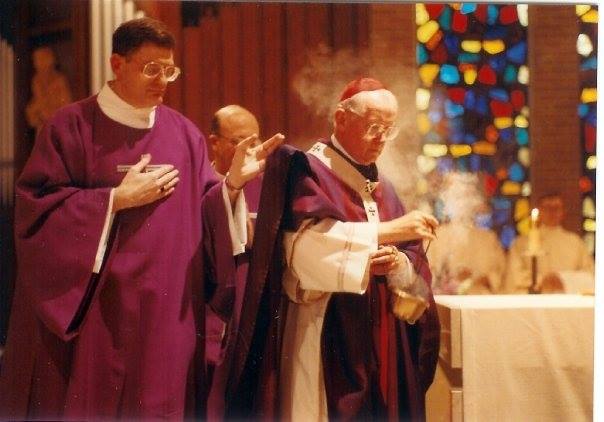
Fr. Tom Henseler, Deacon Harry Clyde, Fr. Jack Smith, myself, Cardinal Hickey

A couple of days ago, on 25 March, I celebrated 30 years as a Deacon of the Catholic Church, ordained on 25 March 1990 by the late Cardinal James Hickey, the Archbishop of Washington, DC. It was the Fourth Sunday of Lent as well as the traditional date for the Annunciation. Mary’s words, “How can this be?” resonate for anyone called to ordained ministry: each of us knows only to well our weaknesses, our sinfulness, our unworthiness.

The past 30 years have been filled with grace and blessing. In ways I never could have imagined thirty years ago, God has brought me into contact with God’s People in so many different places and situations. We have laughed and cried together (fortunately, I think the laughter has far outweighed the tears!), as together we try to walk the various paths we have been given, but paths that ultimately lead back to God.

With deep gratitude for these first thirty years, I thank God, my family, and the People of God, and I renew those promises made at ordination so many years ago, pledging to serve to the best of my abilities as long as God gives me strength to do so.

Holy Mary, Mother of Deacons, pray for us!

.

“Laudate Si'” and Deacons: Things to Ponder While Implementing the Encyclical

laudato-si

Pope Francis has issued his first encyclical letter to the world, Laudate Si’: On the Care of our Common Home.  For several weeks, even before its release, commentators within and outside the Church have been opining about its possible content, the magisterial weight of its teaching, and even on the role of the Holy Father (and indeed, any person of faith) on questions related to ecology and the environment.  In the hours since its release, commentary has exploded from every quarter.  I don’t intend to enter that fray until I’ve been able to read the entire document, but it might be helpful to consider how we, as deacons, might approach the study and implementation of the encyclical.  I offer a few suggestions.

  1. Try to set aside the political rhetoric of current US debates on global warming.

The encyclical is a part of the Church’s magisterium, not an expression of partisan politics.  This is not to say that the encyclical should not have an impact on our political landscape, but reading the Pope’s words through an American political lens will prevent us reaping the full benefit of the teaching.  Certainly, we should not be trying to “proof text” the encyclical to prove or disprove a particular political agenda.  In particular, as deacons, we should help the Holy Father’s words not be coopted by those who might “cherry pick” sections of the encyclical, while ignoring others, simply to meet a political end.

  1. Read the encyclical as part of the larger magisterium of the Church.

As the Pope has said repeatedly, this encyclical must be read and interpreted within the existing matrix of Catholic Social Teaching.  While there seems to be much within the text that has the Holy Father’s unique “voice,” the teaching it contains is in continuity with previous statements of the contemporary Church, including the Second Vatican Council (in particular, the Pastoral Constitution on the Church in the Modern World), the papal magisterium (including Sts. John XXIII’s Pacem in Terris and several teachings of St. John Paul II and Pope Emeritus Benedict XVI), and various statements of national bishops’ conferences around the world.  We can best serve our communities, in my opinion, by helping people see the connectedness of the moral principles being addressed, a connectedness that shows the constant, recurring concern of the Church for God’s creation and our human responsibility for that creation.

  1. As deacons, how might our own ministries reflect this teaching?

What concrete steps might our own communities be encouraged to take in response to the encyclical?  Consider:

  1. Study groups among our adults and young people, actually reading the encyclical and not simply reports about it.
  2. Are there building projects in your parish right now? How ecologically responsible are those projects?  Are there ways that the building materials, energy sources, and so on might better reflect our concern for creation?
  3. How might our parishes and institutions throughout the Diocese form partnerships within the wider communities to improve our response to environmental concerns?

As deacons charged with being Heralds of the Good  News of Christ, we have a particular responsibility and a unique opportunity to serve in communicating, teaching, and acting on the provisions of the encyclical.