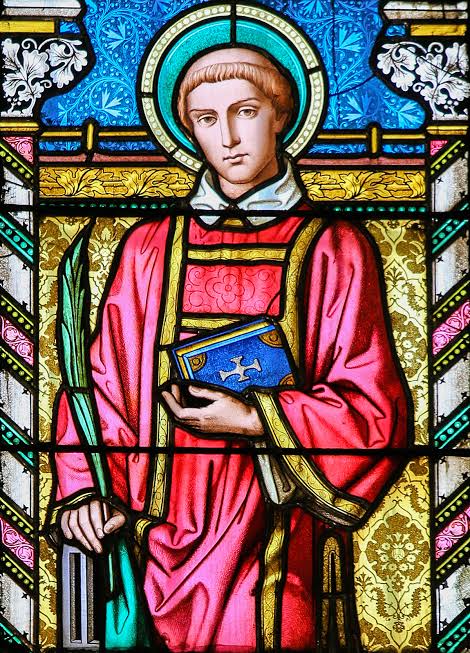
In 258 AD, the Roman emperor Valerian ordered the execution of all Christian clergy in Rome. Pope Sixtus II had been arrested and was being led to his death when his Archdeacon Lawrence approached him with these words. Several days later, Lawrence too would be martyred, following in his bishop’s footsteps. The legend of Lawrence of Rome has inspired Christians, especially deacons, ever since. And his words echo through the ages.
“Father, where are you going without your deacon?” These words came to mind recently when the list of participants was published for this October’s Synod on Synodality. As a student and teacher of Ecclesiology, I was excited to see the expanded “guest list”. Every conceivable category of persons is going to participate in the Synod. Lay women and men, religious women and men, young students, bishops, presbyters, theologians, canonists — almost everyone gets a seat at the table. It is a glorious tapestry of the Church! Except that one strand of color will be missing from that tapestry.

“Father, where are you going without your deacon?” Among all the participants in this part of the synodal process, there seemed to be not a single solitary deacon. I was later able to verify that one or possibly two deacons would be there, although not from North America. To many people, this dearth of deacons may not seem an important issue. However, the diaconate is an ordained ministry that is uniquely synodal in its nature and focus. Ordained “in the person of Christ the Servant” to model the kenotic nature of the Church, deacons are (in the words of St. John Paul II) “apostles of the New Evangelization.” Deacons proclaim, invite, mediate, and pour themselves out to meet the needs of others, with a unique relationship to the bishop and his ministry. In 1967, when St. Paul VI implemented the Second Vatican Council’s decision to renew a diaconate permanently exercised, there were no so-called “permanent” deacons in the Church. Today, there are more than 50,000 such deacons, with about 40% of those deacons here in the United States.
This is more than a question of numbers, however. It is the fact that, given what the Church believes and teaches about the very nature of the diaconate, one of the three orders of ordained ministry in the Church, deacons could and should contribute to the synodal process, including the October Assembly. So, on at least two levels, the current absence of deacons in the process is crushing. First, our absence suggests that deacons have nothing to contribute, or conversely, nothing to learn from the process of the Synod. Second, who is there to share our story, our insights, and our vision?
“Father, where are you going without your deacon?”

 Many people might be unaware of the history behind these three items, so let me cover each briefly. Before doing that, however, we should keep one traditional factor in mind. Throughout the Catholic tradition, East and West, it has been a well-established principle that “married men may be ordained but ordained men may not marry.” Following ordination, then, the longstanding norm (until the 1984 Code of Canon Law) was that, once ordained, a man could not marry — or marry again, in the case of a married cleric whose wife has died. In other words, the very reception of Holy Orders constitutes an impediment to entering a marriage. The 1984 Code (c. 1078), however, permits a request for a dispensation from the “impediment of order” which would then permit the widowed deacon to re-marry. More about this below.
 The three issues mentioned today are all questions that up until now have required a petition from the cleric involved to the Holy See for resolution. None of them were things that could be decided by the local diocesan bishop or the regional episcopal conference (such as the United States Conference of Catholic Bishops). So let’s take a closer look at these three situations.
 “The passage to new marriage for a widowed permanent deacon”: This is a situation which has been faced by many of our deacons over the past decades. Obviously a married man cannot and does not make the promise of celibacy prior to ordination as a Deacon: we do not promise a hypothetical: “I promise to embrace the celibate life IF my wife predeceases me” is not part of our liturgical and sacramental lexicon. However, once ordained of course, that married deacon is impeded from entering another marriage. First, of course, because he is already married! But if his wife dies, he is still not free to marry again because he has assumed that “impediment of order” I mentioned above. St. John Paul II developed three conditions under which a widowed permanent deacon might petition for a dispensation from the impediment of order (notice, by the way, that this is not a “dispensation from celibacy” since the married deacon has never made such a promise from which to be dispensed in the first place). These three reasons, which need not concern us at the moment, have taken various forms over the years, including some revisions by Cardinal Arinze which made the likelihood of obtaining such a dispensation most highly unlikely. The petition for this dispensation right now begins with a petition from the widowed deacon to the Holy See, via his diocesan bishop (or religious superior). What the C9 is suggesting is that in the future, this petition would go from the Deacon to the Episcopal Conference (or, if the Conference develops such procedures) to the diocesan Bishop.


 Deacons Today: Servants in a Servant Church